
André van der Linden: ‘Make cybersecurity as self-evident as fire safety’
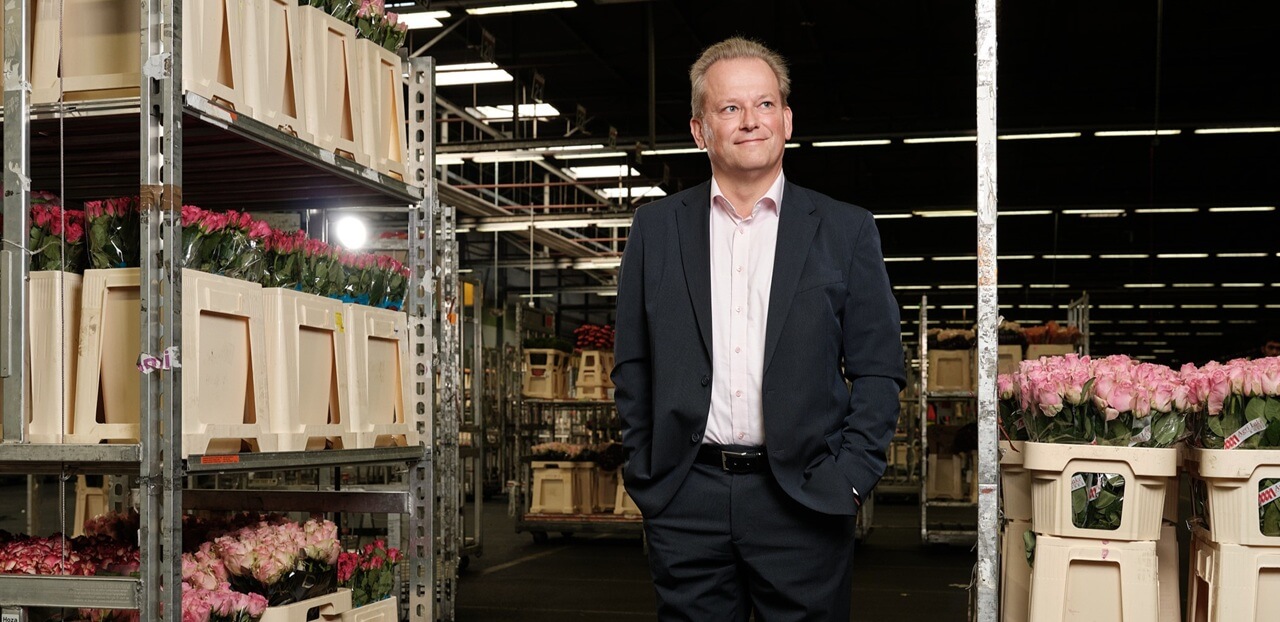
When André van der Linden made the switch from the highly regulated banking world to floriculture six and a half years ago, he entered a completely different universe. After twenty-six years at Rabobank, an international, highly compliance-driven environment, he found himself in a sector of family businesses where business was conducted based on trust. His mission: to lead a large-scale digitization program in a world that had, without any in-depth digital integration, been successful for many decades. Royal FloraHolland was and remains a physical ecosystem, a platform organization ahead of its time, but with auction clocks and carts instead of servers and APIs. The challenge was not only technological but also - and especially - cultural. How do you guide a sector that thrives on personal relationships and proven routines through a digital transformation that requires a new way of working, thinking, and acting? In this interview, Van der Linden shares his vision, the obstacles he encountered, and the lessons he learned with Nadeem de Vree, vice president of Networking and Security at KPN.
After twenty-six years at Rabobank, you moved to a sector that was completely unfamiliar to you. What motivated you to make that move?
‘After twenty-six years at Rabobank, it was a natural moment for me to think: what is next? I had spent twenty years at Rabobank working internationally, which involved a lot of travel, and I wanted to move on from that to achieve a better work-life balance. I decided it was time for something new and activated my network. That is how I came into contact with Royal FloraHolland. I had no knowledge of the sector or the company, so I started from scratch. Which, in retrospect, was a blessing. You enter a different context, you do not know anyone, so you have to learn.
The contrast to the financial world could not be greater. The banking sector is highly regulated, and compliance driven. Now I found myself in a world of family businesses, both on the growers' and buyers' side, who had for decades been doing business on the basis of trust. A world where a phone call is often enough to close a deal. Leading a digitization program in such an environment is a fascinating challenge. I have not regretted the move for a second.’
How do you approach such a large-scale digital transformation in a sector that has traditionally not been digital?
‘My first assignment for myself was to listen and learn. I did not want to jump straight into action mode but first try to understand what was happening in the sector. I visited growers and buyers and had many internal discussions. The constant question was: what is fit for purpose in this context? I told myself that what works in the financial world does not necessarily work here—and vice versa. Things work here in a certain way, so is that necessarily bad?
The transformation we are leading builds on what Royal FloraHolland has been doing for more than a hundred years: being a marketplace where supply and demand come together. The traditional auction clock is an example of this, but direct trade between growers and buyers, which used to be done manually by phone and email, has grown enormously. Our mission is to digitize those processes and to make them more efficient with the promise ‘grow your business, simplify your process’.’
What is the core of your digital strategy, and what role does the Floriday platform play in it?
‘The core is the transformation from a traditional auction company to a platform cooperative that also auctions. We combine a digital platform with our rock-solid logistics platform, and that combination is our strength. Since our foundation at the beginning of the last century, growers have been pooling their supplies to stand stronger together. We have always been a platform organization. Only, the direct trade was done manually and was error prone. Floriday is the digital manifestation. It is the B2B platform where we facilitate direct trade digitally.
For a grower, this not only means a more efficient process but also access to many more buyers than just those they know personally. The same applies to buyers who gain access to a much broader and deeper product range. Floriday has now grown into a sector platform, a digital infrastructure that makes the entire chain more efficient and is even used internationally in some sixty countries.’
Yet, the introduction was not without its challenges. In 2020, you had to deal with a petition from dissatisfied members. What went wrong?
‘When I arrived here, I found companies that were technologically extremely advanced. When you visit a grower in their greenhouse, you see technology everywhere, from planting robots to automated climate control. But on the other hand, the growers I visited at the time did not always have the same level of understanding of automation and digitization. Often, they even had to call one of their children to talk about it.
For many of these growers, we were moving too fast. We launched our digitization ambitions at full speed, but the pace was too fast for a large part of our supporters. This resulted in considerable resistance. The disagreement was not so much about the need for digitization, but about the way and the speed at which we wanted to implement it. We had listened, but mainly to the larger, digitally savvy companies that wanted to move quickly. We overlooked the diversity of our supporters, from the summer flower grower with a turnover of €20,000 to companies with a turnover of hundreds of millions a year. We started organizing workshops with growers, buyers, and software suppliers and asked two simple questions: what do we need to do better and what do you need to be successful? The great thing was that everyone embraced the digital dream. That shared vision, that dot on the horizon, enabled us to move forward together, step by step.’
How do you balance the front-runners who want to move faster with the companies that need more time?
‘It is a constant balancing act. There is enormous diversity, not only in the size of the companies but also in their digital maturity. Some growers and buyers want to move fast and see the benefits, while others need more time and attention. This is further complicated by the software suppliers. The speed of their ERP packages in part determines our pace of innovation. One supplier is not moving fast enough, while another struggles to release two updates per year.
To accommodate this, we offer flexibility. Growers can work via the Floriday screens or via a link to their own ERP software. In addition, we introduced membership packages as of January 1, 2024. A grower who sells everything directly has different needs than someone who relies entirely on the clock (the auction clock gradually lowers the price until a buyer accepts it, ed.). With these packages, we recognize these differences and make membership more attractive and tailored to individual needs. This allows everyone to participate at their own pace, while we move forward as a collective.’
A platform revolves around data. How do you ensure the trust of members when it comes to sharing sensitive trade information?
‘This is a crucial point. From the outset, the most frequently asked question was: is my data safe with you? Trust in the platform stands or falls with the guarantee that commercially sensitive data will remain strictly confidential. To ensure this, we have implemented robust measures. For example, we set up a data committee comprising growers, buyers, a transporter, and an independent expert, which supervises the implementation of the information policy. Data is classified as public, non-public, and strictly confidential. An external auditor annually verifies that confidential data remains within the Floriday ‘information bubble’ and that only authorized support staff can access it in case of an emergency. Transparency is crucial: members must know what happens to their data, and we must be able to demonstrate that we are adhering to the agreements.’
Digitization also entails risks. How do you view cybersecurity for Royal FloraHolland and the floriculture sector as a whole?
‘Cybersecurity is one of the biggest challenges for the sector. For Royal FloraHolland itself, we have our affairs in order. We have always been committed to guaranteeing availability and security, so legislation such as NIS2 is not a huge step for us.
However, the vulnerability lies within the chain. Our recent Trend Report on Floriculture shows that only thirteen percent of entrepreneurs consider themselves fully protected against cybercrime, while forty-two percent are not at all even considering cybersecurity. Growers often think they are too small to be of interest to criminals. But they forget that their entire operation - the climate control in the greenhouse, the cold stores - is increasingly controlled digitally, which inherently makes them vulnerable.
That is why, two years ago, we founded the Greenport Cyber Resilience Center, together with Greenport West-Holland. The aim of this center is to raise awareness throughout the chain and offer practical assistance. We cannot, after all, support the entire sector with our own security team. Through the center, we offer members a free cyber subscription with updates, tools, and crisis exercises. I often compare it to fire safety: no one hopes for a fire, but you do have a fire extinguisher. We need to look at cybersecurity in the same way.’
This transformation requires a different way of working. How have you adapted the internal organization?
‘We were faced with the fact that the world around us was changing faster than we could respond. The traditional approach, where the business asks for something and IT delivers, was no longer sufficient. We therefore adapted our way of working, inspired by the Scaled Agile Framework, SAFe. The focus is now on short-cycle working, experimenting, and learning. Instead of conducting lengthy market research, we now conduct business experiments to quickly learn how the market reacts, and we make adjustments based on that. This requires a major cultural shift and a different organizational structure. We now work with multidisciplinary teams with end-to-end responsibility.
To further facilitate this, we are also modernizing and decoupling our IT landscape. We are separating the commercial, logistical, and financial processes, which were historically closely intertwined. This is a major undertaking, but it gives us the flexibility to in future offer new services more quickly.’
Such a transformation requires specific talent, which is scarce in the labor market. How do you manage to attract the right people?
‘That is indeed not easy. We cannot compete with the big tech companies in terms of salary. That is why we have to do things differently. First, within the digital transformation, we have switched to English as the working language. This gives us access to the international talent market, which is essential for, for example, data scientists and AI specialists. Second, we sell our story and our mission. When I have job interviews, I start with a tour of the logistics halls. The smell of flowers, the scale of the operation, the tangible product – that is what gets people excited.
We work for the third-largest export sector in the Netherlands and have a major sustainability mission. Hopefully, that gives meaning to what we do. And if that does not make you excited? Then you should not want to work here. We also use nearshoring partners in Serbia and Portugal for additional capacity. The combination of an inspiring mission, an international working environment, and interesting technological challenges, such as our recently launched AI lab, makes us an attractive employer.’
You mention the AI lab. What role does artificial intelligence play in your transformation?
‘AI is playing an increasingly important role in our operations and in the sector as a whole. The AI lab was launched to experiment with different applications. These include optimizing logistics processes, predicting supply and demand, and improving quality control. We are doing this very deliberately and gradually. AI is not an end in itself, but a means to improve our services. We look at where artificial intelligence can add real value for our members, whether they are growers, buyers, or other chain partners. The point is to use technology in a way that fits our cooperative values and contributes to a more efficient, sustainable sector.’
What are your ambitions for the coming years? Where do you see Royal FloraHolland in five years?
‘My top priority for the next two years is to increase the adoption of Floriday. All flowers and plants are already settled through Floriday, but our next step is to also increase buyer-driven orders, instead of grower-initiated. For flowers, we are now at around fourteen percent, compared to seventy-eight percent for plants. Buyer-driven ordering increases efficiency of the sales and purchasing processes for both growers and buyers. Floriday needs to evolve from a trading platform into the digital infrastructure for the entire sector. Think of sharing sustainability information, such as a product’s CO2-footprint or packaging data. This is only possible through a central digital infrastructure. Internally, I want our new, agile way of working to become the standard, with business and IT working together structurally to create value.
The role of the CIO is shifting in this regard. It is no longer primarily about the technology itself, but about ensuring that technology is used in the right way to enable business transformation. You have to understand the business inside and out in order to be of value. My dream is that we as an organization continue to learn and experiment, and that cybersecurity becomes as self-evident as fire safety. We may never be the best IT company in the world, but we do want to be the best floriculture marketplace worldwide.’
This interview was published in Management Scope 09 2025.
This article was last changed on 21-10-2025