
Elections 2025: ‘A stable economic policy will help us move forward’
The Netherlands appears to be in good shape. It is among the most prosperous countries worldwide. With an open, trade-oriented economy, good infrastructure, and a highly educated workforce, the foundation seems sound. But for how much longer, as some cracks are showing. Productivity is barely growing, energy costs are high, the power grid is overloaded, and investment in innovation is lagging behind. The departure of several large companies from the Netherlands and the often pre-anticipated exodus of successful startups to America are telling.
In 2023, Mario Draghi, former president of the ECB, warned that European competitiveness is under pressure due to changing trade relations and geopolitical developments. Draghi emphasized strongly that Europe must seriously invest in innovation.
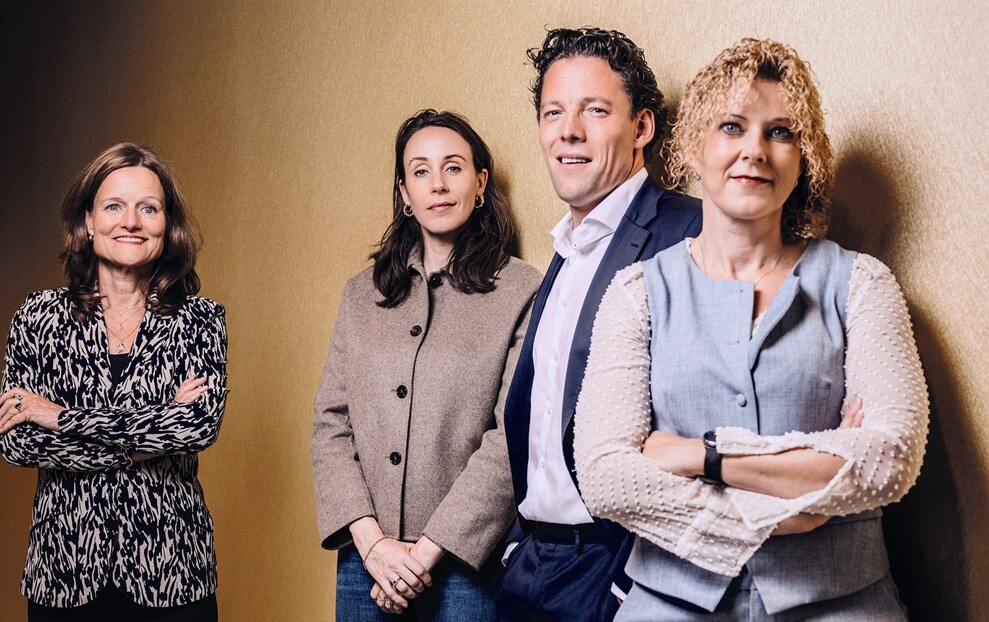
The big question is how a new cabinet can give the business and investment climate a significant boost and thereby stimulate innovation. Three Dutch politicians will discuss these questions: Inge van Dijk, a member of the House of Representatives for the CDA since 2021, and Claire Martens, member of the House of Representatives for the VVD since 2023. Also present is Wimar Bolhuis, who is eighteenth on the candidate list for GroenLinks-PvdA. All three, in their respective parties, specialize in the economy.
In political circles in The Hague, consideration is already being given to how the country will continue to earn its money in future. A National Technology Strategy was introduced, identifying ten key technologies. There is also consensus on the establishment of a national investment institution to resolve the current financing bottlenecks and enable promising, innovative projects with a long-term perspective.
Although, it being the run-up to the House of Representatives elections, the participants occasionally make political statements, they are in broad agreement: ‘The Netherlands must make choices now and take decisive action to secure its prosperity in the future,’ they tell Tjarda Molenaar, director of the Dutch Private Equity and Venture Capital Association (NVP).
What motivates you to become a member of the House of Representatives?
Martens: ‘I previously worked at various startups and scale-ups and noticed how difficult it is for young companies to raise capital. They are often forced to work with investors who have a buy-and-build strategy, even though this does not always align with their mission. Although such entrepreneurs make an important contribution to society, finding suitable financing proves difficult. That was my trigger to move to The Hague and advocate for a future-oriented investment policy.’
Bolhuis: ‘I work as director of TNO Vector, a center of TNO (a Dutch not-for-profit research organization) that focuses on major transition issues. Here, I work on the innovation landscape, our earning capacity and investment climate, and the impact of, for example, the Draghi Report or the National Technology Strategy. What drives me is that things are structurally going wrong in the Netherlands: labor productivity growth is lagging behind and scaling up new business activity remains a challenge. I want to go to The Hague to improve economic policy and solidarity.’
Van Dijk: ‘I worked at Rabobank for almost 20 years, first locally and later at Rabobank Nederland. I was also a council member for the municipality of Gemert-Bakel in Brabant. I was closely involved in the development of Brainport Eindhoven. I saw how sentiment among entrepreneurs changed from ‘it is unfair how everything is going to Brainport’ to ‘we have to work together on this.’ I noticed in politics too that council members were increasingly collaborating. As a municipality, we sometimes made investments to help move the region forward, without it having a direct benefit to the municipality itself. Innovation is developing faster than governments often realize. The challenge is for government to connect effectively to this process.’
What, in your opinion, should a good business climate offer?
Martens: ‘Stable and predictable policy.’
Van Dijk: ‘I agree. We refer to it as peace, sanitation, and regularity.’
Bolhuis: ‘Agreed. And for new companies, three things are important: energy, R&D infrastructure, and access to capital.’
The departure of large companies such as Shell, Unilever, and DSM shows that our business climate leaves much to be desired. How could a new government improve this?
Martens: ‘Entrepreneurs need predictable - you could even call it boring - economic policies. For the VVD, this primarily means a stable fiscal climate. Entrepreneurs ask us weekly not to alter schemes that work, such as the WBSO (Funding for Activists’ Benefits Act), the innovation box, and the expat scheme. At the same time, they want the preconditions to be in order. They say: tackle the nitrogen problem, guarantee a reliable electricity grid, and invest in the economy of the future.
Fortunately, a lot is happening, such as a National Technology Strategy and an R&D plan, and a new industrial policy is on the way. These are important steps. Nevertheless, the fiscal climate remains vulnerable. This is due to the short cabinet terms of two to four years, while companies often plan their investments for eight to ten years. We need to better safeguard our long-term policy. At the same time, there are new parliamentary proposals to use successful schemes as ‘cover’. This is detrimental to the innovation ecosystem and hinders the attraction of talent. Steps are being taken in the areas of nitrogen and energy, but they are limited and too slow.’
Wimar, you were involved in the innovation climate at TNO. How can the government improve this?
Bolhuis: ‘Many companies find that other countries have a more predictable investment climate. Moreover, governments abroad often actively invest in sectors or technologies that are crucial for the future. This encourages companies themselves to also invest. We strongly believe this works.
That is the reason we want to link not only policy but also a budget to the National Technology Strategy. We advocate for a future fund of €25 billion to finance the infrastructure, green innovations, and high-quality economic activity of the future. It is crucial that we dare to invest in the longer term.
Furthermore, investments in research and development must be structurally increased. At the European level, the Lisbon Agreement has been in place since 2000. The ambition was to invest three percent of GDP. The Netherlands has lagged behind to date and is now falling further behind due to government policy.’
Van Dijk: ‘The problem with funds is that they are often one-off, while many developments require structural investment and long-term commitment. We should not withdraw at the first setback – sometimes you need a longer perspective. And yes, the fiscal climate must be predictable. Yet, we must also remain critical of tax regulations that are insufficiently effective. An enormous amount of money is involved. It is better to spend eight out of ten euros effectively than four out of ten.’
Bolhuis: ‘Establishment policy is not only about tax incentives, but also about education, affordable housing, and an attractive living environment. This is crucial for both employees and businesses. Unfortunately, the government has been unpredictable in recent years, with constantly changing policies on funds and regulations, such as the expat scheme. This has created uncertainty and stagnation.’
Van Dijk: ‘I think we can all agree that we should have left the National Growth Fund alone.’
Bolhuis: ‘Right. It was a good instrument for long-term investments. By providing money to companies that want to collaborate publicly and privately, you build a new ecosystem. It was a great complement to fiscal measures.’
How do you view the role of the government versus that of market players? To what extent does the government determine which companies or sectors receive support?
Van Dijk: ‘There is a National Technology Strategy, a 3%-document with the ambition to invest three percent of GDP in R&D by 2030, and an industry letter is on the way in which the minister will address strengthening our earning capacity. All important, but I think too little has been done. I am quite frustrated about that: this technology strategy was launched by the previous cabinet already. This is not meant as an attack on any party, but the question is whether we really dare to make choices, to feel the pain of the consequences but despite of it chart our course together?’
Bolhuis: ‘Indeed, we have to make decisions: which sectors and technologies do we focus on? Through tenders, the government can help startups grow and thereby also realize specific sustainability ambitions. Scaling up requires the European market; the Dutch market is too small.’
What is your vision for European cooperation when it comes to investing and strengthening the business climate?
Martens: ‘The Netherlands has a lot to offer, but our market is small. Without European cooperation, we will be crushed between major powers such as China and the US. We need to look at each other’s strengths and reinforce each other. AI is one such sector we are focusing on. I do hope we will make wise choices. Currently, Dutch companies often launch their tools in the US because of the strict European regulations. While the AI Act is important, it can hinder startups. We need to deregulate smartly at the European level so that companies can grow here and R&D does not leave for the US.’
Bolhuis: ‘I agree that we can tackle major investments in AI or quantum technology only at a European level. Examples include the new quantum computer in Amsterdam and the AI factory in Groningen, co-financed with European funding. Linking Dutch money to European funding and involving private parties is exactly what is needed to remain competitive internationally.’
There seems to be a consensus on establishing a national investment institution that can provide long-term financing. What is the government’s goal?
Van Dijk: ‘The institution must become a driver of innovation. It can mobilize capital and create financing opportunities. The instruments we had so far proved not to be effective enough. I am pleased how quickly we reached agreement on this in the House of Representatives.’
Bolhuis: ‘This concerns financing with a term of ten to twenty years. Financing with such long terms is currently very difficult to obtain.’
Martens: ‘In addition, the institution will receive a form of surety or guarantee, something that the current instruments lack. Companies that want to scale up need an organization that will vouch for them. The institution should preferably have a single framework. Currently, there are too many instruments with different conditions. We are a small country; we need to merge everything as much as possible.’
Van Dijk: ‘It would be good if other financial institutions learned from this. The new investment institution operates in an environment where legal and regulatory obstacles sometimes hinder progress. As soon as these bottlenecks become apparent, we must dare to address them and adjust regulations if necessary. So, it is not only about capital, but also about creating the right conditions and removing obstructive regulations, so that politics and the market can move forward together.’
How can we ensure that the institution can actually pursue a long-term strategy?
Martens: ‘It is essential that the institution maintains a distance from politics. This prevents political interests from influencing its objectives.’
Bolhuis: ‘There must be a clear mandate; the institution must respond to market needs that are not currently being met due to excessive risks or slow returns. Think of long-term loans to innovative ecosystems, infrastructure, or transitions that would otherwise not get off the ground. Furthermore, it is important that we all stay away from the money. This will allow the institution to chart a stable course, ideally for at least ten years, and make real impact.’
Martens: ‘To do this, we need people with experience in the financial sector who understand the pitfalls. At the same time, it is important to bring in younger generations with fresh ideas about social issues and an eye for smaller investments, so that we not only support large companies.’
How will the institution ensure that it can respond flexibly to changes?
Van Dijk: ‘The institution will have to respond to new developments and will also need to have the ability to learn. Flexibility and progressive insights are essential.’
Martens: ‘We also have to accept that not every investment will be successful. If we do not dare to show courage, future technologies will not get off the ground. Look at America: there, risky investments have led to enormous innovations.’
Those are lofty words and promises. Are we indeed going to follow through?
Martens: ‘This requires something from us as a government. If an investment does not prove successful immediately, we should not request a debate with the minister at the first question time. We have, after all, agreed on a framework in which investments are given time to prove themselves. We must give institutions and government officials the space to take risks.’
Bolhuis: ‘Yes, when investing in sectors such as the energy transition or defense, we cannot expect an immediate financial return every year. That is why it is explicitly not a government institution that puts pressure on the budget. However, with these investments, we can ensure that our society and economy are ready for the challenges of the 21st century.’
Van Dijk: ‘What worries me is that our political system makes these kinds of long-term projects difficult. We are used to thinking in terms of opposition and coalition: for or against, we want to judge each other. Whereas this actually requires broader coalitions and cooperation across political lines. We need to be more generous towards each other than we are now. All parties in the House must be willing to look ahead together. I do not see that happening now.’
Martens: ‘At the same time, I see that in committees, such as Economic Affairs, discussions are mainly about content and less about the person or party. The urgency to take necessary steps now is becoming clear. Of course, differences should remain; that keeps us on our toes.’
Van Dijk: ‘There are many issues we can make political, but let us make a few, such as economic policy, a little less confrontational. I think that will help us enormously.’
This article was published in Management Scope 09 2025.
This article was last changed on 21-10-2025