
The CFO’s character is more important than ever
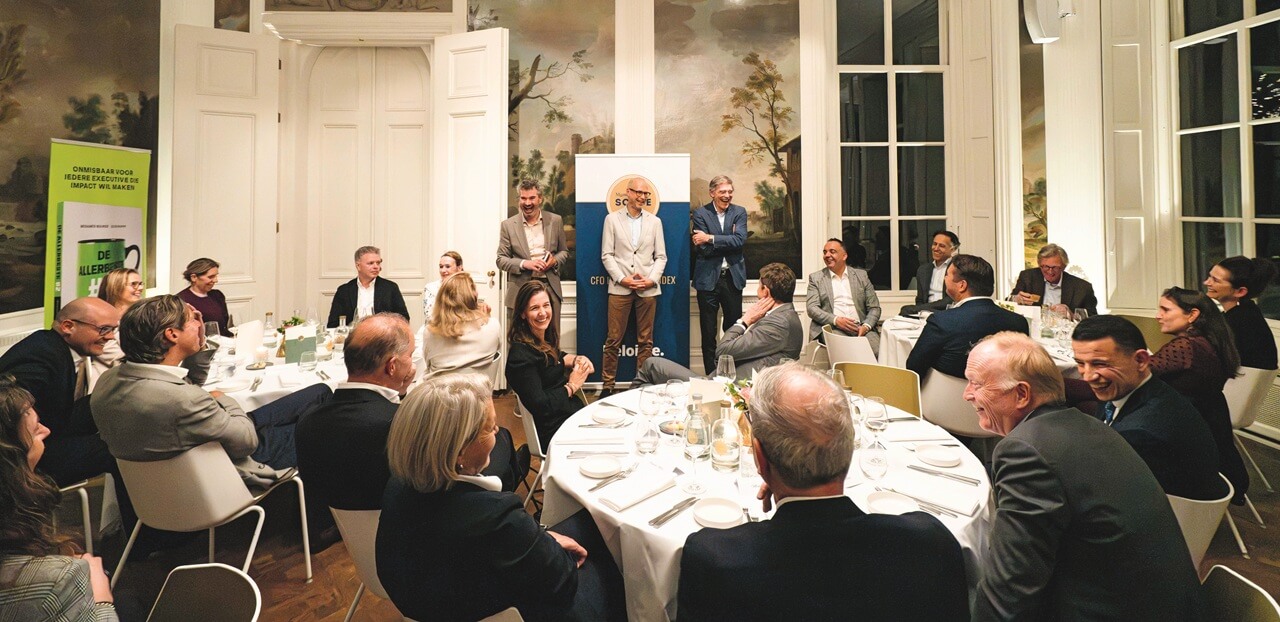
While the CFO of thirty years ago was primarily responsible for reporting on the financial past, today he or she fulfills a strategic role. Often the CFO works alongside the CEO to set the company’s course. Yet today’s CFOs seem surprisingly similar to their predecessors: the average CFO has a degree in economics or accounting and started their career at a Big Four firm. This notable anomaly was the central theme during the first CFO Leadership Dinner, organized by Management Scope in partnership with Deloitte, a founding partner of the CFO Leadership Index.
At the Parc Broekhuizen estate in Leersum, around thirty CFOs, next-generation CFOs, and supervisory board members exchanged ideas on what it takes to be an effective CFO. During the dinner, the first CFO Leadership Index was presented – a large-scale study by Management Scope focusing on the CFOs of the 100 largest organizations in the Netherlands. To mark the upcoming 30th anniversary of Management Scope, the editorial team compared the profiles of CFOs from 1997, 2021, and 2026, drawing in part on data provided by knowledge partner Deloitte.
What stands out is that the majority of CFOs are still men: only twenty-three percent of the CFOs surveyed are women (one percent more than among CEOs). Forty-one percent rose through the ranks within their own company. Furthermore, the role has become more international: one in four CFOs holds a non-Dutch nationality; among AEX-listed companies, that figure is about half. All the findings can be found in our analysis, which was published last month.
The CFO as a marketer: making strategy engaging
René Hooft Graafland, who serves as supervisory board member at several companies, is well-positioned to discuss the changing role of the CFO. In 2002, he became CFO at Heineken and would remain in that role for thirteen years. When he took on the position, the prevailing view at Heineken was that finance professionals did not belong on the board of directors. During those first years, he was therefore operationally responsible, with finance as an area of focus. ‘It was challenging because I was wearing two hats. When I questioned colleagues about their figures, they would ask: 'What about your own business?’ Later, Hooft Graafland transitioned into a full-time CFO role, without operational duties. ‘Together with the CEO, we were the driving force behind the company. I weighed up interests, engaged more with the outside world, and helped accelerate the company.’ Hooft Graafland illustrates how he helped Heineken move forward during his time as CFO by pointing to the 2008 acquisition of a brewery group. ‘It was a major investment. Shortly thereafter, the financial crisis hit. This caused a great deal of nervousness; we had taken on a significant amount of debt.’ To gain a grip on the company’s finances, Hooft Graafland introduced the Hunt4Cash program, which challenged the entire organization to extract as much cash as possible from the business. Employees contributed ideas on selling off assets, scaling back investments, and improving working capital. Variable compensation was tied to cash flow. Thanks to Hunt4Cash, the debt spike was reversed. The lesson, according to Hooft Graafland, is: ‘Think like a marketer. Make sure you get the rest of the business on board. For example, we used test tubes filled with bottle caps to track how much cash had been brought in. Make a strategy fun and positive.’
Assign tasks outside the financial domain
Joris Roelants of executive search firm Egon Zehnder, also notes that the CFO’s role has broadened. ‘Risk management, IT, data, and European sustainability reporting under the CSRD – all of this now falls under the CFO’s purview. That is why we are casting a wider net. A financial background alone is no longer enough.’ Roelants is concerned about whether future CFOs will be given sufficient scope to continue their professional growth. His advice: ‘Give talented individuals assignments outside their financial field. Have a finance professional lead an operational project or give them a temporary role in a business unit. That way you will discover whether someone is capable of more than their CV suggests.’
According to Roelants, the search for a suitable CFO still starts with a strong CV. In addition, Egon Zehnder looks for candidates with a healthy dose of curiosity (are you open to feedback), insight (the ability to quickly extract the essence from a mountain of data), commitment (the capacity to work well within a team), and determination (the drive to set things in motion).
The character of a CFO matters immensely, according to Hooft Graafland – sometimes, it is even the deciding factor. In 2023, Ahold Delhaize, where Hooft Graafland served as chair of the audit committee, selected Jolanda Poots-Bijl (formerly of Van Oord and VolkerWessels) for the role, even though on paper she did not meet three of the four profile criteria. ‘She had no experience at a publicly traded company, no background in consumer goods or retail, and no knowledge of the U.S. market.’ Why was she appointed CFO anyway, and why is she so successful, according to Hooft Graafland? ‘Because of her personality, her openness toward the business, and the complementarity and rapport she shares with CEO Frans Muller.’
Roelants understands that supervisory boards tend to be conservative when it comes to CFO appointments. ‘If things go well, it is a credit to management; if things go wrong, the supervisory board members are held accountable. But still, why not opt for a wild card more often?’
Working in tandem with the CEO
For aspiring CFOs, the step into an executive role is a significant one. They must provide collective leadership, join a board with its own dynamics, work in tandem with the CEO, and lead their own finance team. ‘Leadership and team spirit are therefore essential for the CFO role,’ say Mohamed Bouker and Egon Hoppe, both partners at Deloitte. Together, they have guided over 100 CFO transitions.
Bouker and Hoppe have outlined their insights in the book De The Very Best Number Two, which was presented during the dinner. The title refers to the CFO’s ambition. ‘As the best number two, you can make an incredible impact. You keep the CEO, the number one, in position and ensure that he or she is successful,’ says Hoppe.
But how do you remain loyal to the CEO while also providing a counterbalance when a plan is too risky? ‘Everything hinges on a solid relationship between the CEO and the CFO,’ Bouker states. ‘If that relationship is right, it is phenomenal. If not, you end up with trouble.’ Such a relationship does not develop on its own, and not every organization invests enough time in it. Bouker adds: ‘You do not achieve it by going out to dinner together, but by working side by side, for example on a project.’ Hoppe adds: ‘Define the framework for your collaboration during calm times, not when you are under fire. That is hardly the time to figure out how to work with one another.’
One CFO in attendance noted that this relationship affects the entire organization: ‘A one-centimeter difference at the top translates to one meter in middle-management and ten meters on the shop floor. That is why the CEO and CFO must speak with one voice.’
Openness about CEO ambitions
The modern, strategically minded CFO often acts as the driving force behind change. He or she protects the company from irresponsible risks but does not constantly hold back. An important prerequisite is that the finance team is well-organized, says Bouker: ‘Those who stay close to the business and place trust in their teams are informed early on – and, together with the CEO, can step on the gas.
What if a CFO wants to advance to the CEO role? The prevailing view around the table was openness about ambitions is always a good thing; keeping it to yourself only complicates the relationship. ‘The timing has to be right, though. Do not lay your ambition on the table with a CEO who has just taken office.’
Every CFO would do well to ask themselves: do I aspire to more? The answer is by no means always yes. Many CFOs find fulfillment in the role of the very best number two and know that this role suits them best. Bouker points out that many CEO candidates underestimate the role of being ultimately responsible.. ‘Following the CEO is something very different from leading the way. When things get tough, you are the one who has to make the decisions and, if things go wrong, take the heat.’
Next-Gen CFO
The conclusion of the evening: a good CFO works alongside the CEO to set a company’s course. Financial acumen and risk assessment are indispensable. But whether that course is maintained depends in part on his or her character. Is the CFO curious enough to make course corrections, can he or she get the organization on board with the strategy, and can he or she steadfastly maintain the course? And, above all, is he or she a critical sounding board for the CEO? In this sense, the personality of the next-gen CFO is more important than ever.
This article was published in Management Scope 10 2026.