
Embrace discomfort in the boardroom with these seven good practices
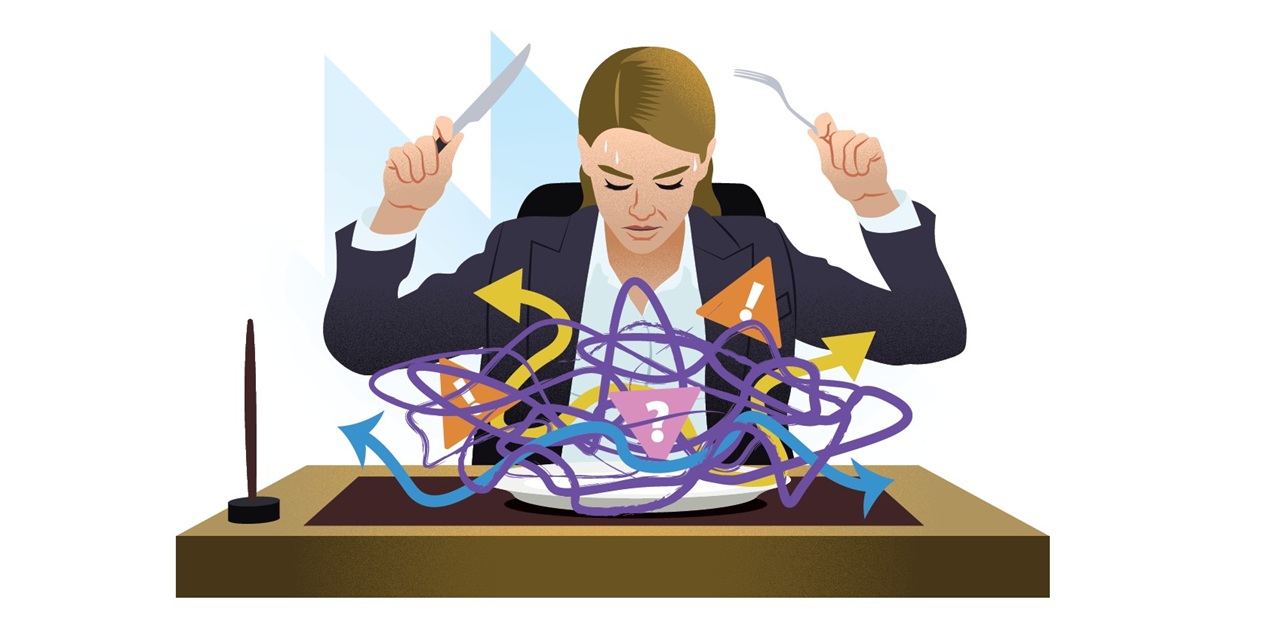
Supervisory board members and executives must create value that is sustainable and socially just in a world that is full of tensions, contradictions, and uncertainties. Annual surveys of board members and executives worldwide show that they identify these challenges as a major risk and as (too) complex and unpredictable. Risks such as cybersecurity, biodiversity loss, and geopolitical tensions are recognized, but too often the men and women at the top try to manage them reactively, using an approach based on years of experience and accumulated knowledge. However, this traditional approach - rooted in the industrial era of some 250 years ago - is falling short because that knowledge and experience were gained in a world that was fundamentally different from today's. The outside world has become exponentially more complex, yet the boardroom often still operates largely from an approach suited to a predictable world with stable supply chains and an outside-inside perspective.
The transition to a sustainable economy requires a different kind of leadership. This is the conclusion of more than 80 supervisory and executive board members who, from 2022 to 2025, together with academics and governance trainees, participated in the projects Discomfort in the Boardroom and In-Depth Governance. These projects focused on the personal leadership of supervisory and executive board members, and in particular the discomfort between their professional and personal identity.
The essence of this discomfort is that there are tensions between themes, needs, or values that are irresolvable. A good example is corporate social responsibility. If economic, ecological, and social interests are equally important, all these aspects will have to be weighed continually, and economic interests will sometimes have to give way to social or ecological values. This becomes uncomfortable when used to thinking in terms of business models and making the best economic choice. Sustainable leadership therefore requires ‘tension competence’ from supervisory board members and executives. Decision-making improves when the perceived tension is explicitly brought to the table and included in the decision-making process.
Analyzing the discomfort
The challenges faced by board members can be categorized into thematic tensions (such as short-term versus long-term focus, AI versus data protection, or shareholder value versus social impact), systemic tensions (for example, between the role of executive and supervisory board member), and social tensions (both interpersonal and personal). At the individual level, for example, executives and supervisory board members experience the ‘identity paradox’: the desire to blend in with the collective versus the need to stand out. These inner conflicts, often fuelled by conflicting personal values and dominant norms, can lead to a sense of loss of authenticity.
In practice, there is a strong tendency to obscure these tensions and paradoxes through routines and cognitive biases. Routines offer efficiency and protection against paralysis, but at the same time can hinder sustainable value creation by avoiding fundamental issues. Cognitive biases, such as the status quo bias (preference for the existing), confirmation bias (seeking confirmation of one's own beliefs), and present bias (overvaluation of immediate rewards), reinforce these routines and can cause paradoxes to be either ignored or smoothed over. Dealing with the perceived tensions and breaking patterns require a different way of thinking, feeling, and acting. Not reactively based on external triggers such as regulations or competition, but proactively, inside-out based on ethical reflection and underlying values. The seven good practices below can help executives and supervisory board members to not avoid the tension, but rather to embrace it and turn it into something productive.
1. Seek out and explore the discomfort: Tension in the boardroom caused by the themes of transitions also creates tension in the interactions about it within the boardroom. The tendency to instinctively avoid this tension leads to stagnation. Executives and supervisory board members must actively seek this out and seriously explore it. ‘Seeking’ and ‘exploring’ together form the central good practice, that what essentially needs to happen. It then depends on the context and the individual which of the remaining six practices are most helpful. Good practice five - know yourself and show yourself - is also about vulnerability and expressing doubts. Self-evidently a board or supervisory board might not always have a composition that makes it wise to show such doubts. In such a situation, good practice two - listen and ask different questions - may be more effective in breaking patterns. At the same time, all practices are ultimately interrelated. After all, by asking different questions, you indirectly reveal what you consider important and what affects you.
2. Listen and ask different questions: Transition conversations require attentive and in-depth listening and asking ‘slow’ questions that elicit deeper insights. Examples include: ‘What does this choice mean for future generations?’ or ‘What are we leaving out of the picture?’ This leads to higher-quality decision-making and opens space for the unknown.
3. Break through obstructive routines: Fixed patterns and routines ensure efficiency but can block innovation. Reflecting on which routines are helpful, and which are hindering, is the first step. By consciously creating space for alternatives, you arrive at new, more nuanced decisions that are better suited to the current challenges.
4. Prevent moral complacency with ethical reflection: Ethical reflection goes beyond compliance and requires fundamental questions about justice and the good life, also for future generations. By making ethics an integral part of decision-making and discussing underlying human- and worldviews, you remain morally sharp.
5. Know yourself and show yourself: Authentic leadership begins with self-knowledge: what drives you, what are your values and beliefs? Daring to share personal experiences and reflections strengthens connections with others and increases credibility, but it takes courage to show the human dimension in a traditional context.
6. Dare to be moved: In addition to rational thinking, it is essential to allow feelings and intuitions into boardroom discussions. Being moved by social issues, colleagues, nature, or art is not a weakness, but a strength that increases engagement in dealing with transitions. Thinking and feeling reinforce each other.
7. Become a connector: Today's complex issues transcend sectors and interests. This calls for connective leadership: building bridges between parties, even when perspectives or interests diverge. Breaking through polarization and actively seeking cooperation, even when it is uncomfortable, opens the way to joint solutions that create ecological, social, and economic value.
Paradexity and paradox governance capabilities
The seven good practices can help address what we call paradexity: the merging of paradoxes and complexity. In a turbulent and rapidly changing world, paradexity contributes to the feeling that we are losing control. Harnessing paradexity means transcending contradictions and embracing complexity, even if this causes discomfort and tension. We call this harnessing of paradexity paradox governance capabilities. An example of a lack of paradox governance capabilities is the tendency in the boardroom to dive straight into problems and act too quickly to avert a disaster or mitigate risks. Good practices recommend the opposite: slow down, both in a major crisis and in routine decisions. Do not try to manage away complexity but embrace it as an integral part of your daily work. Acting too quickly can make the situation worse in the long run. You may think you have solved a problem, but in reality the ‘solution’ often becomes part of a larger, new issue. Think of a stain on the wall. You can hit it with a hammer, and the stain will indeed disappear. But what you do not see at that moment is that the structure of the wall has been compromised and might only show visible damage in two- or three years’ time.
The challenges of our time demand executives and supervisory board members who have the courage to face the discomfort in themselves, in the organization, and in the world. This requires proactive, inside-out leadership. By slowing down, reflecting, and making room for other questions, values, and connections, the possibility to shape real transition arises. You will not get out of the boardroom without a few scratches. It is not about avoiding scratches, but about learning to live constructively with paradexity and thus paving the way for a more sustainable and just future: paradox governance capability.
This essay was published in Management Scope 07 2025.