
Annemieke Roobeek: ‘Democratization, anchoring, and imagination’
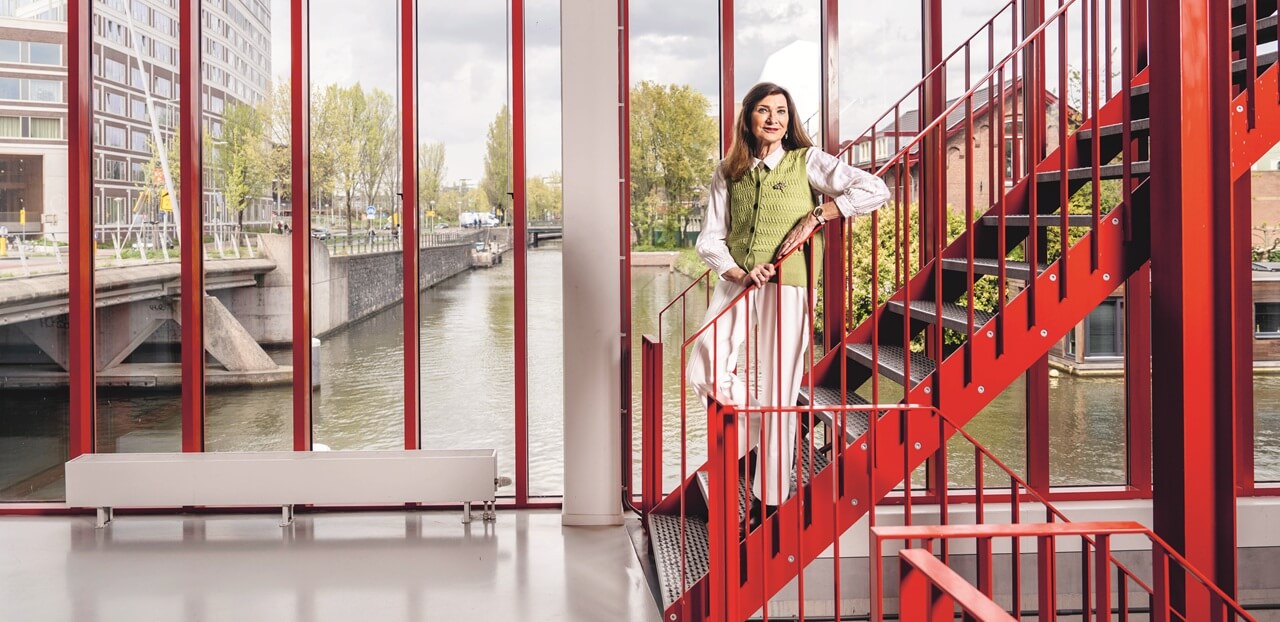
On the cover of the booklet containing her emeritus lecture, Roobeek strikes a remarkable pose. Her academic gown is draped only halfway across. That is exactly how she stood in a photo taken thirty-seven years ago, with her inauguration as professor on the Verolme Chair of Technology and Economics at Nyenrode Business University. With this statement, she makes it clear that her perspective extends beyond that of a scholar. She does not want to hurl theoretical models from the ivory tower of academia towards society. ‘From day one, I was right at the center of the field. I kept asking myself: Is the academic picture accurate? What is it really like?’
That ‘reality check,’ as she calls it, defined her multifaceted career. In addition to being an academic, she is also an entrepreneur, director, supervisory board member, facilitator, and change agent. Trained as a political scientist specializing in international relations, she earned her Ph.D. in economics, focusing on the role of technology in competitive relationships. In 1989, Roobeek, then thirty, was appointed as the youngest female professor. Since 1997, she has been a professor of strategy and transformation management at the same university. Roobeek always consciously chose a part-time professorship; this allowed her to remain independent and active in society.
She founded three consultancy firms and served on a number of supervisory boards, including at Fortis, PCM Publishers, ABN AMRO, KLM, Eneco, and Randstad. Always with the same conviction: ‘A supervisory board member must be both professionally competent and socially rooted.’
At the end of March, Roobeek delivered her emeritus lecture, titled Democracy and Imagination – on organizing desirable visions. In it, Roobeek argues that we are heading toward a new order. ‘After years of neoliberalism and gridlocked bureaucratic systems, it is time to solve major societal issues horizontally,’ she states. ‘Decisions are no longer made by the lucky few, but together with the lucky many. Both within society and within companies, this leads to renewal and a promising perspective.’ Roobeek shares what this demands of leadership and whether she already sees the outlines of a new order during a stimulating conversation with Joyce Leemrijse, partner and notary at A&O Shearman.
In addition to your role as a researcher, you have taken on many other roles. Were you an exception?
‘I know few people with a comparable resume. I never had a traditional job; I always had a lot of work. Driven by curiosity, I wanted to apply my knowledge and skills broadly in companies, within organizations, and in government, and to teach about this at the university. I tackled issues that were too complex or too risky for mainstream academia or consultancy firms. I have always sought to involve a broad scope of people from across the organization to harness collective intelligence.’
Were you ever surprised? That reality was different from what you expected?
‘No, on the contrary. As a researcher, I had the organizational tools and the ability to look about twenty-five years ahead because I could track trends and technological developments. Technology has always been crucial in this regard, because it leads to new processes and products and impacts how we work, what we consume, and what the revenue models are. By linking technological developments to industrial structures, societal impact, and a society’s capacity for absorption, I can anticipate which direction things might take.'
In the late 1980s, you introduced ‘bottom-up strategic management.’ What did this achieve?
‘I firmly believe that transformations should not be designed in the boardroom, but together with the shop floor. It makes little sense if people just parrot what managers say; you have to formulate a new strategy together, and knowledge and experience are found across all levels. If you look no further than your colleagues at the top, you are excluding about eighty percent of your staff. Those are precisely the people who work extremely hard on operations and execution. They can often explain better why a strategy will not work than a manager or someone from the supervisory board.’
How do you involve employees from top to bottom?
‘Make sure everyone speaks the same language; that can also mean using different words. Let colleagues have their say and incorporate their insights into the strategy. If people recognize themselves in this and if it is also articulated in an appealing way within a broader perspective, support is created. Employees can then embrace the process, because they know the reasoning behind it. This also prevents strategies from failing during implementation.
When people are enthusiastic about a company's direction, you can leave them to take responsibility. No additional management layer is needed, in fact, less management is needed. Organizations become stronger when people at all levels take initiative and feel empowered to participate. That is what I mean by the democratization of power within companies. This insight led me to establish the Modern Employee Participation (MMZ) executive program at Nyenrode around 2012. It is a mini-MBA for works councils, and dozens of companies and organizations have since participated.’
What was the thinking behind it?
‘If you want governance—the golden triangle between supervisory board members, management, and employee participation—to function well, all parties must be able to contribute strategically to the discussion. This is now also stipulated in the governance code, and the Social and Economic Council (SER) recently gave this point extra attention in the context of modernizing the Works Councils Act (WOR). At Nyenrode, we had and still have programs for supervisory board members and executives—but at the time, there was nothing for the top members of the works council. With the MMZ program, we delve into the substance and also focus on boardroom dynamics. How do you, as a works council, hold your own against a seasoned executive who ‘just quickly’ explains a strategic issue? It takes knowledge to raise a topic in such a way that an equal conversation ensues. Many Works Council members do not know that they have the right to nominate one-third of the Supervisory Board members.’
In addition to democratization, you advocate for more imagination. How do you foster that?
‘You have to speak a language that evokes images in people’s minds. They turn it into a movie in their heads. Compare it to what happens when you read a book well. A story really comes to life: that is how it works in a change process too. The trick is not to make it too explicit right away; people need to be able to fill in the details themselves. If you can establish a strategy using imagination, you create a desirable vision for everyone. A vision that is appealing to everyone and that is feasible, because those involved want it.’
How do you approach that yourself? Do you also provide guidance?
‘Good question. As an academic with broad knowledge, I often know where things might be heading. But you should not spell out the direction. The future is not a blueprint. Architects often come in and say: this is how we are going to do it. That makes it their plan, whereas you are aiming for a shared plan. That is why I build it up in a convergent way. I start with the challenge, show bits of a concept, but let people fill in the details themselves – with examples they provide themselves. This creates a story they are part of, and the sense of recognition is strong.’
You create storylines. How do they differ from scenarios?
‘Scenarios are often backed by data – which can be powerful but also limiting. Storylines are possible future directions within a recognizable context. They appeal to the imagination. Just this week, I created three storylines for six European grid operators who are jointly building a platform together to organize the fluctuating demand for and supply of renewable energy in a smart and flexible way.
The first storyline involves strong control of the platform, leaving little room for new market players to gain access. The second storyline outlines a future in which an Elon Musk-like figure steps forward to buy the platform for a large sum of money. In that case, we would end up with American designed batteries, made in China, ICT management in India, and the threat of a new monopoly leading to even greater European dependence. Furthermore, the European consumer will be left holding the short straw, facing high costs.
In the third storyline, the parties work towards a European platform and operate as a not-for-profit European utility that is innovative, flexible, and digital. The costs for European consumers and businesses remain manageable. The future of much more sustainable energy production also demands this. When the wind blows over the North Sea, Austria can benefit from it, and when the sun shines brightly in Germany and it is raining in the Netherlands, this sustainable energy can be used elsewhere. The six parties unanimously chose the European narrative; they found that the most appealing prospect.’
Then, you are also a form of seducer …?
‘Yes, that is essentially what it is about. You tell a strategy as a story in such a way that people see what they consider good, less good, or find wrong. Then you can choose a direction more quickly and set your course.’
You argue that democracy is under pressure. Where do you see that happening?
‘I observe that the very fabric of our democracy has become frayed in recent years by neoliberal policies. If you succeed, you did it yourself, and if you fail, it is your own fault. Because of these policies, we no longer look at the big picture and what we do for each other as a society. We have forgotten how to look out for one another, how to mean something to one another. Why is that? By shifting care responsibilities onto informal caregivers under the guise of ‘participation.’ Vulnerable groups, from young people to the elderly, have faced enormous cuts in the welfare sector. The benefits scandal and the inadequate handling of earthquake damage in Groningen have eroded trust in government institutions.
Consider also what is currently happening with disability benefits, elderly care, or support for families. People in vulnerable situations are more likely to be put under even greater pressure rather than to be helped. What I find downright antisocial is that people who are entitled to benefits are deliberately not informed about them. As a result, tens of thousands of children and their families live in poverty, even though this does not have to be the case, because as a wealthy country we have a social safety net that we all pay taxes for.
Finally, I see that democracy is also faltering in the way politics deal with major issues, such as the energy transition. Why were we years behind the rest of Europe in the field of renewable energy? The answer is simple: for a long time, we had a prime minister who literally said: we do not have enough sunshine, and the wind does not blow hard enough. This made it legitimate to protect the fossil fuel industry, continue giving subsidies for fossil fuels, and curtail the sustainable energy sector.’
Are you hopeful that we are moving in the right direction?
‘Fortunately, yes. Despite the political direction, citizens installed solar panels on their roofs. In fact, we have grown into one of Europe’s largest solar energy producers. That is the power of the undercurrent: innovation taking shape outside of established structures, driven by people who no longer want to wait for The Hague and who see that the narrative can change by taking action themselves. Developments in the areas of energy cooperatives and decentralized hydrogen are also encouraging. The official narrative is that the Netherlands lacks the industry for this. Meanwhile, there are hundreds of local initiatives – at gas stations, transport companies, farms – that are experimenting with hydrogen on a small scale and demonstrating that it does work.
That undercurrent will lead to government policy eventually shifting. For example, I expect Tata Steel to close its gates in the foreseeable future. Although billions in support have once again been pledged to this polluting steel plant, the undercurrent points in a different direction. For more than twenty years, damning reports about the impact on public health and air pollution have been published; we can no longer look the other way. Because Tata’s business model no longer fits into a society committed to sustainability, that plant will eventually close, either entirely or largely — I am convinced of that. And then there will be an opportunity to clean up the area and radically green it with attractive housing in a dune landscape. With the right imagination, it will become Amsterdam Dune City. Why not?’
What will our society look like in twenty-five years?
‘It will be green and clean. I am certain of that. Every morning, I am cheered by the positive news on the Change Inc platform. That is where you read about the developments of the undercurrent. It is about innovation in circularity, companies proving that business and social impact can go hand in hand. That is the undercurrent that is incredibly active but often has to fight an uphill battle.
Incidentally, that undercurrent is not a new phenomenon. In 1974, the Club of Rome published Limits to Growth – a groundbreaking report that was the first to scientifically demonstrate that unlimited economic growth on a finite planet is impossible. It was dismissed by the (fossil fuel) industry. But the undercurrent it set in motion has never stopped, and their children are now the sustainable executives, engineers, and consultants.’
Back to the business world. Has the democratization you advocate for also made its way into the boardroom?
‘Certainly. When I started my first supervisory board position in 1993, it was still very ‘chic’ and ‘old boys’ club.’ I was often the first woman to walk in and encountered a closed club of like-minded gentlemen. Usually, I was disappointed with the substantive input of the group on the board. That has totally changed. Over the past fifteen years, collaboration with executives has become more interesting, more enjoyable, and better. That applies to the layers below as well. In addition, diversity has increased significantly, both within executive boards and supervisory boards. Diversity is no longer idealistic talk. It is the norm, because it works.’
Did the increased diversity on the supervisory board also lead to better oversight and sharper discussions?
‘That is a matter of conscience. A supervisory board member must be socially rooted. That is also explicitly stated in the latest governance code: supervisory board members are required to conduct a social impact assessment of the strategy. Yet, supervisory board members have often followed only one career path within a specific function. Nowadays, everyone thinks it is great if someone has been a CFO or HR director and is also a woman. I see it differently. While the supervisory board has indeed become considerably more diverse, supervisors often lack sufficient societal experience. I observe a decline in societal engagement within the supervisory board. And that is a shame: it is difficult to address major themes if supervisory board members themselves do not look beyond their own field of expertise. That first wave of women who entered these kinds of positions did exactly that. They were often socially rooted; for example, they also held voluntary board positions at NGOs, in healthcare, or were involved in local initiatives.’
What issue have you personally brought to the table as a socially engaged supervisory board member?
‘At Eneco, in addition to diversity, I also put the LGBTQ+ theme on the agenda. I realized it would be difficult to address this from the executive board or the shop floor, so I took it on as a supervisory board member – together with employee representative body and an executive. We kept it small at first because it is a sensitive topic. We organized a roundtable discussion that drew a surprisingly high level of interest. Not only from Eneco employees within the community, but also from employees we had not expected it from, such as parents, family members, and friends of LGBTQ+ individuals.
There was a technician who put it beautifully: ‘We always have that beautiful LGBTQ flag flying. But when I come to work, I am just back in my little box, and I conform. If that flag comes to life and I am allowed to be myself, I will do my job better too.’ Amazing! It shows what a supervisory board member with a broad social awareness can do. You are a diplomat, an advisor – but also an enabler of new themes. A supervisory board member with less social awareness would not be quick to put those on the agenda. Yet such themes are precisely what foster warmth and connection within an organization, making it a much more pleasant place to work for many more people. That is the power of social anchoring.’
Finally, what does your future look like as an emeritus professor?
‘Three days after my retirement lecture, I was already back in the classroom, happily teaching. I am not going to rest on my laurels, though I will be more selective in what I do. I still hold several supervisory board positions, and as an entrepreneur, I continue to guide change processes.
With GrwNxt, I am working with my team on advanced AI models for healthy nutrition. That is the most important prevention for a productive and healthy population. Fostering imagination, especially with unexpected partners. That remains something wonderful.’
This interview was published in Management Scope 05 2026.
This article was last changed on 19-05-2026