
Corné Greyling: ‘The cosec navigates an increasingly complex landscape’
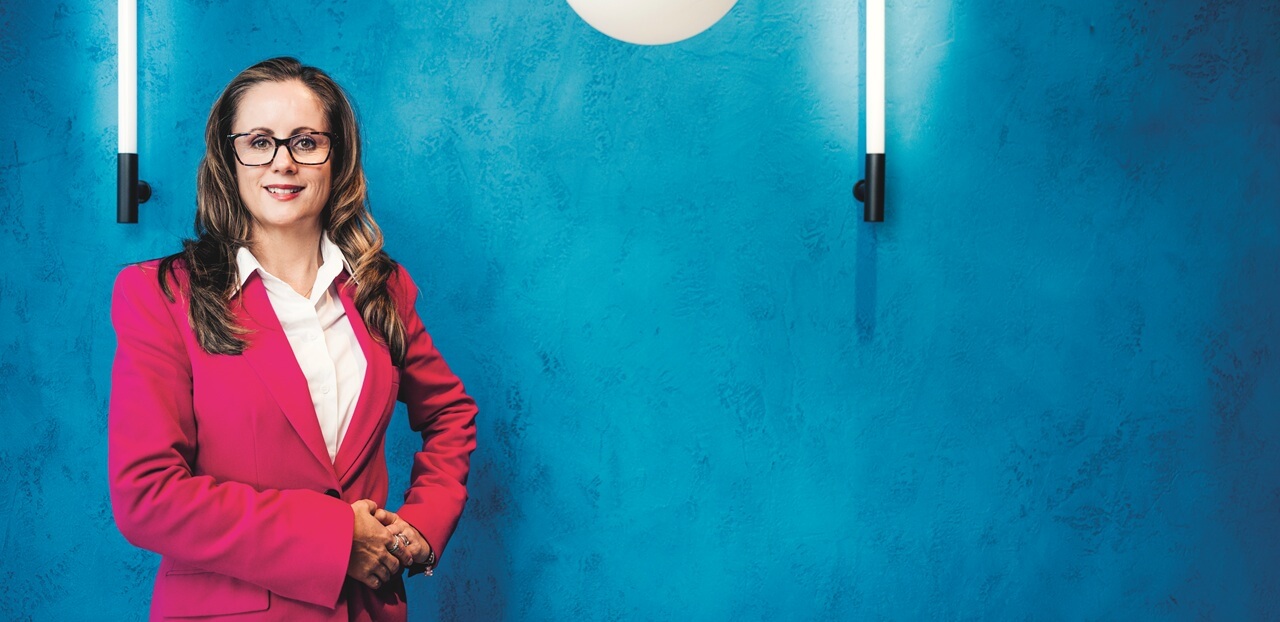
Corné Greyling does not like to be in the spotlight. She prefers to keep her head down and do her job as vice president company secretary & corporate legal affairs at Ahold Delhaize. A Google search or ChatGPT prompt for information about her results in nothing more than a short resume on LinkedIn. And a response of ‘Do you perhaps mean Johan Corné Greyling, the Namibian rugby international who currently plays for the Windhoek Draught Welwitschias?’ But no, that is not the person, although ‘our’ Corné Greyling also comes from southern Africa. She was born in South Africa, where she grew up and received most of her education. It is also the country she left with her partner to build a future in the Netherlands, she tells Joyce Leemrijse, partner at A&O Shearman. After legal positions at financial services provider TMF Group and insurer NN, Greyling is now working with the top executives at supermarket group Ahold Delhaize.
It is difficult to find something about you online. No social media, no articles...
‘That is right. My activity on social media is very limited. I actually only use LinkedIn, and purely for business connections. Other than that, I do not feel the need to share my opinion on everything or to give insights into my personal life. I do that with family and friends. And I prefer to meet them face to face.’
How did you end up in the Netherlands?
‘In 2006, I followed my then-boyfriend and now husband to the Netherlands from South Africa. He just started a job at Unilever. We thought we would stay for a year or two. But now, almost 20 years later, we are completely settled in the Netherlands.’
Were you able to settle in right away?
‘I found it quite difficult at first. Especially in initial contacts, the Dutch are a bit reserved. But once I navigated that, I quickly felt at home. Dutch people tend to be like diamonds in the rough. They are honest and open, but also very direct. Straightforward. It took me a while to get used to that, but now I really appreciate that sincerity. I think I have become a real Dutch person myself. I learned not to beat around the bush, to just say things as they are.’
And the language?
‘I grew up speaking Afrikaans and English. That made moving to the Netherlands relatively easy. Thanks to Afrikaans, I was able to understand and read Dutch right away. Speaking was a bit more difficult. And writing is still a bit of a challenge. But luckily, Copilot is there to help me dot the i's and cross the t's. Moreover, the working language at Ahold Delhaize is often English, especially in board meetings.
It is funny to see that my son has become completely Dutchified. At home, he speaks Afrikaans and a little English, but when he has friends over, he speaks with an extremely Dutch accent. I cannot even imitate it. For me, the moment I started thinking in Dutch was the moment I realized I was truly integrated.’
Can we go back to your childhood in South Africa. What events shaped who you are today, and what norms and values did you inherit?
‘I do not think there was one specific event, but I have always strived to be independent. Another value imparted was to not accept everything simply on face value. Always ask yourself 'why?’ It is important not to just go with the flow, but to question things and think critically. That being willing to ask questions is a trait that serves me well now.’
One seldom hears about children wanting to become company secretaries. Where did your love for the profession begin?
‘I worked for the legal office of financial services provider TMF Group for a long time. That is where my interest in the profession of company secretary began. We had a large portfolio of diverse clients, to whom I provided legal advice. The ‘cosec work’ became part of my work and turned out to be diverse and interesting. At a certain point, I had to make a decision: what do I want to do, what do I really want to achieve in my career? I thought that perhaps I should try to find a position as a corporate secretary.
I got the opportunity to become deputy corporate secretary at the insurance company NN, and I went for it wholeheartedly. That was an extremely interesting time, and it was a fantastic learning environment for me, with great colleagues and good mentors. NN had just taken over Delta Lloyd and were busy with the integration. That is where I really grew into the role of company secretary. It was a perfect fit, it fitted me like a glove, and I think it laid the foundation for me to successfully perform my current role as company secretary. The work is legally oriented, but you also get insight into all aspects of the business. You really get to see the ‘inner workings’ of the company. What is more, no two days are the same.’
Can you describe what made you change jobs?
‘What really appealed to me about Ahold Delhaize is the type of company it is - a retailer close to the people. We put food on the table. We serve 72 million customers a week. It is tangible. It is truly about the people here. When Ahold Delhaize approached me with this position, I thought it would be a good opportunity to prove what I am capable of. And I have not regretted the move for a moment. I am also happy with the opportunities I have been given. Since January of this year, my role has expanded further, and I am now also involved in corporate legal affairs. I am really broadening my own scope, horizon, and portfolio, which is fantastic. I love what I do.’
What qualities are important for this role?
‘I think you need to be well organized, above all. You need to be able to think critically, especially in stressful situations. You need to dare to ask questions and not accept everything blindly. And you also need to be very people oriented. You need to be able to assess the space. You need to be able to judge the pace, and especially whether everyone is still on track. It is very easy to lose track of your colleagues in the fast pace of work. If you make sure the human connections are in place, it becomes much easier to ensure everyone is on the same page and keeping up.’
As a company secretary, much of your work is with the people on the board of directors and supervisory boards. These boards have their own dynamics. Do you need the same qualities for that?
‘You work with the most influential groups of people within the company. It requires a certain skill to always navigate this in the right way. You need to be well informed about what is going on. You need to ensure that the flow of information works well.
You also need to have the courage or the confidence to occasionally say you disagree with something. That is not always easy, but directors and supervisory directors are people too. Ultimately, trust is paramount. They have to trust me, and I have to trust them. With trust, there is safety, and you can openly voice your opinion. I do believe, however, that you should always do this in a collegial manner. I will not sugarcoat anything, but if you convey the message in an agreeable way, people will be more receptive to it.’
I read in an interview with Chairman Peter Agnefjäll that he considers taking initiative to be extremely important. Are you able to do that?
‘I feel a lot of freedom. And that comes from the trust I have been given. If I see an opportunity for improvement, I feel free to take the initiative and make a proposal. I have been very fortunate with Peter Agnefjäll. He is very open and encouraging. My goal is to build a similar relationship of trust with his successor, Wiebe Draijer, because it is so crucial to the performance of this role.’
Are there any changes you really want to focus on in the coming years?
‘One of the major items on my teams' agendas is AI. For me personally, I also want to further develop my teams, making them stronger, and ensuring good cooperation. My teams play an important role in ensuring that we get the right information from across the organization. Their insight and dedication are essential to how we operate and contribute at a strategic level.’
How could AI help your CoSec team?
‘We are still in the early stages, and I think there definitely is a great deal to be gained in efficiency. We want to further automate and professionalize certain processes in a secure environment, without compromising governance standards or team integrity. There are many small, everyday processes for which we could eventually use AI-agents. These mainly concern the standard processes involved in preparing for meetings, summarizing documents, registering new board members, and applying for proxies from the Chamber of Commerce. Perhaps we can use AI to make these processes faster and more efficient.’
Is AI the biggest change for the company secretary, or are there other themes?
‘I see that the governance landscape is changing significantly, which requires a fair amount of navigation. The role of the company secretary too has really changed in recent times. In the past, it was more of an administrative role. The modern company secretary is a multifunctional governance expert who combines legal, strategic, ethical, and digital expertise to navigate an increasingly complex landscape. You have to represent the interests of the company and its stakeholders while also serving the board. You have to ensure general communication and cooperation on the necessary topics. That can be quite complex at times. There is still much to be done in terms of reporting and there are enormous changes happening in both Europe and the United States. We are also facing a barrage of new regulations.’
An important issue will undoubtedly be the new Risk Management Statement (RMS). How complex is that for the CoSec?
‘The impact will be relatively large, as the RMS represents a fundamental shift in how Dutch companies approach risk management and governance. Companies are still working on their gap analysis with regard to internal controls. What does it entail, what is expected of us, how are we going to report?
With all the laws and regulations, the annual report is becoming so much more than just a financial report. I think that is where the added value of the RMS lies, and it will probably lead to stronger internal controls, more transparency, and greater confidence among stakeholders. We have a solid team working on this, so I think we are in a good position.’
To what extent can you make use of the knowledge of fellow CoSecs?
‘Fortunately, these are precisely the kinds of things I can discuss with fellow company secretaries. We have regular networking meetings with various organizations, where we discuss all kinds of topics openly with each other. I now also have a valuable network of my own, which I regularly consult when I need input. How do you do that? It is great to be able to just ask. You are not alone. You do not have to keep reinventing the wheel.’
Ahold Delhaize presented its new Growing Together strategy last year. What appealed to you about this approach, and how is it being implemented?
‘What appealed to me was the focus on people and culture. The customer comes first. Whether that customer is the customer in the store, or, from my perspective, the board or my team. The customer is at the forefront of every decision we make. We are currently busy implementing Growing Together. I think we are well on track. All the themes from our strategy are reflected in virtually every meeting agenda. I see it as my personal responsibility to make sure of this. Are we on track, is everyone on board, what is the next step? To keep it small and personal - I find it important, for example, that members of our supervisory board make regular site visits. That they visit the stores, all our brands, meet our colleagues, our customers.’
What is the next step for you?
‘I think I have really found my place and my role. I am still developing rapidly. I need to get to know the retail sector better. And I am now developing myself more as a manager, as a leader. My team is growing, so from a management perspective, I will continue to be challenged in the coming period. But I am happy with where I am in my life and career at this moment.’
Does your future lie in the Netherlands?
‘Definitely. I am not going anywhere else for the time being. The Netherlands is now our home, although it remains special to visit family in South Africa.’
This interview was published in Management Scope 09 2025.
This article was last changed on 21-10-2025