
René van Vlerken (Euronext): ‘The end goal is a European capital market’
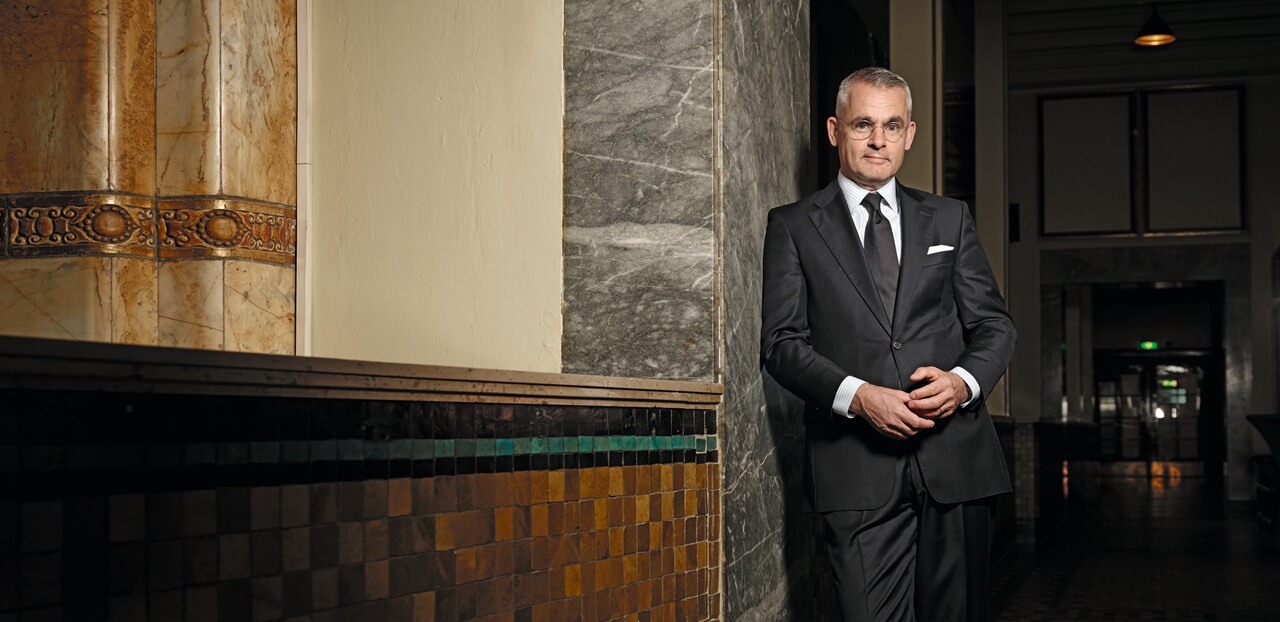
‘I worked with him for a while!’ exclaims René van Vlerken. Gerbrand ter Brugge, who is now partner at Oaklins Netherlands, was van Vlerken’s manager during the two years he worked at ABN AMRO. Van Vlerken graduated from hotel management school and had little experience or knowledge of financial markets when, back in 1996, the bank was looking for candidates with diverse backgrounds and studies. ‘Hotel management school is very generic; you learn to think in terms of guests and customers. ABN AMRO was investing heavily to compete with the major international banks in financial market activities. We were trained in three months.’ When asked about Gerbrand’s management style, Van Vlerken replies: ‘Very entrepreneurial, goal-oriented, direct, and very commercial. The client’s interests always came first.’ Ter Brugge adds: ‘And sometimes somewhat blunt. A dealing room is an enormously energetic environment; you are always on your toes, and there is always a certain competitive tension. If you had a major deal, it had to succeed; it had to be concluded in a single day. I thoroughly enjoyed that time. If there is one thing I sometimes miss, it is a spectacular day on the stock market.’After ABN AMRO, Van Vlerken worked at Rabobank. ‘I worked there until the end of 2016, and in February 2017, I started here.’
‘Here’ is Beursplein 5 in the heart of Amsterdam, where the Amsterdam Stock Exchange merged with the Brussels and Paris stock exchanges in 2000. Seven European countries have now joined this European exchange. The goal of Euronext, where Van Vlerken has been CEO Amsterdam since 2024, is to become a comprehensive European trading platform that can compete with the United States and the rest of the world.
Van Vlerken and interviewer Ter Brugge discuss the role of banks, which has changed significantly since the credit crisis due to stricter laws, regulations, and solvency requirements. ‘Whereas in Gerbrand’s time, ABN AMRO was still the leader in capital market transactions for Dutch and international companies seeking to list on the Amsterdam stock exchange, the banks now need to compete more with other international banks and advisors.’
The Netherlands is an open country and welcome foreign companies doing business in the country. American specialist banks have also become very active in the Dutch markets. What does this development mean for the stock exchanges?
‘Euronext is a pan-European exchange. Twenty-five years ago, the Netherlands, Belgium, and France took the initiative to link these exchanges to create a single European exchange. Seven countries have now joined, and if all goes well, Greece will also join. From there, we aim for further consolidation, towards a single European capital market.
Within the Euronext group, Amsterdam is the most significant platform for international companies. This goes all the way back to the founding of the Amsterdam stock exchange four hundred years ago. Since then, Amsterdam has been successful in attracting international companies and international investors. In the Netherlands, we have developed a community of banks, advisors, and law firms which are strong also internationally. And because we have become so international, we also attract significant international competition. Essentially, the stock exchange is nothing more than a marketplace. We have developed an infrastructure to bring together supply and demand for capital as efficiently as possible. The success of the Amsterdam stock exchange is, by definition, the success of the Netherlands. There is so much knowledge and expertise in that network; not using it optimally will mean a huge missed opportunity.’
Do you feel that there is a brain drain going on, compared to twenty years ago?
‘In the run-up to the elections, we are, together with The Association of Proprietary Traders, the VEB investors’ association, and the DUFAS asset management industry association, among others, working on a position paper on the relevance of the Dutch capital market for our economy and society. This is something not always understood in The Hague. One of the topics is talent development in the financial sector. How do you encourage students to build a career in the financial sector? Knowledge and talent development in our sector is under enormous pressure, especially compared to other countries. It is difficult to attract and retain talent.’
Yet, Dutch universities are still producing good graduates. The Netherlands has a considerable advantage in this regard; the starting point is sound. These graduates are desperately needed. The consolidation of exchanges that Euronext wants is essential for Europe; we need to move towards one large, integrated exchange as counterbalance to the Americans and the Chinese. What was the most important development during your year at the helm of Euronext Amsterdam?
‘The consolidation of a European capital market. After November 20, 2024, with the second term of the Trump administration, the urgency of establishing a European capital market has grown enormously. We can rely less on the United States in terms of defense, the economy, and capital markets. A European capital market is a vital part of the solution. There is still a long way to go. In the European debate, depending on the prevailing political climate, national interests to large extent still prevail. But much has happened in the past year that contributes to our ambition. I call Euronext a kind of CMU (European Capital Market Union, ed.) on a smaller scale. The ambition for a single European capital market is more widely shared, and the urgency is more keenly felt. In that respect, Trump is good news.’
The world is changing very rapidly. Artificial intelligence is expected to accelerate all processes. Nowadays, you can have ChatGPT write a prospectus for going public at the touch of a button. The key question then is if everything in it is correct? It is much faster, but also far easier to go wrong. What do you see as the most important technological challenges?
‘Digitization in general and AI in particular represent a major opportunity, including for the stock exchange, for example, in monitoring and controlling the market. They also threaten its stability. Artificial intelligence can gather a wealth of information, the reliability of which is difficult to verify. Stock exchanges too try to make use of this kind of information as much as possible to make their organizations more efficient and facilitate the market even better.’
I notice that smaller companies are less likely to go public. Is that a Dutch trend?
‘That is the case worldwide, but the Netherlands is certainly also affected. Euronext Amsterdam has only a regulated market supervised by the Netherlands Authority for the Financial Markets (AFM). In other countries, you also have unregulated markets, the MTFs. In the Netherlands, there is a problem with financing startups and scale-ups. The transition from startup to scale-up requires substantial growth capital. Those tickets are too large for banks and venture capital, but often too small for private equity.
We must ensure that the available capital is better utilized for these types of companies. Euronext Amsterdam continues to call on investors, pension funds, insurers, and also The Hague to mobilize the local capital providers.’
The Netherlands is a world leader in photonics, nanotechnology, and defense-related technology. However, many scale-ups get stuck because they have difficulty raising capital, and pension funds are no longer supporting smaller companies on their way to the stock market. We all want to become less dependent on America. We speak with defense companies with, for example, promising drone technology that are struggling to raise capital. What is needed to help these companies go public and thereby create winning Dutch high-tech companies?
‘Through public-private partnerships. We need to repatriate the money that large institutional investors invest globally and invest it in the Dutch economy. Institutional investors and retailers need incentives to do so, such as providing a fiscal stimulus, dividend tax reductions, and loyalty bonuses. But investors must also feel a moral obligation to invest that money locally. You could say: pension funds should invest more locally, but that is only part of the solution.’
After the credit crisis, we rightly started limiting risks for consumers. But money must continue to flow. Do you think we are too cautious in this regard?
‘That also has to do with culture. Our pension system has made individuals lazy. The pension fund invested for you, so you did not have to think about active investing yourself. A new system is good news because it raises awareness about investing. The fact that young people are so interested in cryptocurrencies is, in the long run, good news for the stock market. Because people will likely eventually think: I should not put everything in cryptocurrencies, but diversify my investments. Because young people are thinking about volatility - which is what cryptocurrencies are by definition - their perception of risk is different.
Education to convince the younger generation that it is better to invest in stocks and companies than to trade only in cryptocurrencies, is important. This helps companies in Europe obtain sufficient capital to grow. It is important to bring about this cultural change among the new generation.’
You spoke earlier about a moral obligation to invest money locally; how do you foster that awareness?
‘By discussing it privately and publicly: what is needed in the Netherlands, in Europe, to have sufficient capital available for self-reliance, sustainability, and security? You cannot just keep tapping into the treasury; it is by definition a collaborative effort. The government must facilitate the provision of funds from the private sector. You have to stimulate public debate on this and demonstrate the importance of the capital market.’
Is that not sufficiently reflected in the political picture?
‘We wrote our position paper for a reason. I see more awareness at the ministries, but administrators and politicians are guided by the issues of the day. The current Dutch government recognizes the importance of the capital market, but we do not know what the situation will be after the election on October 29.’
The capital market is still widely associated with greedy individuals, without any awareness of how important a well-functioning capital market is for every Dutch citizen. As a result of the credit crisis, the financial sector has gained a bad reputation, which is understandable. But whatever we think of it, we need that market to be able to earn our money. I think that perception is now changing again in the political arena. In my opinion that is a positive development. We have to work together with Europe, each with our own strengths. If we focus on this as a national government and financial market, citizens might also recognize the importance of that market?
‘People see business more as an ATM and a burden than as a key pillar of a successful economy, prosperity and the well-being of people. There is a significant undervaluation of the business community. Not everyone understands the importance of a good entrepreneurial and investment climate. The fickleness of the government policy is disastrous for businesses and investments.
Successful countries are predictable countries. The ultimate strategy is to move towards that European capital market. Consolidate liquidity. There is enough capital, but because the market is so fragmented in Europe, it is difficult to quantify. This discourages foreign investors from being active here. It is time to create that famous capital markets union, the CMU.’
So, the good news is we are moving in the right direction, but as always, we, Europe, are moving slower than the US and China due to our complexity. The building blocks are sound, Euronext is on the right track, and we are exceptionally wealthy. But we can only win this race through greater collaboration. What does that require?
‘We should bring all the initiatives together, secure the government’s guarantee, and get private financing flowing. Everyone sees the urgency, but are we also prepared to give up some of our own autonomy, in the Netherlands and in Europe? Sometimes local and national interests still trump European interests. You need leadership to bring the parties together and say: this is our shared goal, what are you going to do?’
Who should provide that leadership?
‘In The Hague, they say the business community, and in the business community, they look to the government for the initiative. We will have to do it together. But the financial sector and the business community should take a more prominent role to tell our story.’
We should not wait for Brussels, but take the lead in the areas we excel in. ASML is a good example. But are the conditions favorable for new ASMLs to emerge? Politics has a major role to play here.
‘When former ASML CEO Peter Wennink said at his farewell: if things here do not improve, we will leave the Netherlands, French President Macron was on the phone two minutes later. Wennink’s successor is from France, after all. Very quickly Brainport, local politicians, and other parties joined forces, and suddenly things became possible. Because there was a sense of urgency: ASML might be leaving, and it was not an empty threat. We need companies of this scale for our economy and prosperity.’
This interview was published in Management Scope 09 2025.
This article was last changed on 21-10-2025