
Sandra Phlippen: ‘A CO2 tax is not a punishment’
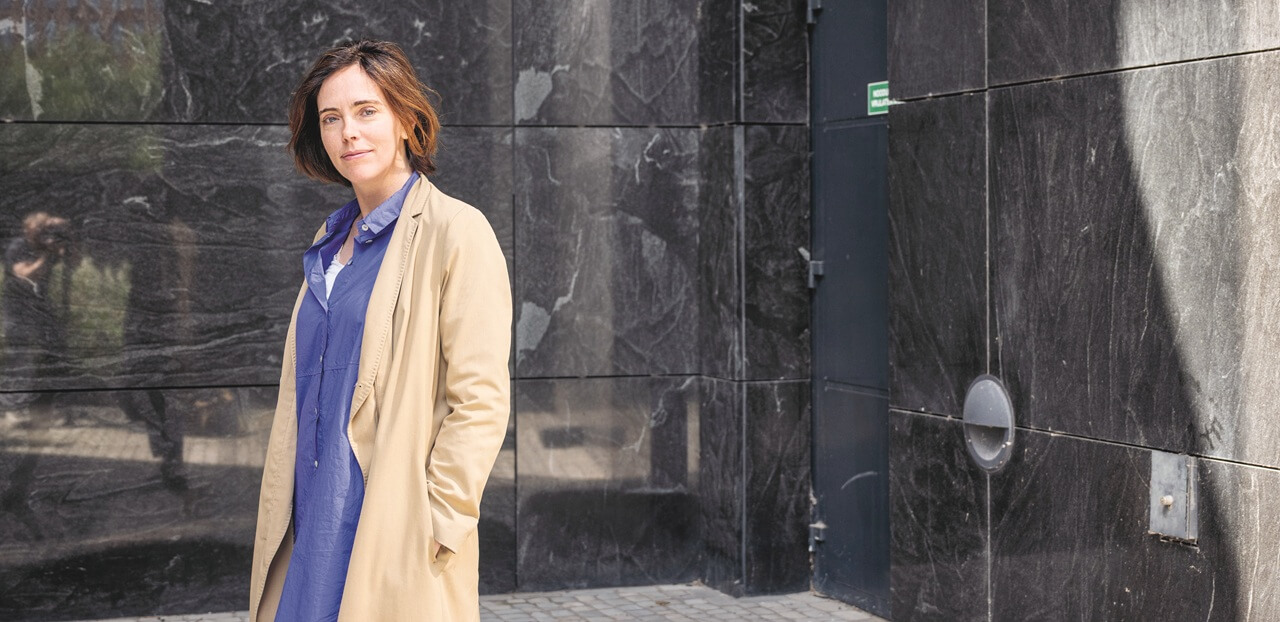
Sandra Phlippen, chief economist at ABN AMRO, recently announced a two-month sabbatical. She will be a candidate for the Dutch political party D66, and help write the election manifesto for the Dutch House of Representatives elections. She also writes columns and opinion pieces, regularly appears on radio and television, and, especially since her 2022 guest appearance on the Dutch TV program Zomergasten (Summer Guests), is one of the Netherlands’ best-known economists. With her team of twenty-six specialists, she develops future scenarios and analyzes economic trends, but she also uses her public role to actively share ideas and discuss social issues, particularly those related to sustainability and climate change. Two years ago, she was interviewed on this subject for Management Scope by Marc-Jan Reumers, managing partner Benelux at strategic consultancy Kearney. Now that the transition to a sustainable economy in the Netherlands seems to be stagnating, it is time to take a look back but also a look ahead.
Two years ago, we discussed the importance of positive tipping points for accelerating the sustainable transition. Have you seen any such positive tipping points since then?
‘I will then have to talk about sustainable accounting standards from an investor perspective, because quite a few changes are happening there, and in a positive sense. Let me take a moment to explain, so stay with me. In Europe, when making investment decisions, investors look at both the impact of climate policy on the financial performance of companies, financial materiality, and the reverse, that is what the impact of the company's activities on society and the environment is. The latter is, of course, what really matters. Yet in the United States, 80 percent of sustainable investors use the MSCI ESG ratings and indices, which focus primarily on financial materiality. In practice, this can even be counterproductive, as after every natural disaster major banks and insurers worldwide withdraw their capital from the affected areas to protect their core markets. This obviously is devastating news for these often already vulnerable areas.
So that financial materiality consideration does not help the ESG movement, and I was therefore always very cynical about it, but I now see something changing. Last June, I attended the watchers meeting of the International Sustainability Standards Board (ISSB) in Berkeley, the organization that defines sustainable investment standards worldwide. The watchers meeting comprises around 50 people who, as with the ECB watchers meetings, provide feedback to the board on how these investment standards can be improved in practice and from a scientific perspective.
Although the actual application of these standards depends on local laws and regulations, there are now more than 40 countries where investors have adopted these standards and, for example, impose a risk premium on companies with high emissions and few emission reduction plans. This is even happening in countries where there is no strict climate policy, such as the United States. Why would American investors do this despite Trump's anti-ESG policy? One reason is that they take into account that after Trump, someone like Biden may return to the White House. They realize that they will then be left high and dry with few sustainable investments and therefore demand a higher compensation for that risk. I think that is a very positive development. The market sees and prices the risk of emissions even if there are no short-term policies to address it.’
Is sustainability not also driven by the intrinsic motivation of companies, for example because they are genuinely concerned about the impact of climate change on their operations? Think of cacao processors and coffee producers, whose products are at risk of becoming unaffordable.
‘There definitely is a group of executives who are engaged in large-scale emission reduction regardless of the risk, but that is a very small proportion. Looking back, very little has been realized of the mantra of recent years that the business community would take social responsibility now that the government is withdrawing. Companies do want to do something about corporate social responsibility, but they are not going to sacrifice their competitive position to do something good for the world.
In fact I do not think we can ask that of individual companies. We have to recognize that the public and private sectors have different responsibilities. And so the government will have to tighten the reins again. At the moment, nitrogen problems are causing an enormous mounting of tension. Housing, agriculture, infrastructure, nature conservation… everything in the Netherlands is under pressure. I think most entrepreneurs would like to invest their way out of this predicament, but they need to know what the pot of gold on the other side looks like. Will they be able to build a decent future? Reliable policies play a major role in this. The Dutch government can also blame itself for the current negative sentiment towards farmers. It initiated land consolidation in order to achieve economies of scale, to enable Dutch farmers to compete with Eastern Europe. It would be to the government’s credit if they were to admit, in retrospect, that they handled this incorrectly. That acknowledgement creates the mental space to be able to change.’
There is a lot of difficult news about the climate. Where do we stand now? Is it a very bleak scenario, or do you see ways to turn the tide?
‘We are heading for approximately 2.7 degrees of warming. More than two degrees of warming rapidly increases the likelihood of it becoming three or four degrees warmer... so things are definitely not that great. From a macroeconomic perspective, however, the transition is inevitable. Doing nothing will cost us a staggering twenty percent of global GDP by 2050, while the costs of the transition would amount to about 1.5 percent of global GDP. The business case is therefore emphatic, a no-brainer, really.
The problem is that each country has a different point at which the costs of doing nothing exceed those of the transition. At the moment, everyone is still thinking in terms of their own self-interest. It would be great if we could recognize that solving the problem is in our collective interest. There has been talk for some time about forming a global CO2 club – for example, around new trade agreements – which countries would join when they reach that break-even point between doing nothing and doing something. If all those countries then introduce CO2 pricing at the same time—to restore a level playing field globally – that could really make a difference. I just fear that it will be too late by the time it gets off the ground.’
What needs to happen to convince directors that investing in sustainability is ultimately in their own interest?
‘Every director should consider the question: what benefits will I have achieved for our company and for society if I have done everything I possibly could for the transition by 2050? And can I quantify those benefits? That is a difficult, but not impossible, challenge.
Take any bank, for example. It has to hold capital for emissions on its balance sheet, as required by the ECB. In other words, if banks lend money to companies with high CO2 emissions, they have to set aside part of their own capital for this purpose. So doing nothing costs money. The challenge then is to calculate how much capital you can free up by investing in projects that reduce emissions at customers, so you can use that money for other worthwhile activities. To validate the business case, you also need to try to quantify other long-term benefits of these investments. For example, what are the benefits if you can attract more talent or retain employees for longer as a result? Once you have quantified all those economic benefits, you can convert them back to a concrete financial value in the present.
It is essentially the classic investment question, just in a different area. Until those future benefits are actually realized, directors need co-investors from outside, so that they do not price themselves out of the market in the meantime. It also requires the government to stimulate consumer demand for clean products by making them the cheapest option. For example by raising money through pricing in CO2 on polluting products and distributing this back to households through substantial subsidies. This makes the transition budget-neutral for people and helps companies quickly find a new market to grow into.’
Meanwhile, in the Netherlands, the CO2 tax is being scrapped.
‘That is why we really need to move away from the idea that a CO2 tax is a punishment. It is, in fact, a lever to our future. The clean, pleasant living environment we all want is lacking scale because it is too small and too expensive. The polluting world we come from has enormous scale and will not scale down on its own, because companies have no interest in doing so. We need a lever as in the transition phase to clean processes and products, there always is a relatively short window when it can be very expensive to adapt, for example because an electric car is still slightly more expensive than an older car, even including CO2 tax. It is therefore essential for the government to remove that last hurdle through subsidies for businesses and consumers, and the revenue from the CO2 tax can be used for that. The CO2 tax is therefore a wonderful tool for shifting the incentive.’
How do you get people on board with that vision of the future? In elections, for example, climate is not exactly a topic that everyone is immediately enthusiastic about.
‘People do feel a sense of climate urgency and want something done. They just do not want it to interfere with their lives, especially if they think those restrictions do not apply to people with a lot of money. I understand that fairness issue very well. What would help is visualization with the help of landscaping, for example, using artist's impressions to show what that pleasant living environment of the future will look like thanks to the transition. Then people will be enthusiastic about moving in that direction, and investors will want to build their commercial real estate in those places, for example. Together with former UN Water Envoy Henk Ovink and architect Winy Maas, I am working on a plan to give substance to this concept.’
You are very outspoken about everything related to the climate. Do you have the freedom to do so within the bank?
‘Absolutely. I have agreed that if I cannot speak freely about something, such as individual companies, I will not and will not want to say anything about it. But if I do say something, I want to do so in good conscience. That also fits in with my economics office, because we are in the business of making factual analyses of the economic consequences of certain choices. The same applies to our projections. They are not based on what we think the world should be heading towards; they provide insight into the most likely scenario.’
In a world that is changing so rapidly, how can you even create realistic scenarios of where the world is heading?
‘By looking closely at data and figures. When it comes to the transition, we create a scenario for each sector – built environment, industry, mobility, agriculture, energy – to achieve zero emissions by 2050. This involves questions such as: at what rate should those emissions be reduced? What does a ton of reduction cost in each of those sectors? And what do you need to invest to achieve that annual reduction percentage? And also: how much additional electricity demand will there be if everyone in the built environment and mobility goes electric? How quickly can the energy sector scale up its green sources? In some scenarios, the energy sector could even become more polluting because other sectors are successful, for example due to rising demand for electricity while there is still insufficient green energy available. We continuously measure and weigh all these aspects. The speed at which such a scenario can become reality is mainly determined by policy and politics. For example, we now know that the pace at which European banks are reducing their emissions is completely unrelated to whether or not they have made a net zero commitment through the Net-Zero Banking Alliance. All banks are reducing emissions on their balance sheets, but this is solely due to regulation, not their own policies.’
This implies that these scenarios will have to be continually adjusted after a political shift, such as the one currently taking place in the US or soon after the elections in the Netherlands.
‘Policy does indeed set the tone. You can try to stay ahead of the curve a little, but not too far. In practice, we create quadrants. On one axis are banks or companies. Their policies can deteriorate, remain unchanged, or become ambitious. On the other axis is the context in which that bank or company operates. It too can deteriorate, remain unchanged, or become ambitious. For each of those nine boxes, you can do calculations along the lines of: what is the impact on the organization if it remains unchanged in a world that is deteriorating?’
Your current job requires a lot of creativity and therefore mental space. You said in a previous interview that you want to change jobs every five years and take a sabbatical, that is, mental space in between. You have been in your current position since 2019. So is it time for the next step?
‘Those five years have never been sacred to me. It is more that after such a period, I usually feel that something new is needed. I have a really great team now, a truly warm and welcoming environment, so it is very difficult to continue to meet my own expectations for those five years. Incidentally, I take plenty of mental space in this job. I am not a manager who breathes into the necks of the team, and I do not think that is good for professional integrity. And of course, my ‘political sabbatical’ is also a refreshing break for me. At the same time, I am involved in thinking about our climate strategy as a bank from behind the scenes, and my children are entering their final year of high school. There is certainly no room for boredom in my life.’
This interview was published in Management Scope 08 2025.
This article was last changed on 23-09-2025