
‘Sensitive issues remain undiscussed too often’
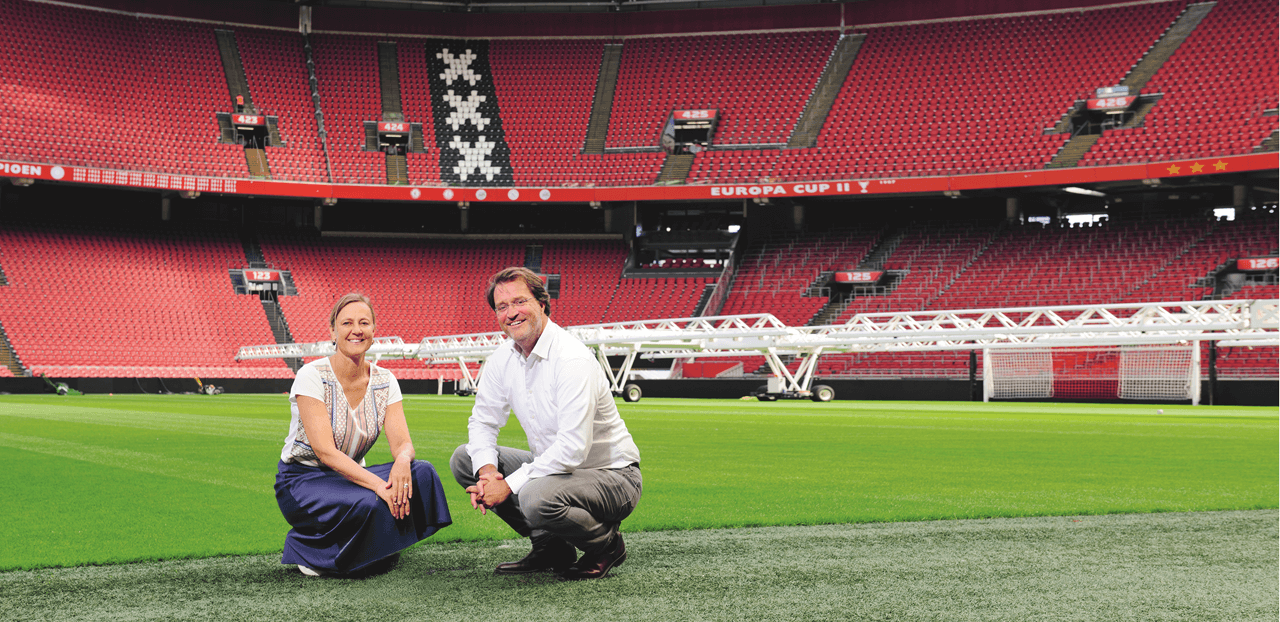
Tanja Dik is CEO of the Johan Cruijff ArenA in Amsterdam and, of course, a fan of Ajax, the stadium's main tenant. Her conversation partner, CEO Jan-Joost Bosman of the family business Auping, is naturally a fan of Go Ahead Eagles, the club from the Dutch city of Deventer where the bed and mattress manufacturer has been based since its founding in 1888. But he also openly admits to having a soft spot for Ajax. And so he is happy to visit Tanja Dik for this interview, and at the photographer's request, they pose side by side in the stands and next to the stadium’s turf. The conversation continues in a comfortable space filled with memorabilia from the ArenA's history. It turns out to be the former boardroom. When Dik took office in 2021, she decided to turn it into a meeting room and forgo a dedicated workspace. She prefers to roam the building in sneakers, visible and approachable to her 70 employees. Bosman does not have his own office either. To both of them this is an outdated concept.
They are equally aligned when it comes to the sustainable transition. In 2020, Auping made a drastic change with the decision to, in the long term, make its entire mattress range circular. The Johan Cruijff ArenA, already one of the most sustainable stadiums in the world, aims to be completely net positive by 2030. A recent major step forward is that since August 2024, large events such as football matches and concerts have been powered entirely by green energy thanks to 4,200 solar panels on the roof, a wind turbine, a sustainable energy marketplace, and two mega-batteries.
A further alignment is that Bosman participated in the Discomfort in the Boardroom project, which was completed in 2023. Dik participated in the follow-up project, In-Depth Governance. Both projects, an initiative of MVO Nederland with support from the Goldschmeding Foundation, aimed to help directors and supervisory board members find the balance between ethical issues and the interests of the company.
Both Auping and the ArenA have already made significant progress in the sustainable transition. Why did you want to participate in this project?
Bosman: ‘During Discomfort in the Boardroom, scientists and executives tried to find answers to the question of why companies do not more often focus on sustainability. That appealed to me, because it was precisely around that period that we had taken the step of making our entire mattress range circular. That caused some discomfort. You want to do what is best for people and the environment, but at the same time you have a financial responsibility. As a frontrunner, you also run the risk that the pack or consumers won't follow. It was very useful to be able to discuss everything we encountered with others and to place it in a broader context.’
Dik: ‘I was particularly struck by the articulation of that discomfort. If you feel discomfort, you just need to open your mouth and let your heart speak. It still happens too often that sensitive issues remain undiscussed because executives find it stressful, doubt whether they are ‘established’ enough on a supervisory board to strike the right chord or have previously experienced that they are not really listened to. I myself like to seek out discomfort, but it was instructive to reflect together during the project on how this affects you, and to learn how to operate even more effectively by, for example, asking different questions. It gave me tools to better substantiate what I already do naturally and to apply it in a more structured way.’
Did participating in the project help resolve the discomfort at Auping?
Bosman: ‘It certainly made me realize how essential it is to deepen the relationship between directors, supervisory board members, and shareholders in order for the transition to succeed. A significant portion of our revenue and profit comes from the sale and production of mattresses. If the transition to circularity is not successful, it poses a major risk for the company and for me as a director. That is why I entered into discussions with the supervisory board and our shareholders at an early stage. Ultimately, we opted for this direction, both in terms of the risks and the investments, which ran into millions for a new factory and a robotized production line for circular mattresses. In the dialogue with shareholders and the supervisory board, the long-term horizon of a family business helps.
If you seek that connection at an early stage, there is a better understanding of the company's financial development during this period. We only see every mattress we sell again after eight to ten years. You need that period to replace the existing range and recover some of the materials. In the meantime, there may be a dip in results, but we still need to generate sufficient returns to continue investing in the factory, the people, and the brand, because there is more than enough competition in our industry too. We also seek to connect with that competition by making our circular technology available. In this way we try to accelerate, because on our own we are too small to change the entire market. In the Netherlands, more than 1.5 million mattresses are discarded every year, so it really has an impact if they are reused instead of incinerated.’
Dik: ‘We are also seeking that connection. Every year, we have at least 25 league matches here, between twelve and eighteen concerts, some conferences, and 200,000 tourist visitors. Because we, as a management organization, outsource operational tasks such as cleaning, security, waste processing, and catering, we simply need those other business partners - and, for that matter, the visitors - to take action. For example, it is important to work together to impress on Ajax supporters the impact of improper waste separation. If you throw plastic in the designated bin, it can be reused. If it gets mixed with mud because you throw it on the ground, we have to rinse it first and then reuse is no longer feasible.’
You are, then, fulfilling one of the seven good practices that emerged from the In-Depth Governance project: become a connector. Another is: prevent moral complacency with ethical reflection. What ethical dilemmas do you discuss in the boardroom?
Dik: ‘That could be about a Beyoncé concert, for example, for which she is coming to Europe with 187 trucks. Not really in line with our strategy to reduce the impact of concerts, but if we do not program her, we lose revenue, disappoint fans, and make less progress in sustainability. Besides, Beyoncé is coming to Europe anyway, so does it help if we say 'no' and she goes to another venue? These are the kinds of conversations that take place here at the table.
Furthermore, a good ethical conversation is only possible if everyone feels comfortable to safely express their opinion. Also, daring to discuss uncomfortable topics and then taking groundbreaking steps requires a certain degree of independence of thought. In many companies, I fear, there are big egos at the table, afraid of reputational damage, shareholder backlash, or simply their own careers – because will they not miss out on another appointment by focusing on sustainability? I seriously believe that ego or fear is holding back a great deal of sustainable development.’
Bosman: ‘To ensure that people feel free to raise difficult or unpleasant topics, we have developed a leadership program focused on secure base leadership. The bottom line is that in a psychologically safe, caring work environment, people dare to take more risks and speak out more – which in turn helps to bring about transitions. As a tool, for example, there is a wooden fish painted in Auping blue hanging on a hook in every meeting room. If something is bothering you, you take that fish and put it on the table. The idea behind it is that the fish has to be put on the table, otherwise it will rot and stink. A simple trick that works very well.’
Since 2020, Auping has had B Corp certification, an American quality mark for companies that meet high standards in social and environmental performance, transparency, and accountability. Is this also interesting for the ArenA?
Dik: ‘That is definitely my goal. The application itself is not the problem, because we have all the necessary points. What we are running into is that an amendment to the articles of association is also required and the American term significant impact has been translated into the Dutch text as ‘significante impact.’ It is not exactly clear what that means. Could this involve executive liability if you are expected to prove a significant difference, and does this have legal consequences? Talk about causing discomfort in the boardroom... I have suggested to B Corp that ‘significant’ be translated as ‘substantial’ in the Dutch text, but I have not been able to get it through yet. So both the discussion with B Corp and the discussion with the supervisory board about this are work in progress. I would like to obtain this certification because it is a useful roadmap to support our ambition to become net positive and because it is currently the only international quality mark that shows that the steps we are taking are also being assessed.’
Another good practice: know yourself and show yourself. Where do you want to make a difference?
Bosman: ‘I started my career in cosmetics at L'Oréal, and at the time, sustainability did not play a role there. The company was primarily focused on introducing many new products and thereby generating more revenue and profit. At the latest, after I moved from L’Oréal to small and medium-sized businesses, first at sun protection manufacturer Verosol and then at Auping, I became convinced that if you can make an impact in your field, you should do so. I can no longer imagine making mattresses the old way or that I would even want to work somewhere where sustainability is not a priority. When I am done, I want to have made a positive contribution.’
Dik: ‘As a family, we always went camping in nature. That is where I learned to clean up after yourself and not to throw anything on the ground. If you learn this at home, you automatically apply it in the companies where you work. During my time at Stage Entertainment, for example, it seemed attractive to release the musical Mama Mia in six countries simultaneously because of its popularity. In practice, it was more sustainable to start in the Netherlands or Germany and then reuse all the set pieces in the next country. My commercial calculations also showed that this approach was financially more attractive, so I could sell it to one person on sustainability and to another on financial gain. My message is that you can make a difference in any job. What motivates me even more is that I became a mother. We are already leaving a rather messy world behind for our children, so anything I can do to improve it is a bonus.’
What do you see as a good follow-up to the In-Depth Governance project?
Dik: ‘Actually, every participant in that project already has some connection to the subject, but we need to be clear that many people still cannot care less about it neither know much about it. As far as I am concerned, the next step is for us as former participants to step out of our bubble and try to reach those who think differently. I use every platform I am given to do this, such as recently during a presentation at the supervisory board dinner for all the participating companies of the municipality of Amsterdam. By talking about discomfort in the boardroom, I hope to challenge a new group of supervisory board members. Together, we can spread the ink spill – because ‘oil slick’ is the wrong word in this context.’
Bosman: ‘We do indeed need to break out of that bubble, and all convey the same message. We could even develop a kind of script. Personally, I always end my tours at Auping these days with 'discomfort in the boardroom.' That is actually the most interesting part, because it is an honest story and people also get to hear that everything is not only positive.
Shortly after we decided to make that transition, the coronavirus pandemic hit. Then Russia invaded Ukraine, and we were faced with inflation, skyrocketing labor costs, and persistently fearful consumers. Because there are so many factors around you that are beyond your control, I now tell other companies that you do not necessarily have to go from zero to one hundred in one go. You can also go from zero to five, as long as you take steps in the right direction.’
This interview was published in Management Scope 08 2025.
This article was last changed on 23-09-2025