
From hopeful questions to a hopeful future?
In-Depth Governance is about asking courageous, hopeful questions focused on the future. The question is not only what is permissible and technically possible, but above all whether, from your perspective on humanity and worldview, it contributes to the necessary transitions and the well-being of future generations. These are unusually uncomfortable questions, but they are essential for breaking through existing patterns.
From the outset, the participants in the In-Depth Governance project agreed on the usefulness of these difficult questions, and hopefully so do not only the participants but also a larger group of executives and supervisory board members. The urgency is perhaps greater now than ever, because of Trump- and Wilders-like figures who promise to take the world back to 1950. More than ever, we yearn for an optimistic perspective on 2050. Leaders play a crucial role in shaping that perspective. Leaders are in positions of power and can see further. They can see what is needed and what will be required in 2035 and beyond.
An excellent position
A start has been made. And we also know that the pace needs to increase. That is not easy. During the In-Depth Governance project, I spoke to many participants. I noticed that there are a lot of ‘yes-buts.’ So many unknown risks... if you are the first to embark on a new, more sustainable but more expensive path and your competitors benefit from the cost advantage they suddenly have... Phew... maybe we should just wait for that promising innovation... or the European regulations that are supposed to level the playing field... And besides, we are so small, a drop in the ocean. Just look at the Americans and the Chinese.
It is challenging to move away from the familiar and trusted and formulate a solid, sustainable, inclusive, circular ambition for 2035 , and then translate it into concrete action, into a hopeful future. But we learned that people who are alert to the world would tolerate cognitive dissonance only for a limited time. Executives and supervisory board members feel the discomfort, the tension of conscious incompetence that hurts a little more with every new insight, every day. Right?
The question is how to get out of the rut, where to start? With leadership, of course. But what is that exactly? Henry Truman, also president of the United States, 80 years ago, was shocked when asked how it felt to be the most powerful man in the world, able to impose his will on everyone. He gave a wonderful definition of leadership: ‘I am in an excellent position to help people do what they know in their hearts must be done, but what they do not feel like doing at all.’ So let us move forward to that new economy of 2050!
Finally, time for hopeful questions
I believe the time for excuses and old calculations is over, and we no longer need to waste time on it. Thanks to ChatGPT and its consorts, the big, hopeful questions are finally getting the time they deserve. This dawned on me a few weeks ago. This insight might be familiar. I came to sit in the front row at an auction of 250 top cows for an episode of the Dutch TV program Wat Houdt Ons Tegen (‘What is holding us back’), which focused on the question of changing the proposition of farmers. One by one, these cows were hoisted onto a stage, all the time ferociously excreting. Behind me sat around 1,000 farmers with thick catalogs on their laps, frantically calculating what their bid should be. On the screen behind each animal, about 100 numbers and abbreviations appeared, summarizing the qualities of the bovine in question. I took a barely legible picture of the screen and asked ChatGPT: how much is this cow worth?
My new best friend needed two seconds and explained precisely and cheerfully why I should aim for between €2,500 and €3,000… the cow went for €2,800. In short: as a complete layman, I could have done quite well with this.
Filling our heads with more knowledge, more facts, and more analysis is a waste of our time and energy. Recently, a consultant admitted that he had been able to give a management team such clear advice after a few hours using AI that the CEO, astonished and indignant, remarked, ‘This is better than what I had to pay McKinsey €750,000 for a few months ago.’
Fantasy
What does this mean for the work of executives and supervisory board members? It may require a class on ‘how to write a good prompt,’ but what is no longer necessary is to spend hours checking, comparing, and assessing annual reports, calculating market shares, margins, and different strategies and scenarios. In fact, a stack of annual reports in combination with the strategic plans can be transformed into a customized podcast which integrate the information in an easily accessible and digestible format. Anyone who wants to know how the competition is doing can enter a few details and produce the smartest analysis imaginable. Everyone has access to the same analysis, with the effect that this no longer serves as a distinguishing asset.
You make a difference by putting your imagination to work and looking to the future with creativity and hope, driven by the desire to do the right thing. For example, by assessing the consequences of global warming, the loss of biodiversity and inclusivity, and how you can respond to these challenges with courage and entrepreneurship. In this way, artificial intelligence more or less forces us to focus on what is really important and still unknown: why do we do what we do, can it be done differently, should it be done differently? Where do we want to be in 2035?
That original quest always starts with the question: what do I think about this? How can I, as a human being, citizen, parent, ensure that the solutions I come to are aligned as closely as possible with my ‘professional integrity?’ To achieve this, dialogue is crucial, also slowing down and truly listening. Well, we have time now.
Looking Deep Within
I will continue for a moment, because these are big questions. For thousands of years, we have been primarily concerned with organizing enough, with survival. With success, as there is more than enough, even for ten billion people. But in the meantime, we have become deeply addicted to as much as possible, as quickly as possible, as cheaply as possible. Just one example: we are well on our way to producing the equivalent of 500 billion T-shirts worth of clothing worldwide, every year. One in three items of clothing purchased is never worn, and the rest gets discarded after being worn five times. We also know that if we continue like this, there could be more plastic than fish in the ocean by 2050. Who in the world would want that?
We need to start producing, consuming, and distributing in a completely different way. We agree on that. And we need to take the lead, which is not easy. We have never really had to do this ourselves—I say ‘we,’ because I recognize this. To find the answer to the question of which direction to take, my grandparents went to church once a week. My parents distributed flyers for D66 (a leftist, environmentally conscious Dutch political party) and believed in a fair government that would take care of the distribution issue. I studied business administration and, after the fall of the Berlin Wall, believed that the amoral market would steer our behavior in the right direction. That turned out not to be the case. If we continue like this, there will soon be 40,000 billionaires (currently around 3,000) and the rest will have nothing.
Are we going to return to the church or the government to sharpen our moral compass? Both remain important, but it is my firm conviction that the time has come, thanks to AI, to look deep within ourselves and ask ourselves: what does it actually mean to be human, to enjoy the freedom of acknowledging that taking responsibility is inherent to being human?
If we all begin to grapple with that question, we will encounter the same concerns. That is the foundation for the trust so desperately needed to rebuild our society. In this way, hopeful questions can lead to a hopeful future. Because we all know that what we are doing now is unsustainable.
You have wings, use them.
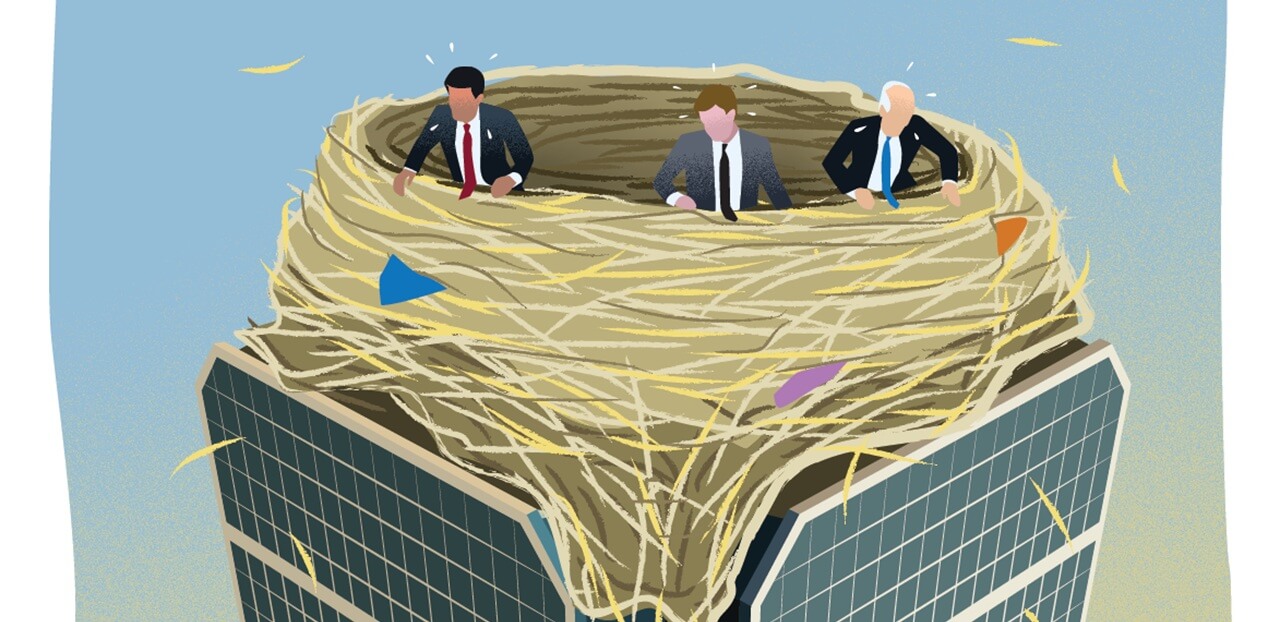
That starts, of course, with being courageous. For inspiration, I quote the last person who held up an unflattering mirror to the current president-king of the United States, calling on him to take care of immigrants and be merciful. Do you remember, the day after his inauguration – Bishop Mariann Budde? In her book ‘How we learn to be brave: Decisive moments in life and faith,’ she states: ‘The journey begins long before we take the first step, with an inner urge, an event that sets everything in motion, or an invitation that takes us by surprise. We feel called to transcend the boundaries of life as we know it. There is almost always resistance, and if not from ourselves, then it comes from those who want us to stay where we are. Complete willingness is rare. Like young birds that need to be pushed from the nest, we often do not know we have wings until we are forced to fly...’
Anyone who calls themselves a leader knows that our wings exist. They also know what wings look like and how to spread them. Every leader can set the example. It is empowering, so leave the warm nest, be born again, and fly!
I asked my new best friend how to get started. Two seconds later, I received the following response: ‘Today, talk to someone about a difficult task or decision you both feel coming up – and start with 'what is holding you back?' Listen and build motivation, clarity, and trust from there.
I wish you all the best!
This essay is a transcript of the spoken word column that Jeroen Smit presented during the closing event of In-Depth Governance on May 15th.