
Raymond van Eck (Fairphone): ‘We are done being the exception’
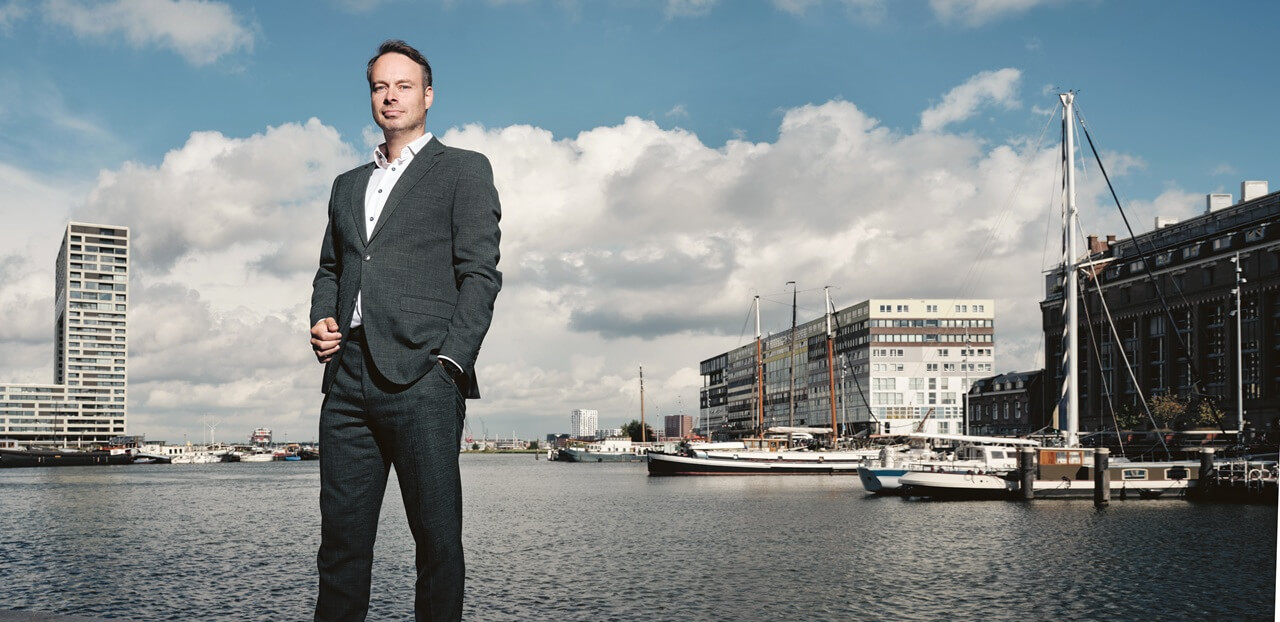
The conversation takes place at Fairphone's headquarters in Amsterdam, in a meeting room with a spectacular view of the Houthavens along the IJ River in the Western Port Area. Raymond van Eck, CEO of Fairphone since August 2024, has just held his weekly ‘bulletin’ prior to the photo session. ‘We update everyone on how the company is doing and what we are working on. Transparency, both externally and internally, is one of our core values.’
He places his Fairphone Gen 6 on the table in front of him: flatter, more compact, lighter, and more sustainable than its five predecessors and, according to Van Eck, ‘a perfect alternative’ to smartphones from other manufacturers. ‘Many people associate sustainability with making concessions. We want to show that this does not have to be the case.’
Van Eck briefly outlines the development of Fairphone, which started in 2010 as an awareness campaign with the aim of highlighting the abuses in the mining for and production of smartphones. When that did not yield satisfactory results, Fairphone founder Bas van Abel in no time raised enough money through crowdfunding to create his own sustainable and fair smartphone. Since that first Fairphone, investments have been made in the modularity and repairability of devices, in extending their lifespan through software support, in promoting living wages and better working conditions in factories and mines of suppliers, and in creating a positive impact throughout the supply chain. An annual Impact Report reports ‘in complete transparency’ on what has been improved and what is still not possible. Van Eck: ‘In recent decades, we have taken many steps forward through learning by doing. The next step, in my view, is towards 'maturity.' If we want to show the industry that you can produce consumer electronics in an ethical way, we will have to prove that you can be successful in doing so. That means we now have to take commercial steps to achieve some serious scale, because we operate in an economy of scale. People often think that the slightly higher cost of our phones is due to a sustainability premium. In reality, you spend a few tens of dollars extra per device for fair materials and normal payment. The majority of the price is determined by scale. The more devices you sell, the lower the fixed costs per device and the better the conditions at suppliers.’
How do you prevent scaling up from leading to concessions on Fairphone's values?
‘By always putting the mission first. This implies that you have to drive both agendas - company growth and product development, for example, towards even more fair materials and lower energy consumption – at the same time. We will never pursue growth for the sake of growth, thereby abandoning our values. We want to be an example of how you can successfully run a company in which taking impact into account is perfectly normal. Responsible scaling also means that we do not rush into other geographical areas. Our core markets are currently Germany, the Netherlands, the United Kingdom, and France, and we supply a total of fourteen European countries. Of course, it is our aspiration to also sell outside Europe, and we regularly receive inquiries from the US or India, for example, where we have many followers on social media, asking when we will be coming their way. So there is interest, but if we take a big leap at once instead of tackling it step by step, we may end up in uncharted waters and take on too much risk.’
Have you seen a shift in employers' willingness to choose your product and bear the additional costs in recent years?
‘We made significant strides in the B2B market last year. This is driven in part by the European CSRD directive, which is pushing companies to look more closely at how they can further integrate sustainability. At the same time, we are seeing growing interest among employees, in line with the desire to electrify their vehicle fleet, for example. Another interesting trigger for companies is total cost of ownership. If you can keep phones in your fleet longer thanks to our software support, you will have substantially lower costs in the long run than if you have to give your employees a new Samsung every two or three years – even if they may be slightly cheaper to purchase. Of all smartphone repairs, 70 percent involve the screen. With us, you can install a new screen yourself for less than 90 euros without losing the warranty. That also saves costs, which is attractive to companies. Of course, most important is that we now have a device that can perfectly deliver everything a company or government needs.’
Your story is somewhat similar to that of Tony's Chocolonely, which also started as a campaign but ultimately had a significant impact on the entire sector. How do you, as a relatively small player, try to make an impact?
‘I think our impact far exceeds our size. For example, Bas van Abel was one of the driving forces behind the right to repair movement in Europe, which ultimately led to the European Right to Repair legislation. In 2021, we co-founded the Fair Cobalt Alliance, an initiative dedicated to improving living conditions and creating fair, safe, and formal small-scale cobalt mining in the Democratic Republic of Congo. Many players in the chain have since joined. And in 2022, we were the first company to purchase fairmined credits, a Bolivian initiative that supports the artisanal and small-scale gold sector by paying a fair price for their gold, enabling them to invest in better working conditions and environmental protection.’
Do you also have influence on Apple, Samsung, and other major players? Do you see them moving in your direction?
‘Let me put it differently. We are definitely being seen and noticed, and we hope that we are setting something in motion. I do see our competitors taking steps, if only because legislation and regulations require them to do so. Whether they truly embrace sustainability, I dare not say. They all have ample space to do more. For example, Apple and Samsung - unlike Tesla and Glencore, for example - are not yet members of the Fair Cobalt Alliance. That shows that there are still significant opportunities.’
Yet, do you expect the Samsungs and Apples to shift further towards Fairphone? And what would that mean for your competitive position?
‘I hope they make a complete shift, because it is our mission to bring the industry with us. Elements of our proposition are already being adopted. For example, HDM has launched a partially modular design, Apple is doing a number of things with recycling, and software support is slowly starting to emerge. That is all very good, but it also means we cannot sit back and relax. Even though we still have a head start, it is difficult for consumers outside the industry to see why one is better than the other. So we need to think about how we can continue to differentiate ourselves. We are currently doing this with Fairphone Moments, a sliding button on the side of the Fairphone Gen 6 that allows you to switch directly to a minimalist digital mode to limit distractions. In this way, we are trying to position ourselves as slightly more distinctive each time.’
Speaking of distraction, do smartphone manufacturers, and Fairphone in particular, have a responsibility when it comes to the responsible use of smartphone?
‘Of course, as a hardware manufacturer, we have a responsibility, but it is truly a systemic challenge: a shared responsibility for manufacturers, government, parents, schools, and software developers. Behavioral change starts with parents. They live the example for what their child does. If I am constantly looking at my phone at the table during dinner or if there is a constant pinging when I am talking to my children, I have no argument to keep them away from that screen. It is precisely because we know how addictive it is that we developed the Moments button. If it makes you more conscious of how you use your phone, hopefully that will have a spillover effect on how your children use theirs.
At the same time, you cannot only look at parents. The government should be far more stringent and not just produce guidelines and advice. I think an Australian ban on social media for children under sixteen is excellent. And last but not least, we also need to look at the app developers. My daughter, who is almost thirteen and creates makeup tutorials for a dozen or so followers, received a package of products from a makeup brand to try out... apparently they were able to track down her home address. That really frightens me.’
Early smartphones were mainly stand-alone devices. With the rise of cloud technology, social media, and AI, they have become more of a carrier of functionalities offered by third parties. As a smaller player in this extensive tech world, can you still have an impact?
‘Between 1.3 and 1.5 billion devices are produced each year, and there are more smartphones on this planet than people. When you realize that many people still do not have access to this technology, you also know that everyone has one or two outdated or broken devices lying around in their drawer or has simply thrown away their old devices. So there is still a real impact to be made in how we produce, use, and recycle those devices. When it comes to the CO2 footprint - which is enormous for data centers - we can play a role by making things more efficient and not necessarily always offering more services. Another issue surrounding data is privacy. Our phones are delivered without bloatware, software without any function that manufacturers, providers, or software suppliers install on a new smartphone and that immediately starts tracking you. As a manufacturer, you get paid to put it on there. We do not do that because we do not want to force anything on consumers, but it is quite challenging to explain why certain apps are not included as standard. We also offer an open-source operating system, so consumers can choose what to put on it themselves. We do come with Android as standard, because otherwise you really do become a total outsider. We are over being only an exception, because, again, we want to be an example for the industry. Then you have to think about how to position your phone to be more mainstream.’
You are a small player in a competitive market and a Dutch player in an international industry. Are you able to attract enough talent?
‘In terms of size, it is indeed a David versus Goliath situation. In addition to the 140 employees in Amsterdam, we have an engineering team of eight in Taipei and four employees in China – where we manufacture – who visit factories and conduct audits. We have no problem recruiting these people. Our certification as a B Corp and EcoVadis Platinum company is an important driver in this regard. In general, you see that young people like to commit to companies that make an impact. In that sense, we are in a privileged position. It also ensures that everyone who works here shares the desire to challenge the smartphone industry. Of course, it is incredibly cool to be able to achieve your sales targets and show growth despite the enormous marketing power of Samsung or Apple. It is fantastic to work on the impact team and contribute to responsibly produced gold. It fulfills a need for people who think beyond their own business operations. We have around thirty nationalities working here, including people from Iran, Israel, Russia, India, China, and Taiwan. It energizes me that together we have managed to create a working environment in which you do not really notice geopolitical tensions. The fact that this can be perfectly normal is quite refreshing in this world where everything is under tension.’
This article was last changed on 23-09-2025