
Vincent Tuk (Eneco): ‘Data is key in this new energy world’
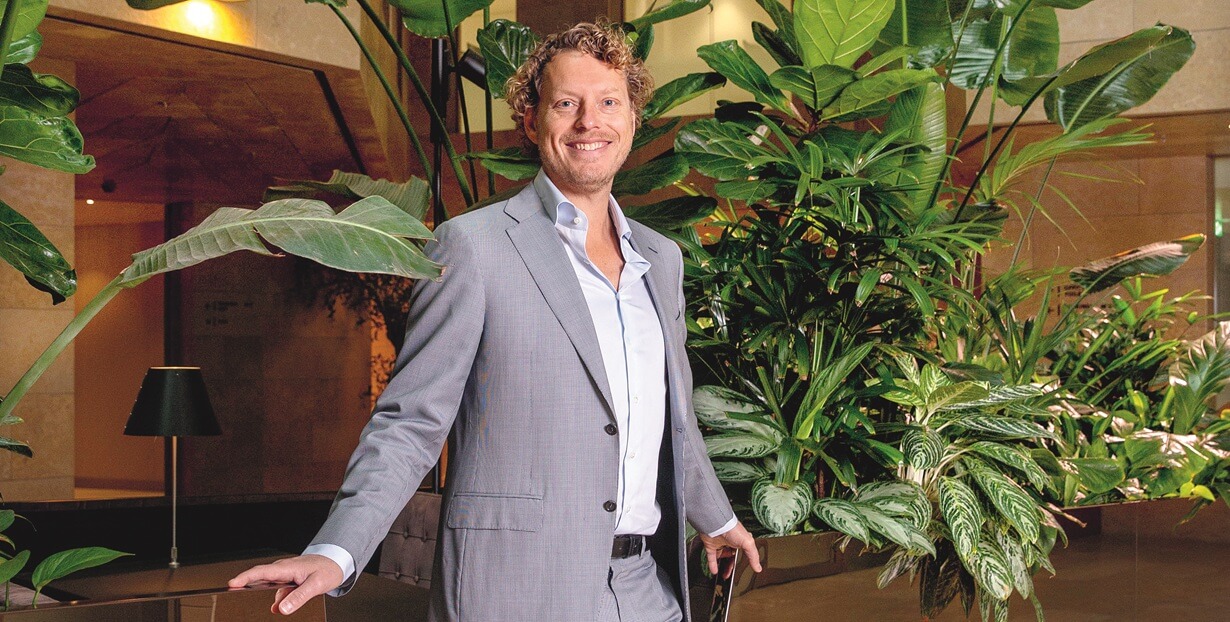
Vincent Tuk has worked in the energy sector for almost his entire career. He started at Shell (including Shell Solar), then at McKinsey, and then spent fifteen years as an independent consultant and entrepreneur in London, where he had previously relocated to for Shell. ‘I loved the city, with its energy and vibrancy, so I started my businesses there, always focused on cleantech.’
In 2011, he founded the consultancy Cleanreturns, which focused globally on electric transport, energy storage, smart energy networks, and virtual power plants (VPPs). A VPP is not a physical power plant, but an advanced digital platform that uses smart software and data to control a network of decentralized energy installations, such as wind and solar farms, battery storage systems, heat pumps and electric boilers, and smart charging stations for electric cars. In 2021, he began building a virtual power plant for Eneco, first as a consultant and since 2022 as chief technology officer. Myriad, as the platform is called, is the first large-scale operational VPP in the Netherlands, Tuk tells interviewer Niels Matthijssen, regional sales manager Benelux at Celonis.
The platform is crucial in the energy transition, according to Tuk. ‘The energy market must always be in balance. In the past, it was relatively easy to coordinate supply and demand because our behavior was fairly predictable. We all came home at five-thirty in the evening, so to speak. Now everyone has their own lifestyle, and demand is much more differentiated. Supply, in the form of wind and solar, has also become more unpredictable, and more widely distributed across the country. The VPP can be seen as a central controller that can manage supply and demand in real time. It can, for example, in the event of a power surplus, send a signal to charge batteries and electric cars, or in the event of a shortage, feed power from large batteries back into the grid, averting the need to fall back on fossil fuel power plants. This ensures flexibility, optimizes total yield and, crucially, reduces CO₂ emissions.’
Who are your most important supply chain partners in this VPP?
‘Owners of wind and solar farms other than our own, manufacturers of control equipment for batteries and wind farms that we control, such as Envitron, and suppliers of home batteries such as Sessy. And, of course, partners in connectivity, such as telecom companies. Furthermore, companies and households that connect their assets, such as large batteries, charging stations, or solar roofs, and receive compensation or a lower energy contract in exchange for the flexibility they offer. This spreading of data flows across tens of thousands of assets throughout the country also entails risks. That is why software companies such as Microsoft are important partners for us when it comes to cybersecurity and data protection.’
You got involved in sustainable energy early on. Looking back at the developments of the past twenty-five years, where are we now?
‘When I worked at Shell Solar in 2000 and they wanted to invest a billion dollars a year in renewables, that was an enormous sum of money given the limited investment opportunities at the time. Now, clean energy is a gigantic global market. The transition happened in waves, at times slower and then again with enormous leaps forward. Sometimes thanks to new legislation such as the net metering scheme, sometimes due to technological innovations, and sometimes due to new business models such as solar roof leasing in the US. People used to think that it would take much longer for solar energy to become profitable, but when China suddenly made panels fifty to seventy percent cheaper, that market became massive. Pioneering companies can also force a breakthrough, as Elon Musk did with Tesla for electric vehicles.
Looking back, we never imagined that there would already be countries that on some days get half or even almost all of their electricity from renewable sources, or that we would now sometimes have a surplus of sustainable energy and have to find ways to use it wisely. Batteries could be the major breakthrough in this regard. At the moment, the returns for offshore wind are not that attractive, but I am sure someone will develop efficient turbines that will get things moving again and that market conditions will also improve. All in all, we are now at a point where we are doing things that we could only dream of ten years ago. Changing legislation or geopolitical developments will slow things down from time to time, but the trend is clear, and the business models always manage to fall into place in the end. As a company, you therefore have to believe in the long term. The current energy market offers enormous opportunities. The tricky part is to choose what you truly want to excel in.’
What does Eneco truly want to excel in?
‘We prioritize based on our One Planet Plan strategy, with the main ambition to be climate neutral by 2035, both in our own activities and in the energy we supply to customers. This is the guiding principle behind all the decisions we make. Increasing the flexibility of the energy system is one of our priorities. Eneco wants to be the leading player in Europe in this so-called flex market. That is why we built the VPP, which we also want to market outside the Netherlands with our trading team. This includes helping customers switch to alternatives to natural gas by developing the best tech-enabled products. Where full electrification is not possible due to network limitations, you can often get more out of an existing connection than you think, for example by better managing the energy flow. Data plays a key role in this. Without data, you cannot do much in this new energy world.’
Is Eneco not more of a tech company than an energy company now?
‘We are a customer-first, tech-first energy company. Technology is becoming increasingly important, and our non-technicians need to be equally aware of the possibilities of data and artificial intelligence. We have deliberately integrated our tech team fully with our business people. Together, they work in multidisciplinary teams across value chains such as consumer, business, heat, and assets. In customer service, for example, we are using advanced machine learning to segment the customer portfolio even more effectively so that we can bring the right offer to the right customer at the right time. That has the potential to be of considerable value for us. Customer service needs an engineer to build the right programs for them, but they need to be on the same page.
Working with autonomous teams in value chains has been a truly important transition. To make technology accessible to everyone, we have also put far more focus on developing long-lived products and platforms that can solve structural problems in the energy transition. These customers can be internal or external. For example, we create products that enable traders to improve their work, but we also build platforms that give consumers more insight into their energy consumption, so we can then advise them on possible steps in their sustainability journey. The starting point is always: what problem are we solving for the end consumer? Then you place the right talent around that.’
You need a lot of tech talent. How do you attract that, given the competition in this sector?
‘We are working very hard on that, and it takes time. Being tech-first and consciously building a true engineering culture with projects like the VPP or twin platforms plays a major role. But the way we do that also appeals to talent: establishing a strong product management system and actively involving engineers in the problems we want to solve. The fact that talent is even considering us is due to our focus on the climate. They are a pretty demanding group and want everything to be the right fit. Attracting talent is already much easier than when I started three years ago, because we now have several excellent people in-house whom we encourage to go to conferences and training courses to share our story. Technicians get excited when they can learn, so it helps if you have skilled professionals on board. Talent attracts talent.’
Given the importance of data to Eneco, how do you ensure that it is reliable and available at the right time?
‘What you still often see in organizations is that a dataset is thrown into a database, and then a whole project has to be set up to remove incorrect, incomplete, inconsistent, or duplicate data. That is a disaster and completely inefficient. Our starting point is that data must be of high quality from the outset, that it must be available to everyone, and that everyone knows what that data means. You do not want to have to call around first to get clarity on your data. Reliable, high-quality data can only be obtained by building quality tests into the source, i.e. the programming code. If something goes wrong, it must be detected automatically. This is the exact opposite of first producing data and then checking it. We are extremely strict about that.’
A recent study by the Massachusetts Institute of Technology states that ninety-five percent of GenAI projects fail despite enormous investments. Only five percent are said to lead to rapid revenue growth, while the vast majority have no measurable effect. How do you see the role of genAI within Eneco?
‘That is, of course, only one report ... For us, machine learning is particularly crucial right now; that is where we, as an integrated energy company, see the most value. We apply it deeply in all processes, from trading to customer value management. We have set up a strong data engineering and data science team of over a hundred people for this purpose. GenAI potentially offers huge potential. Within Eneco, we use it mainly in customer experience and software development. We are also looking at processes such as applying for permits and how we can improve our tone of voice with customers, as genAI excels at that. At group level, we are exploring other possibilities, but we are convinced that genAI only really delivers results if you are prepared to completely overhaul your business processes. I am not interested in reducing a few FTEs by doing one or two things more efficiently. It has to be about real benefits: can I structurally reduce risk with genAI? Does it help me to steer the business structurally faster in finance? Can we use genAI to help find co-workers who are a better fit with the culture and have the necessary skills, and therefore stay longer? If you can get people to stay an average of a year longer or keep them more motivated, this has immense valuable for us, but then you have to do more than just automatically screen resumes. With genAI, we really need to look beyond the quick results to what we can and want to do fundamentally better.’
What trends in the energy market do you foresee for the future?
‘Balancing supply and demand will continue to shift from national to local: local networks, local optimization. We will be working with even more partners, and new players will join the market, for example, those with large quantities of batteries. At the same time, the integration of electricity grids and markets between countries will increase. Not only because we can benefit from it when the wind blows in Germany, but because there may be winners across the border, developing new propositions that we can use to serve larger groups of customers. Perhaps the most important change is that the prosumer, the energy-producing consumer, will soon be in the majority, meaning our customers will play an even more central role in the entire energy system. This is also one of the biggest challenges, because how do you make these customers aware of this role and how do you get them on board in the right way? We assume that most customers do not want to be kept actively busy with this. For example, they do not want to have to figure out for themselves when the best time to charge their electric car is. They expect us to arrange that, also at the best price and with the lowest CO₂ footprint. Unburdening is becoming a key word.’
You work in the field of sustainable energy. Do you also live in a fully sustainable home?
‘More and more people will soon be energy-neutral thanks to insulation, solar panels, batteries, and heat pumps. At Eneco, we see it as our role to guide customers as best we can in their choices. When my wife and I moved to the Netherlands permanently two years ago and wanted to live in Amsterdam, we chose an apartment in the old city center, which unfortunately has an energy label G. There are many such homes in the Netherlands, and insulation and double glazing are essential first steps. We have a dynamic energy contract and are aware of the times when energy is particularly sustainable. Unfortunately, things like the existing heat pumps are not yet a good solution for such homes, but we are exploring the possibilities. We have chosen not to own a car and are happy to use the electric shared cars in the neighborhood. Once we have a large battery of electric cars, we will be able to use that collective storage capacity to absorb peaks and troughs in the supply of sustainable energy, thereby increasing the reliability of the grid. If homes start using primarily their own electricity in future, there will be more available for everyone.’
Interview by Niels Mathijssen, regional sales manager Benelux bij Celonis. Published in Management Scope 10 2025.
This article was last changed on 18-11-2025