
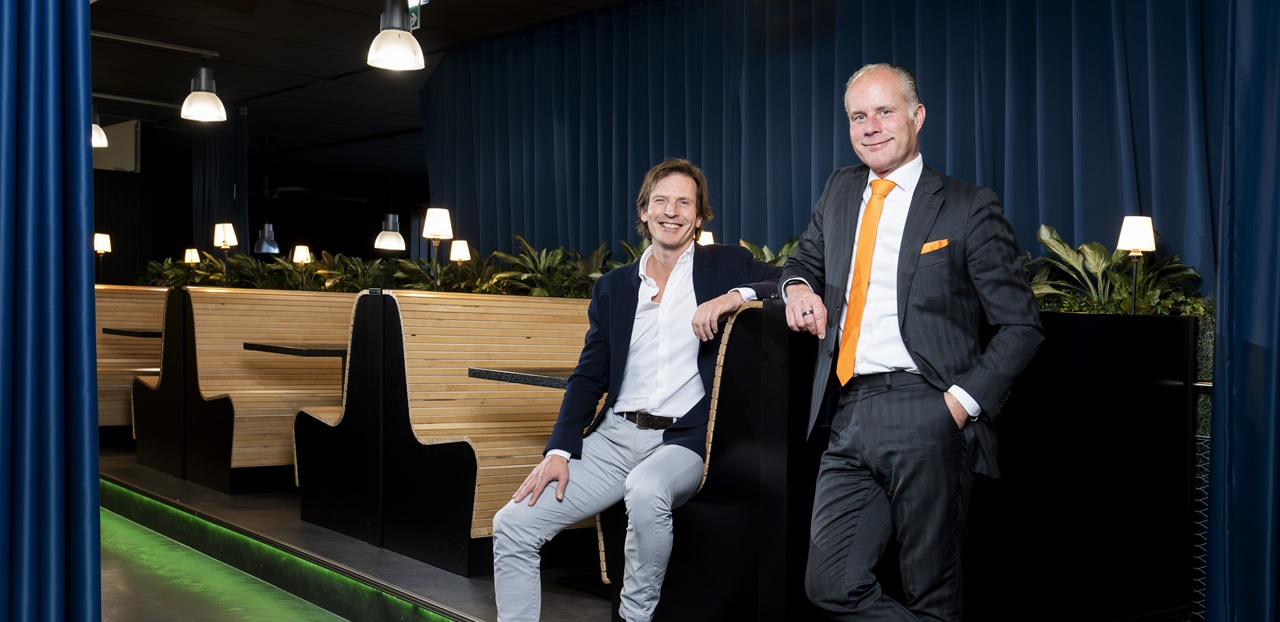
Siete Hamminga and Guus Verhees on Robin Radar's scale-up journey
Robin Radar Systems, based in The Hague, is a global player in precision radar. The company originated as a project within the TNO research organization for the Dutch Air Force. It developed sophisticated avian radar systems. Where birds were too small for conventional radar systems, Robin Radar could detect bird intensity and analyze and predict their flight movements in real time. This is ideal for airports that want to avoid aircraft colliding with flocks of birds. Robin Radar’s systems were also used at wind farms to protect migratory birds by temporarily shutting down turbines. The company is still involved in bird detection: ‘I measure our success not only in revenue, but also in terms of impact’, says CEO Siete Hamminga. A statue, Hamminga's ‘monument to the fallen goose’, stands prominently on display at the company’s offices. Since 2014, the company has also been making drone detection systems for dual-use applications, which can be used for both civilian and military purposes. A few months ago, Robin Radar acquired its largest radar contract yet to supply drone radars destined for Ukraine.
Today, the once-struggling Robin Radar has customers in more than twenty countries and expects to surpass the €100 million mark in revenue this year. Hamminga's company - an innovative entrepreneur who, fifteen years before the Ring video doorbell became popular, launched a smart doorbell with little success - can rightly be called a game changer. With its roots in the scientific world, it has seized the opportunity to use high-tech radar and artificial intelligence in such a way that, with the support of investor SHIFT Invest, it has grown into a profitable international company that contributes to the safety of people and animals. Guus Verhees is managing partner of SHIFT Invest, which invested in Robin Radar in 2012 and only recently exited. In a conversation with Juul Vaandrager, deputy director of the Dutch Private Equity and Venture Capital Association (NVP), Hamminga and Verhees talk about the course of their collaboration, the future, and the deep tech investment climate in the Netherlands.
The company originated at TNO, where Siete Hamminga became involved in the ‘Robin’ project in 2010. Siete, what made this TNO project, which seemed on the verge of collapse, so interesting that you went all in?
‘I had a company which aim was to accelerate innovations. I saw that large organizations, such as TNO and the European Space Agency (ESA), had difficulty to truly market brilliant ideas. When TNO's management asked me to look at the Robin project, I saw that it was a technology that solved a clear problem in the B2B market: bird strikes. I then acquired all the rights and brought three TNO people with me. The decision to focus – to phase out all my other activities and focus 100 percent on this – came after the first deal. That first order, with Hat Yai Airport and later with Schiphol, confirmed that this was a viable niche.’
Guus, what was the deciding factor in 2012 for your fund to invest in this young and risky technology?
‘The technology was unique: nowhere else in the world was there a system that could track birds in real time. We saw opportunities in both airports and ecological monitoring for wind farms. The fact that TNO had been working on this also greatly increased the credibility of the technology. We were convinced that we could bring more to the table than other investors. Our Mainport Innovation Fund – now SHIFT Invest – is supported by five strategic partners: KLM, Schiphol, Rabobank, the Netherlands Enterprise Agency (RVO), and Delft University of Technology. For Robin Radar, the link with Schiphol was particularly important, and for our fund, Schiphol's validation of Robin Radar's uniqueness was crucial. But ultimately, it is always about the people. Siete had the vision, and we also saw that he could deliver on the commercial side and the execution. That is a unique combination.’
Siete, the deal with SHIFT Invest in 2012 was a milestone, but the years that followed were financially challenging. What was that encounter with the investors like?
‘It certainly did not go well. We made losses for three years in a row – more than a million each year. At first, we thought the returns would quickly follow the investments in growth, but that did not happen. The reason was threefold. First, it was not an existing market; we had to create the market. Second, the turnaround time for deals was much longer than expected, especially with government agencies and through tenders. The air force deal, for example, took three and a half years. Thirdly, we were working with a binary model at the time: if we sold three radars, the sale was profitable; if we sold two, it was a loss. It was extremely tense. At a shareholders' meeting, I even suggested that they discuss, without me present, whether I was still the right person to steer the ship.’
To what extent did you ever see the external investors and supervisory board with investor representatives as a limitation?
‘It is a blessing and a curse. The pressure increases enormously. I experienced a lot of stress in preparing for meetings. But I can recommend it to everyone. Having a supervisory board forces you to make plans. A supervisory board provides a counterbalance: what did we agree on? Are you still on track? It keeps you on your toes. At the same time, a supervisory board is only effective if there is a relationship of trust with the entrepreneur. That is fundamental. I need to feel safe enough to say: I did not do this right, or I see a major risk here. If that trust exists, you can work together in the best interest of the company. If not, you end up with an entrepreneur who plays games to hide the failure.’
During Robin Radar's first, loss-making years, the shareholders maintained confidence in the company and in Siete as CEO. Guus, can you explain that?
‘Of course, we had our doubts at times. But it was always an informed decision. Thanks to our strategic connections, we knew that parties such as Schiphol Airport wanted to structurally use radar for bird movement detection. We knew that the market was small but growing, and the product was fundamentally sound and affordable. What was crucial was Siete's openness. When he asked if he was still the right man for the job, we knew that if anyone could do it, it was him. That support was necessary, because the alternative was to liquidate the company prematurely.’
During that loss-making pioneering phase, Robin Radar made a risky decision: to invest in a new product segment. Siete, you decided to raise additional funds to develop drone radars. What was the deciding factor?
‘We already knew that drones would become a growth market, with all kinds of very different applications. Our new technology would be able to distinguish between birds and drones by looking at the micro-Doppler, speed differences within the same object, which makes the rotor blades of a drone visible. Although the aviation sector initially said, 'If we are not allowed to shoot drones out of the air anyway, what is the point of detection?', we knew the danger was real. The Gatwick incident in 2018, when drones shut down the airport near London for three days, costing tens of millions, proved the urgency. That was the turning point; that was when people understood that the operations stop when there is a drone in the airspace.’
SHIFT Invest is an impact investor. How does that fit with investing in Robin Radar, which partly develops military applications?
‘The impact case is twofold. Initially, the focus was on safety, protecting people in aviation, and nature, monitoring bird migration and protecting birds at wind farms. At the time of the investment in 2012, we had agreed on a clear impact policy. This policy has always been a priority for management and the supervisory board. The context has since changed significantly with dual use. But Robin Radar makes it clear that defensive technology brings safety – not only for critical infrastructure and airline passengers, but now also directly for people in conflict zones. A textbook example of how technology can contribute to peace and security.’
The war in Ukraine caused a spike in demand for drone detectors. Siete, what impact did this have and how are you scaling up?
‘The timing was bizarre. Two weeks before the Russian invasion I had already pitched to the Chief of Defence that we should supply drone radars. Then, in 2023, we won the largest radar contract in our history to supply drone radars to the Dutch Ministry of Defence, which were donated to Ukraine. In the early years, we produced twenty radars a year; now we produce six a week. Our maturity and the enormous demand converged. The key question now is: is this a temporary peak, the new normal, or perhaps just the beginning of enormous growth? We cannot look further than six months ahead for our defense contracts. That is why we are now focusing on adaptability and diversification.’
What does that mean?
‘As mentioned, we've gone from producing around twenty radars a year to six per week. This requires an agile organization – a strong core with a flexible shell. We closely involve the supply chain in our plans, so we can deliver extremely quickly – because we sometimes have to deliver twice as many radars as budgeted. At the same time, we are trying to limit our dependence on conflict-related revenue – we do not want to be dependent on the Ministry of Defence. That is why we are opting for geographical expansion. We are fully committed to the US and have opened an office in Washington. We are also focusing on product diversification. We are focusing more on the security market: prisons, nuclear power plants, border security, and airports. This will give us a balanced revenue model.’
SHIFT Invest recently exited. Siete, how do you, as an entrepreneur, ensure that the party acquiring a selling investor's stake is also a good fit for the company?
‘I wanted to prevent shareholders from selling off 'bits and pieces' on their own to parties that do not add value. As a management team, we established criteria that were important to us, such as corporate culture and autonomy in the Netherlands. That really kept me awake at night. I would hate to see the company stripped down by a foreign player or by a buyer who drives people away from this company. I truly hope the company continues to exist even after I leave. That is why we collectively decided to look for a partner that could buy everyone out and help the company enter the next phase – not so much for capital, but for strategic added value. In other words: a partner with sufficient resources for major investments – such as local production in the US – and who shares our values. Fortunately, we found one.’
Siete, how does the government influence the growth of deep tech scale-ups in the Netherlands?
‘The government plays an indispensable role. The knowledge of TNO – with two decades of expertise – formed the basis. Subsidy instruments such as the Innovation Credit from the Netherlands Enterprise Agency (RVO) were incredibly important in the pre-seed phase. I prefer customers to subsidies, but the government also helped as a launching customer, which gave us enormous credibility abroad. The Dutch Commissariat for Military Production (CMP) introduced us to American giants such as Boeing, which became the launching customer for our bird radar in America.’
What can the Netherlands do better to help deep tech scale-ups grow?
Hamminga: ‘If the government is truly serious about scaling up the Dutch defense industry, we need a long-term perspective. We need long-term contracts, from three to five years. That is the only way we can invest sustainably in scaling up capacity, attracting talent, and at the same time getting the price down. In 2022, the defense industry was not ready for peak demand; I told the ministers that we need contracts to be able to scale up.’
Verhees: ‘Exactly. And to allow companies like Robin Radar to scale up, VC funds in the Netherlands need to grow, and pension funds need to be persuaded to see deep tech and impact as important segments. This will not be possible without government assistance, although, the government should provide support, not intervene.’
What advice would you give entrepreneurs and investors?
Hamminga: ‘My appeal to other entrepreneurs is to dare to build something that makes the world a better place. Focus on sustainable value, not just quick profits. Culture eats strategy for breakfast: company culture is crucial for future success. The basis is trust: within the company, between employees, and in cooperation with shareholders and supervisory board members. As an entrepreneur, I must be honest and open, and the supervisory board must create a safe environment in which that vulnerability can exist.’
Verhees: ‘My general appeal is that we need to look at risk differently. In this day and age, it is important to dare to take risks and accept that things will go wrong. That is part of innovation. We are often still too risk-averse in the Netherlands. Furthermore, my appeal to investors is to be patient. Innovation, especially in deep tech, takes time. The core of every company is its culture and people. If you invest in the team, you get something back that is bigger than just financial returns. Robin Radar shows that profitability and purpose go hand in hand – provided you have the patience and vision.’
Interview by Juul Vaandrager, deputy director of the Dutch Association of Private Equity Firms (NVP). Published in Management Scope 10 2025.
This article was last changed on 18-11-2025