
Rutger van der Leeuw (Enexis): ‘More copper in the ground is not the solution’
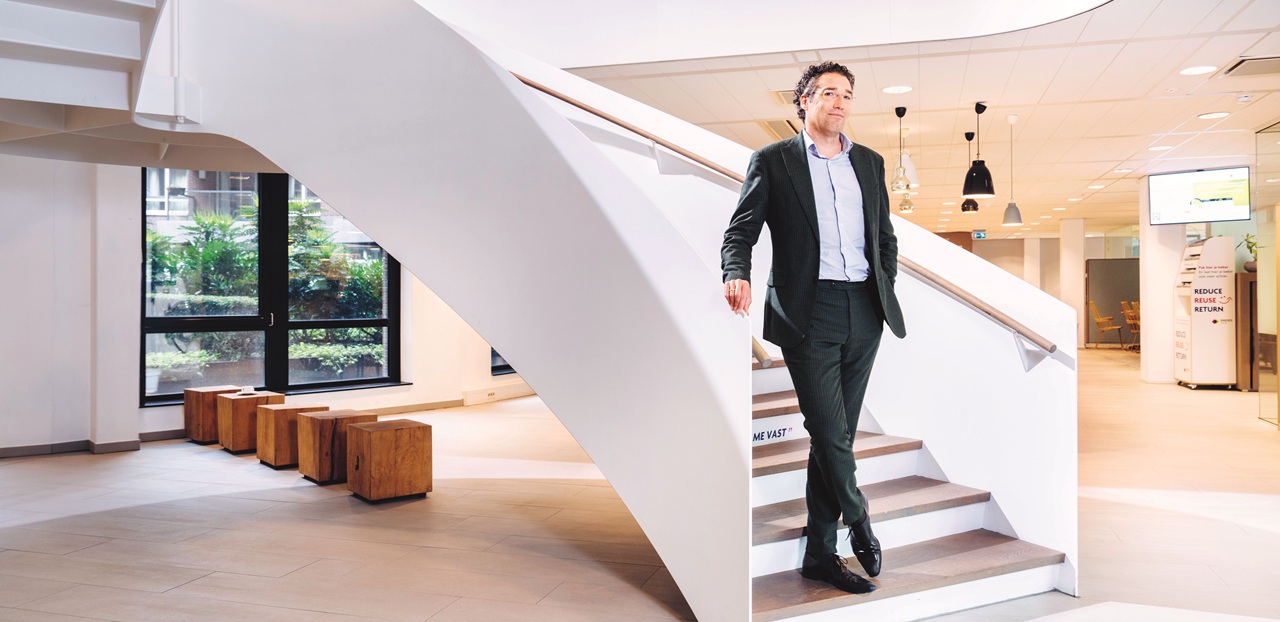
Rutger van der Leeuw greets his visitors with an outstretched hand in the Enexis boardroom in 's-Hertogenbosch, in the Dutch province of North-Brabant. Over the next hour, he talks enthusiastically about the challenges of the energy market, the growing demand for electricity and gas, accelerating the transition to sustainability, and the vulnerability of infrastructure. Since being promoted from operational director to CEO two years ago, Van der Leeuw has been ultimately responsible for decisions that will have a long-term impact. To keep the service area in the provinces of Groningen, Drenthe, Overijssel, North Brabant, and Limburg running, enormous investments are required. He balances his public role with the daily management of a company with 5,700 employees: a delicate combination of social and business objectives. While industrial applications such as AI, data servers, batteries, and cooling systems are driving up energy demand, they also face the seemingly simple task of keeping the lights on in private homes, he assures us. He is calling on the national government for upscaling and ensuring reliable supply.
The energy transition has significantly changed the role of the grid operator. When you joined the company thirteen years ago, Enexis was still a management organization; now you are in the spotlight. What expectations does that bring?
‘Our role has indeed changed, and there is much more pressure. We used to operate quietly, which was in keeping the nature of our work: our infrastructure is literally underground. Now we are in the spotlight because we are a key player in the success of the energy transition. Of course, our core task remains managing gas and electricity – and we want to continue doing that reliably, solidly, and in the background – but added to this is that we now need to be more vocal about the new energy system, which we will, after all, be helping to design. We are a major construction partner that directs environmental processes and who is called on to provide solutions for the optimal use of the network.
We cannot achieve this by simply putting more copper in the ground; the energy issue has become too complex for that. It is my job as CEO to make clear where we want to go, what we need to achieve this, and who we are going to do it with: shareholders, suppliers, and citizens. Energy concerns everyone. We all have a role to, in solidarity, play in the responsible and supportive use of gas and electricity. The fact that the light turns on when you press a button is not as self-evident as we think.’
All eyes are on you as manager of one of the six grid operators in the Netherlands. How do you experience that pressure?
‘As a healthy tension. When I started at Enexis thirteen years ago, grid management was less exciting. The turning point came with the Paris Climate Agreement in 2015. Since then, everything has accelerated. Attention to nitrogen and carbon emissions has grown. In ten years, the number of solar panels on homes increased by a factor of fourteen. Electric cars became commonplace. And since the war in Ukraine, complex factors such as safety, security of supply, and rising costs of increasingly scarce raw materials have emerged. We no longer want to be dependent on gas and oil from Russia or the United States.
It is my job to ensure that social pressure gets reflected proportionately in the organization. We should not be paralyzed by stress. That is why I always go back to basics and keep repeating our objectives: why do we do what we do and what is your role in it? Employees should know that they matter and that they have a tangible contribution to make to the energy transition. I do not take their commitment for granted. And because we gain new employees every year who are not yet familiar with our objectives, I keep reiterating these, so they too quickly become involved in our mission.’
Construction, grid congestion, safety, and resilience require a healthy balance. How do you achieve that?
‘It is a continuous process of weighing things up. As I said: communicating enough, making it clear what we want to achieve. Weighing the pros and cons. What really helps is that we have invested in leadership and an inclusive composition of our company. This allows us to examine complex problems from different angles. Of course, it would be easier to have a team of like-minded people who all agree with each other, but then you end up with suboptimal solutions. We have exceptionally loyal employees. The fact that we are a utility company with a social mission attracts people with a sense of duty and a willingness to work for the common good.’
Energy suppliers must treat all households and businesses equally. In practice, grids that have a major economic or social impact are given priority. How are those choices made?
‘Enexis has three million residential consumers and 200,000 large business connections. We adhere to the Netherlands Authority for Consumers and Markets (ACM) prioritization framework, which determines which projects are given priority for connection in the event of grid congestion. The potential lies with these large consumers. For now, they are reluctant to adopt flexible contracts, storage, and peak spreading. Installers also lack the necessary knowledge. There are good examples, particularly in the food industry and manufacturing companies. Did you know that if all existing large consumers surrender three to five percent of their capacity, the entire waiting list would be cleared?
The problem is that as scarcity increases, consumers are less inclined to give away a portion of their capacity. Energy hubs are an option, but they are very complex to implement. Participants are afraid there will be no fair distribution if one of the partners goes bankrupt or suddenly needs much more energy than they do.
What could work is to agree in advance that one of the participants in a hub will purchase more energy on a structural basis. Even better is to have companies with completely different profiles work together in a hub. Think of a transport company that runs buses at night and a factory that operates during the day.’
Construction can meet the growing need for energy: building additional transformer substations, laying cables and pipes. But in the Netherlands, we lack the space, people, and materials. Construction is also a politically sensitive issue, given the nitrogen debate. Is a breakthrough still possible?
‘Construction is mainly held up by land acquisition and the permit process. It would really help if there were a nitrogen exemption and permit applications and objections took less time. We apply for 80,000 permits annually. Permit rounds for large medium- and high-voltage substations take the longest: five to seven years. Hopefully, the new cabinet will deliver a stable policy that addresses the regulatory burden and eliminates time-consuming procedures. We also need clarity on difficult issues such as the net metering scheme and the nitrogen issue. As long as there is no clarity, we are stuck in a vicious cycle. After all, as long as we cannot build, factories cannot become sustainable – and nitrogen levels will remain high. We are now focusing on the flexible use of the existing grid. Every year, we draw up a ten-year plan. After two years, we can see the first effects of this. We have agreed with large industrial customers that they will share their plans with us so that we do not make unnecessary connections.’
The International Energy Agency estimates that electricity demand will grow by four percent annually until 2027. Enexis will invest over €3 billion in the expansion of electricity grids over the next three years. Is that enough? And will there come a time when you can scale back the investments?
‘I think so. We are now preparing for the future, expecting to recoup our investments in thirty to forty years. Building a future-proof energy network is a complex undertaking. Over the past 120 years, Enexis has built a ten-gigawatt network. We are now adding 1.5 gigawatts each year. So, we are doubling what we have built up in 120 years in just six years. Synchronizing all processes across the entire supply chain is extremely intensive and requires long-term planning. This is hampered by the ever-changing demands of the outside world. It is our job to be flexible at the front end, but to keep things as calm as possible at the back end. The work of our technicians, engineers, and contractors must remain plannable and predictable. That interface between internal and external sources requires continuous coordination. A certain level of predictability in government policy is therefore essential.’
How do you ensure a good balance between growth and return?
‘The challenge is that energy demand is growing faster than we can keep up with. This means we cannot reduce the shortage, and the pressure is mounting. That can be frustrating at times. We grow at double digits every year, but the queue of large business customers has grown even longer. Nevertheless, there will come a day when we close that gap. This year, we are recording growth of thirty-seven percent, compared to twenty-six percent last year. These are growth rates that are typical of a startup. That gives us the confidence that we will eventually get there.
The key question now is how we can scale even faster. You can expand a network fivefold, but due to the enormous costs involved that is not an option. Part of it will have to be built physically, while the rest will come from flexible management with congestion management. This is doing well with consumers. Look at smart charging of electric cars outside peak hours and the growing popularity of home batteries. The government anticipates an investment requirement of €220 billion in the coming years. That amount is based on the expectation that a large portion will be met flexibly. If we want to keep the energy transition away from coal, oil, and gas, we must apply this flexibility, otherwise it will easily cost another €30 billion. An offshore grid is also necessary. The amount of wind energy generated, thirty to forty gigawatts, is equivalent to the gas yield we used to get from Groningen. Further electrification is essential for the sustainable transition.’
In recent years, we have seen that energy infrastructure can be a target for sabotage and cybercrime. Does that keep you awake at night?
‘No, but we are vigilant. We take threats extremely seriously. We run a company with vital infrastructure. This means that geopolitical threats are high on our agenda. It is not about repairing damage after an attack – that can be fixed – but about prevention at the source. We have invested in scenarios for unsafe situations and simulations of malfunctions. The level of cybersecurity has increased dramatically. The tricky thing about a cyberattack is that you do not know who you are up against. For physical sabotage, we have created a triage system based on the most vulnerable locations of 200,000 assets, such as switch boxes and high-voltage substations. Energy has become so self-evident that we no longer expect power outages. That places a great responsibility on our shoulders.’
You played a leading role in expanding Enexis's grid capacity and are facing potentially even greater challenges. How will you look back on this period in fifteen years?
‘I will look back on a dynamic time. In the previous years, little happened, and now everything happened in one to two years – and simultaneously. In fifteen years, we will still be benefitting from the investments we are making now. I am proud of that. The efforts for the energy transition are the Delta Works of our generation. The difference is that we are investing €226 billion, while the Delta Works cost the equivalent of €25 billion.’
Interview by Roy Seton, Partner at Deloitte. This interview was published in Management Scope 10 2025.
This article was last changed on 18-11-2025