
China’s AI ecosystem: What can Europe learn?
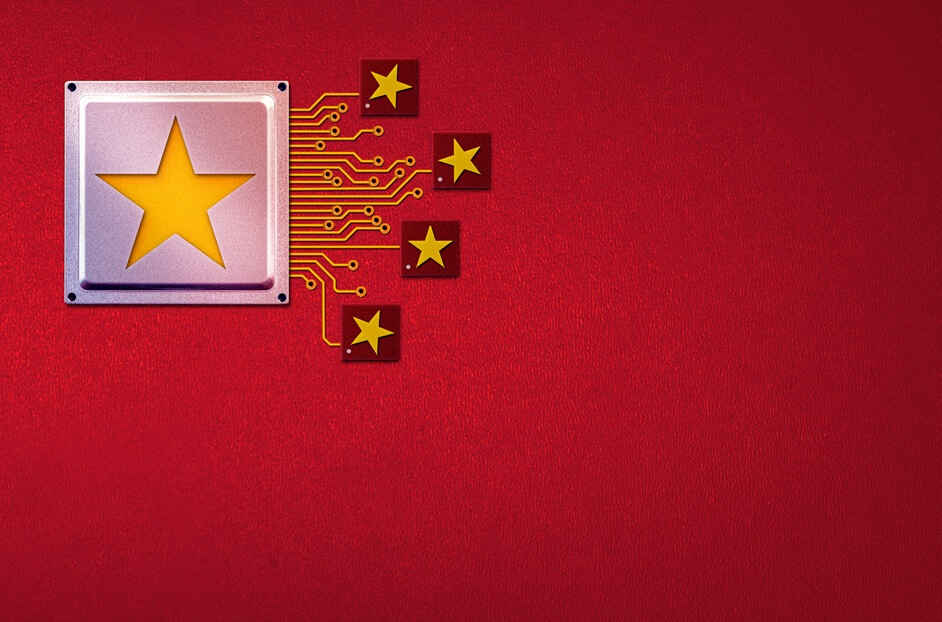
China no longer is interested in building the best AI models alone. The country is building an entire AI ecosystem. Within this ecosystem, it connects the models with large distribution networks, data, cloud infrastructure, manufacturing, and practical applications. Consider Alibaba’s e-commerce and cloud ecosystem, ByteDance with its vast reach among consumers, Tencent’s WeChat infrastructure, and the growing use of AI in factories, logistics, and vehicles. In doing so, China is developing its own approach to commercially leveraging AI. What matters here is not which model performs best. It is about how quickly intelligence can be embedded in economic activity and how that can be amplified by an AI flywheel. The lesson European businesses can draw from this is to not blindly copy China, but learn how to recognize how technology becomes more powerful when models, distribution, data, ecosystems, and speed reinforce one another.
The best model?
For years, the conversation about AI revolved around the United States. Silicon Valley built groundbreaking models, venture capital funded them, and major cloud companies provided the necessary computing power. China was generally seen as a fast follower – a perception that is increasingly outdated. Stanford’s AI Index 2026 shows that, in March 2026, the performance gap between the top American and Chinese models had shrunk to just 2.7 percent. China was ahead of the United States in terms of the number of publications, citations, patents granted, and industrial robot installations. However, US companies continued to produce more notable, groundbreaking models.
The more significant question, therefore, is not who has the best model, but rather who can translate intelligence into economic value the fastest. A model is not a revenue model – regardless of its potential. China’s distinctive strength is becoming increasingly evident in the layer surrounding the model: platforms with enormous reach, data from millions of transactions, cloud and computing infrastructure, dense production networks, and rapid cycles of experimentation and implementation.
From models to ecosystems
The AI flywheel helps explain how these components reinforce one another. Distribution drives adoption: adoption generates proprietary behavioral and operational data. That data can then be used to improve the models and agents (AI systems capable of acting autonomously). Better intelligence expands the number of applications, and successful applications, in turn, attract partners, developers, and more users. Each rotation of this flywheel amplifies the next. As AI becomes integrated into commerce, payments, logistics, social platforms, or manufacturing facilities, these economic activities provide data for learning.
Alibaba clearly demonstrates this mechanism. In April 2025, the company announced that it had made more than 200 of its Qwen language models publicly available (open source). This resulted in over 300 million downloads worldwide and more than 100,000 models derived from them.
Alibaba’s strategy goes beyond simply selling access to models. By offering models with open weight – where the model settings are public, but unlike with open source – the training data and code are not – developers and companies can download, customize, and use them. This accelerates their adoption. Alibaba, in turn, profits from cloud computing, business services, and the broader ecosystem surrounding them.
That is one of the reasons why China’s AI strategy is compelling, even if the model itself is not necessarily superior to others. Openness can, in fact, be leveraged as an ecosystem strategy. By providing a well-functioning model to many developers, the resulting applications and derivative models then reinforce each other naturally. Meanwhile, the competition shifts toward the stack surrounding it – the infrastructure and services. As a result, the nature of the competition shifts. It is no longer about owning a single model, but about participating in a much larger network.
The physical economy as a second driver
Chinese AI also stands out due to its strong connection to the physical economy. According to Stanford’s AI Index 2026, China accounted for approximately fifty-four percent of global industrial robot installations in 2024. Factories, warehouses, vehicles, and logistics networks provide environments in which AI can be tested, measured, and improved. In logistics, AI supports warehouse management, route planning, and scheduling. In financial services, AI supports fraud detection and risk assessment. In retail, AI drives product recommendations and AI-enabled sales. In manufacturing and mobility, AI is becoming increasingly intertwined with production systems and the products themselves.
This leads to faster interaction between software and the real economy. A digital platform learns from clicks. A factory learns from how often machines operate or break down, as well as from production quality. When this data is fed back into AI systems, intelligence becomes a genuine tool in business operations.
Broadly speaking, this also applies to Chinese consumer platforms. ByteDance’s Doubao had 382 million monthly active users in June 2026, Qwen had 167 million, and DeepSeek had 129 million, according to research firm QuestMobile. The specific figures are less important than the underlying mechanism: AI can be deployed on platforms with a wealth of existing consumer data and use the new insights generated to enhance that data. The lesson for companies elsewhere is that while a powerful model is valuable, access to customers is equally critical.
Generative AI is now shifting from answering questions to executing work processes. The first wave helped individual users create text, images, code, and summaries. The next wave connects AI to business processes. This will be followed by a phase featuring agents that independently use various tools, coordinate multi-step tasks, and act within defined boundaries.
A simple AI assistant can tell a manager that inventory levels are too high. An agent, by contrast, can independently check demand according to specific rules, review supplier information, prepare procurement orders, and generate or update forecasts. Only exceptions to those rules that require human judgment are referred by the agent to a human. This results in a strategic shift: AI evolves from a tool for various isolated projects to an instrument that enables continuous learning within the organization. As agents become more powerful, companies must rethink work processes, responsibilities, control mechanisms, and the division of tasks between humans and machines. China is also combining the rapid adoption of AI with official oversight: by August 2026, more than 1,100 generative AI services had been registered, while the country is simultaneously working on broader national standards for AI agents. This combination of scale and oversight is part of the ecosystem narrative.
What Europe can learn and do now
China offers Europe a practical lesson: do not aim to replicate Chinese technology, but build your own AI flywheel based on your own strengths. Build on your own capabilities. European companies possess strong brands, scientific expertise, industrial know-how, and intellectual property, and enjoy a high level of customer trust. The challenge is to connect these strengths with AI before competitors do so.
Drawing on the Chinese examples, I propose five priorities:
- Identify which advantage you want to strengthen.
First, identify the strengths that already set your company apart – customer relationships, proprietary data, intellectual property, production capacity, a strong brand, or specific expertise. Then, assess where AI can make those strengths even more valuable. - Redesign key business processes.
Focus on pricing, demand forecasting, sales, procurement, customer service, risk management, and day-to-day operations. These are areas where results can be measured based on changes in revenue, margins, working capital, customer retention, or lead times. The goal is not to make the work twenty percent faster; the goal is to structure the work differently. - Build, borrow, or collaborate strategically.
Develop your own AI in areas where it truly sets you apart. Use existing models, APIs (interfaces between software programs), and infrastructure in areas where these capabilities are available to everyone. Seek partnerships in areas where it is difficult to build distribution, specialized data, or access to local markets on your own. - Build oversight in from the very beginning.
As AI shifts from answering isolated questions to executing work processes, companies need clear rules. These include rules for data access, agent permissions, human approval, accountability, and error detection. Oversight must be built into the system from the start, instead of being added only afterwards. - Measure the flywheel, not individual activities.
The question of how many employees have tried an AI tool is not that important. What matters far more is whether AI-driven decisions lead to better business results or whether AI usage generates data that yields more valuable insights and leads to wider adoption of AI. The result is a self-reinforcing cycle in which each rotation of the flywheel leads to the next, even more valuable rotation.
In short: Europe does not need to reinvent the wheel. There is no need to create European variants of existing Chinese AI technologies. Europe should build its own flywheels around the strengths it already possesses. In other words, leverage existing AI technologies to further expand its own competitive advantages.
Essay by Bo Ji, Chief Representative, Cheung Kong Graduate School of Business Europe. Published in Management Scope 09 2026.