
Allard Castelein: ‘The path to greater resilience will be long’
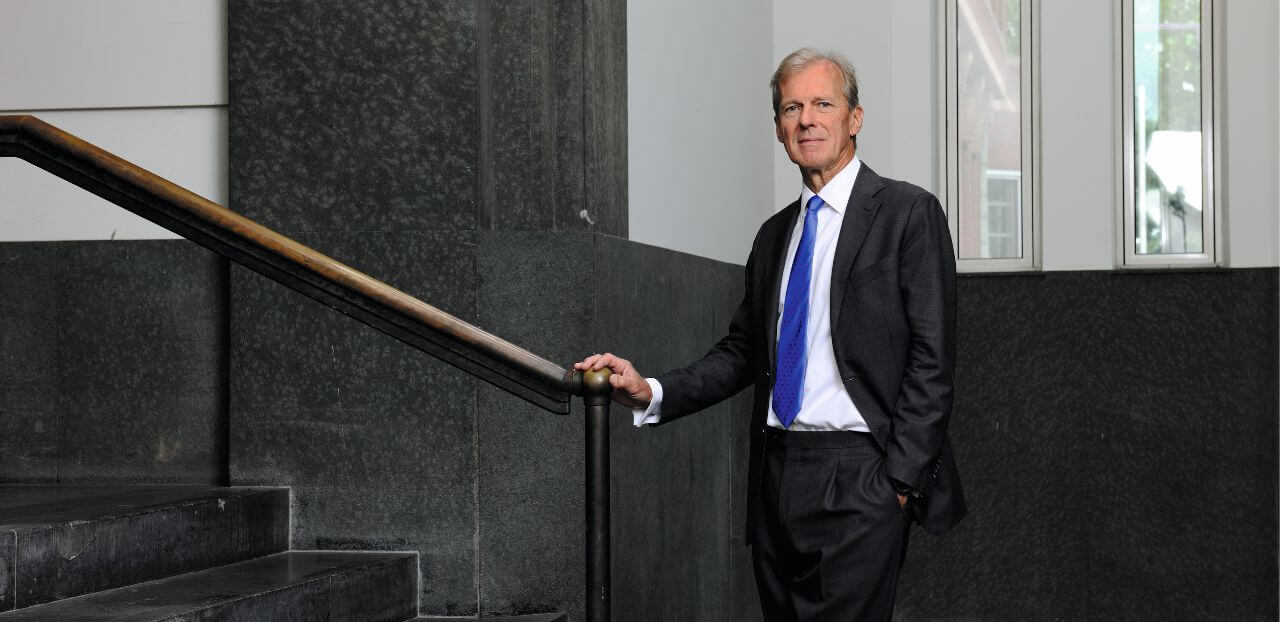
‘Resource strategist’ Allard Castelein lived in Hong Kong for some time in the early 1990s during his long career at Shell. Even then, he noticed that the Chinese were actively securing their value chains. Speaking to Charles Honée, partner at A&O Shearman, he says: ‘They have continued to do so over the past decades, while we in Europe and the Netherlands were focused on open markets, free trade, maximum efficiency, and minimal inventories. That world of lean and mean and just-in-time made sense in the context of the dismantling of trade barriers, continuous availability, and increasing mutual understanding. The result, however, is that over a period of thirty years, we have become unduly dependent on Chinese state-owned enterprises in particular, and consequently on the Chinese government, when it comes to critical raw materials.’
The successive shocks of recent years, the Covid-19 pandemic, the blockade of the Suez Canal by a stranded container ship, the Russian invasion of Ukraine, the various tariff threats by the United States, and the crisis in the Middle East, have driven home the realization that this context has changed structurally. Critical raw materials needed by the Netherlands, particularly for the energy transition, digital transition, defense, aerospace, medical equipment, and basic chemicals are, due to geopolitical developments, no longer always and readily available. And so, in March 2024, Allard Castelein, who had served as CEO of the Port of Rotterdam Authority for nearly ten years, was appointed Special Representative for the Raw Materials Strategy by the Minister of Economic Affairs. Since then, he has been advising the Dutch government on how to make supply chains more resilient. But he warns in advance that it will take quite some time before Dutch vulnerability diminishes. ‘Just as it took China a long time to achieve its current dominance, our path to building greater resilience will be a long one.’
You have been in office for over two years now. What progress has been made during that time?
‘When I started, I held numerous discussions with companies in, for example, the offshore wind turbine industry, the battery supply chain, and basic chemicals. Virtually no company appeared to have its entire value chain mapped out. Often, they did not even seem to get the problem, as all they had to do was call their supplier to get what they needed. Even on the boards I serve on, I was the one who had to kick off the discussion with questions like: how dependent are we on our suppliers? And if that supplier always reassures us, have we asked where they source their raw materials or products? You might have to ask that ‘where’ question three, four, or five times to effectively penetrate deep into the chain. Moreover, you need to gain a clear understanding of what the critical elements in that supply chain are for your company. Which raw materials or products would prevent you from completing your production process if they were unavailable?
I am now seeing progress in this area. More and more companies have started investigating this, but – and this is my caveat – often out of curiosity rather than a sense of true necessity. Although the topic is receiving increasing attention, the sense of urgency could be much greater. This applies not only to executives and supervisory board members, but also to shareholders, parliament, the government, society, and the European Union.
We have developed five strategies that will lead to greater resilience. First, it is prudent to build up a certain level of stockpile inventory. Second, we can develop specific production processes that fit well within our industrial clusters. Third, we want to encourage new mining activities with ‘friendly countries.’ In addition, we should rapidly develop our circular economy, and finally, we must continue to focus on innovation. All these initiatives require a different approach, and we are working hard on this.
However, I still often sense a lack of urgency and continue to see a desire for a non-complex environment. But unfortunately, that is no longer the reality. What is interesting is that in the United States this necessity is felt very clearly. The US government is actively investing in strengthening both domestic production of critical raw materials and projects in other countries. Together with Australia, they have committed 8.5 billion Australian dollars to strengthening the rare-earth metals supply chain and are investing billions through their Department of War (the unofficial name for the Department of Defense, ed.) in domestic processing projects. Within Europe, it was the Draghi Report, which admittedly is no longer very recent, that last highlighted just how vulnerable the situation is. So, there is a great deal of evidence, but in the European context this has as yet failed to translate sufficiently into the necessary sense of urgency.’
How do you explain that lack of a sense of urgency?
‘The free West has long been convinced that free global trade was our future. Unfortunately, we were proven wrong. In that regard, I sometimes see myself as a bit of an evangelist. I tell the story and encourage stakeholders to be aware of this. To make progress, it will help if we not only clarify what the problem is but also point out potential solutions. And we must make it clear that the situation is so complex that it cannot be solved by either the government or the private sector on its own. We are dealing with a market failure and potentially significant disruption in our economic ecosystem, and I am one hundred percent convinced that we need new forms of public-private partnerships to mitigate risks and enable progress. If we keep doing what we have always done, we will not get a different outcome.’
What might these new forms of public-private partnerships look like?
‘We will probably have to start thinking radically differently about this. The government will have to not only facilitate the private sector but also be an active player itself – at least for a period of ten to fifteen years. Due to China’s dominance in the market for critical raw materials, private investors in Europe and the Netherlands considering investing in, for example, their own processing capacity will be immediately discouraged. They know that China can easily keep the margins on such processing artificially low to wipe out the new competitor. Private parties therefore simply do not get involved. And rightly so. The government will thus have to help mitigate the risks – not to line the pockets of private shareholders, but because the perspective must genuinely be that derisking is crucial to driving this change.
There are a number of levers that can be pulled. The government can assist with financing or capital requirements. It can compensate for price differences, for example, through contracts for difference, or guarantee the purchase of raw materials. In tenders, we can work with an open book model, as is already done by Rijkswaterstaat. In this model, a company provides transparency into all costs, verified by auditors, with a pre-agreed profit margin. If the project turns out to be less expensive, the government shares in the savings. If it falls short, the government shares in the risks. This prevents the misuse of government support, while still providing companies with the necessary financial security to undertake a risky project. The right model must be developed in consultation between the government and the private sector. And, of course, funding must be allocated for this. If the government currently lacks the leeway to do so – given the current difficult political circumstances – we could ask state-owned enterprises to further develop this. Because if there is one thing that is certain: for this transformation to succeed, an intervention is necessary.’
We do not extract many raw materials in the Netherlands. How do you see Europe’s role in all of this?
‘Our role is to organize the supply chain smartly. To become less dependent, we must collaborate across borders within Europe, with other governments and with industrial clusters such as Antwerp and the Ruhr region. We must play open cards with Germany, France, and Belgium and support each other’s projects, for example through mutual purchase guarantees.
If a private investor decides to build a crucial factory in Germany’s Ruhr region, the Dutch government must be willing to contribute by guaranteeing to purchase a portion of the production. If a company chooses the Netherlands, our neighboring countries must support us in purchasing that output. That is the scale and the new dialogue that Europe needs to create an effective pushback. That is why I am in constant dialogue with these countries.’
Should geopolitical supply security become a standard audit topic, just as ESG has become in recent years?
‘Of course, there is no such thing as a sustainable business model if you cannot continue operating because your supply chain grinds to a halt. If there is a lack of liquidity or hundred percent control anywhere in the value chain, you should want to know about it and protect yourself against it. Still, I view this subject primarily through the lens of scenario planning and risk assessment. In risk management, this issue is often characterized as high impact, low probability. My message is that our ‘low probability’ is shifting toward becoming less and less improbable. It is no longer sufficient to ‘hope’ or ‘assume’. Recognize that these disruptions are structural. Given the geopolitical situation, they can and will continue to manifest themselves in the future. It is a must for boards to thoroughly examine dependencies in the supply chain. The greater the dependence, the more concerned you need to be in the current external context, and the more urgent the discussion must be regarding alternative supply routes, stockpiling, and moving away from just-in-time. This may initially seem unattractive due to the higher costs. At the same time, there are no higher costs than those incurred when you cannot deliver. That is why the context of the dialogue must also change. It is no longer just about how a company can operate optimally and as efficiently as possible, but also about how it can continue to function at all in a turbulent and disruptive world.’
Should the bonus structures and KPIs of procurement directors be redesigned to ensure that ‘supply security’ carries more weight than the lowest price?
‘In companies where I have initiated this dialogue with procurement directors, I have noticed that while this interest is often there, they lack the incentives to actually take action. It is really up to the board and the supervisory board to convey this importance, so that it can trickle down to the rest of the organization. That is why I always try to speak to the CEO first, to introduce the concept and to ensure that he or she has the full picture. And of course, you will not get anywhere if you keep evaluating your procurement manager solely on the basis of the lowest price, the most efficient transport route, or the smallest inventory levels. This will need to be managed differently, championed from the top.’
After a long career in the business world, you are now a leading figure in the government. From the perspective of that dual experience: what stands in the way of these new forms of public-private partnerships?
‘There is still too much finger-pointing and too much silo thinking. Take offshore wind projects, where in government tenders the bidder with the lowest price usually wins. Because China supplies the cheapest components, such as magnets, the system almost forces companies to choose China. We need to discuss this and perhaps come to the conclusion that wind energy can afford to be a bit more expensive if we require that magnets be made with material from countries like Japan or Korea. That must be factored into the assessment of the plans.
At the same time, I urge company boards not to be too quick to claim that something is not possible under current legislation and regulations or that it yields too little return. The circular economy in the Netherlands is currently stalling because new materials are cheaper than reuse. This needs intervention. Demonstrate concretely that waste streams can be reused and clearly specify what each party needs from the others – such as amended legislation, a temporary loan, or guarantees to cover price differences. These are the kinds of new dialogues we must dare to engage in. If you want to build resilience as a company, you quickly find yourself in the realm of logistics that are less efficient, more expensive, more complicated, and unfamiliar… Now is the time for companies and the government to jointly identify the dilemmas and to engage in dialogue with the intention of determining the most advantageous direction for the solutions.’
Will things work out?
‘I remain positive. I have conducted a great many joint venture negotiations. If you agree with the other party on the long-term vision, it generally very often is possible to reach the desired solution. When it comes to critical raw materials, there is a shared vision of that future, so that is encouraging. But at some point, funding will need to be secured, and we will have to turn resistance, suspicion, restrictive legislation and regulations, and perhaps even reluctance, into collaboration and a joint plan of action.’
You have had an interesting career path. You trained as a surgeon, worked at Shell for decades, managed one of the world’s largest ports in Rotterdam, and are now Special Representative for the Raw Materials Strategy. What is the common thread? What drives you?
‘I have a strong sense of responsibility, am deeply committed to society, and enjoy being able to make a difference. Besides that, I am not afraid of change. I recognize what needs to change, try to bring about that change, and to emerge from that process as well as possible. In doing so, I have a clear holistic goal in mind: I am always looking for the sweet spot where people, the economy, and nature come together. When change projects are truly relevant and necessary – as is the case now with critical raw materials – it energizes me. Not least because these projects are often quite complicated, and that is exactly what I enjoy.’
This interview was published in Management Scope 07 2026.
This article was last changed on 25-08-2026