
Stefan Sleijfer (Erasmus MC): ‘AI must contribute to better care’
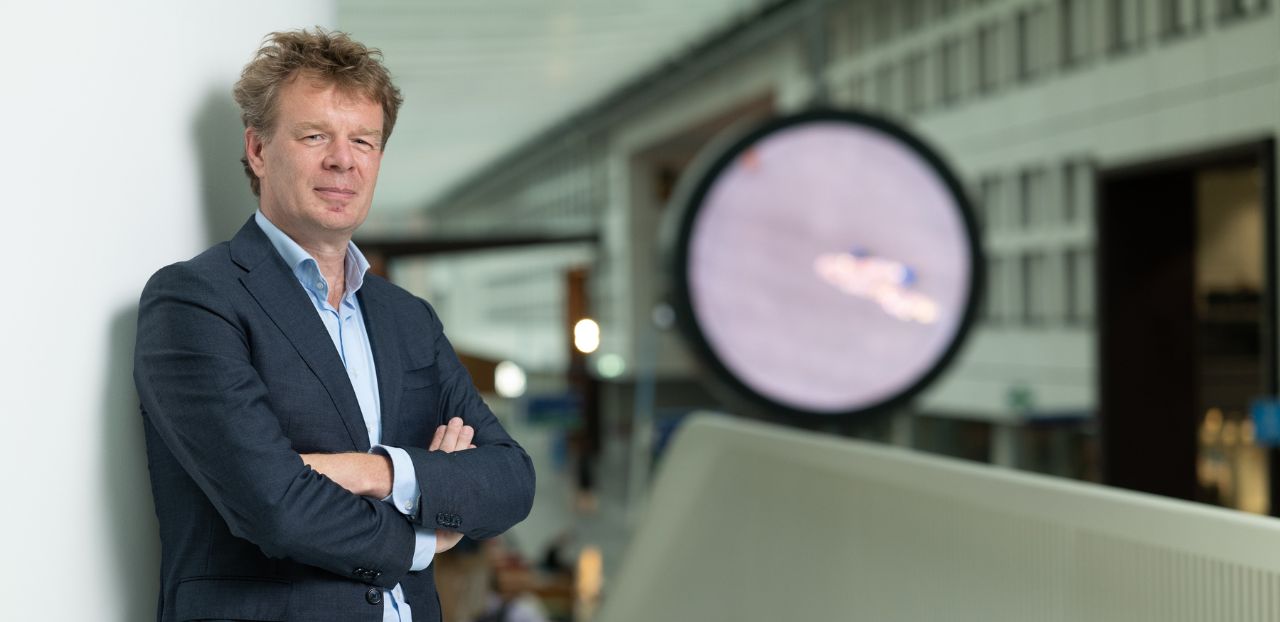
Stefan Sleijfer is a healthcare executive, but also a soccer fan. He played at the amateur level for a long time, until an Achilles tendon injury forced him into the stands. And that is where he sits whenever Feyenoord plays at home. Although a native of Groningen, he never misses a match played by the Rotterdam club. Aida Demneri, a partner at Deloitte, is sitting with Sleijfer in his office. She is fascinated by a framed Feyenoord shirt, signed by all the players. He proudly explains that he received it from a grateful patient. Only the family photo directly across from his desk occupies a more prominent spot. His partner is also a professor at Erasmus MC: she is in endocrinology, he is a medical oncologist. But while she is still involved in patient care, Stefan Sleijfer stepped away from that role five years ago when he joined the board of directors, initially as dean of the Faculty of Medicine and Health Sciences, and three months later as its chair. The major challenge facing healthcare is that public demand is set to rise in the coming years, due in part to an aging population, but the capacity of the healthcare system will not grow proportionally. As a top executive, Sleijfer is therefore tasked with addressing this ever-increasing demand for care and devising interventions to expand the system's capacity. Digital transformation is key to this, not only for Erasmus MC but for the entire healthcare sector. He is also committed to prevention, phasing out the overuse of care and ensuring the sustainable employability of staff. ‘Erasmus MC is an international leader in highly specialized care, research, and education. By raising key issues, we both shape the public agenda and aim to address the challenges involved.’
You became a doctor to make a difference in others’ lives. How do you assess the state of Dutch healthcare?
‘We can be proud of the specialized medical care in the Netherlands. In terms of quality, affordability, and accessibility, we rank remarkably high internationally. We appear in the top three of virtually all existing benchmarks. We are also remarkably efficient: we require only 221 hospital beds per 100,000 inhabitants, whereas our eastern neighbors have 760 and Belgium has 538. Only Sweden performs better, with 187 beds. That fact sometimes seems to be overlooked when looking at media reports. On the other hand, access to healthcare is under increasing pressure, and we have the highest number of nursing home beds in the EU. You also have to take into account that the willingness of the Dutch people to provide informal care is among the lowest in Europe.’
What stood out to you during your first four years on the board of the Netherlands’ largest university medical center? Do you already have an idea of where the solutions and management dilemmas lie?
‘I do not think we can speak of solutions yet, but rather of potential paths toward solutions. There are many societal issues that are as interconnected as they are diverse, but many of them affect the health of the population and, by extension, healthcare itself. Quality of housing, our living environment, climate change, and socioeconomic status all ultimately affect healthcare. We cannot reverse the aging population, which leads to greater demand for care; therefore, we are asking ourselves how people can stay healthy longer so they will not need to rely on the healthcare system – or at least as much. That is why focusing on a healthy living environment and the early detection of health issues is so important.
There is significant inequality among people, leading to health disparities – this is often painfully evident, especially in large cities. We also feel a sense of social responsibility toward the less fortunate neighborhoods of Rotterdam. There are postcode areas in Rotterdam and other major cities where people live, on average, eight years less than in other areas. Vaccination rates are low. For the HPV vaccine, which minimizes the risk of cervical cancer, the average rate in Rotterdam is only forty percent, with significant variations between different neighborhoods. Through population-based screening, we identify which lifestyle factors lead to health problems later in life. The long-running ERGO study (Erasmus Rotterdam Health Research, ed) focuses on the risk of age-related diseases, while the Generation-R study concentrates on the health of young children. Did you know that a child’s first 1,000 days are crucial for the rest of his or her life? In Generation-R, we investigate which factors influence children’s early development. Based on the insights we gain, we continuously explore interventions that give children a better start, and we incorporate those interventions into guidelines and policies once their success has been proven. We do this in collaboration with many other partners.’
Can digital transformation simplify healthcare while maintaining quality and accessibility?
‘Certainly. Much of healthcare can be organized more efficiently. Not only through the use of digital tools but also by taking a critical look at what we do in daily practice and to what extent that truly leads to better outcomes for patients. We very often repeat the same things without asking ourselves whether they add value. Take, for example, all those follow-up appointments in the five years following colorectal cancer surgery. Do we really need twelve, as we once agreed based on the understanding we had at the time? Research shows that it is safe to have fewer. That has already been incorporated into guidelines. It makes a huge difference, not only for the patient but also in terms of the strain on the healthcare system. And we are currently investigating whether check-ups that do need to be done can be performed differently or automated. This makes care even less burdensome for the patient and reduces the pressure on the healthcare system.
Due to digitization, it is possible that a healthcare provider may have to give up a degree of autonomy and has less freedom to act according to their own judgment. If you were to ask me, ‘What is a management dilemma for you?’ that would be one. Yet, as doctors, we should actually strive to make ourselves redundant. After all, we are only passing through; it is the patient’s well-being that matters.’
Erasmus MC is considered the hospital of the future. What do you mean by that?
‘Our hospital grew by providing care for complex conditions, conducting groundbreaking research, and adopting advanced technology. We are constantly exploring how we can improve care for future patients. We are building on that foundation with major investments. The Master Plan 2050, approved by the municipality, calls for Erasmus MC to expand by another 200,000 m² on top of the existing 490,000 m² we currently occupy. That space is intended for researchers and lecturers from TU Delft and Erasmus University, as well as for private-sector partners. Together, we are building a health-tech campus where scientists, doctors, students, and companies can connect. By physically bringing these parties together on the Erasmus MC campus, where care is provided and where we can offer access to many other healthcare providers, we are creating an ecosystem where innovations can be developed, tested, and implemented more quickly.’
In your opinion, what is the purpose of technology and AI: to make healthcare processes smarter and more efficient, or to fundamentally reorganize healthcare?
‘To my mind, it is an overstatement that AI will fundamentally change healthcare. Healthcare is already undergoing significant transformation due to new technologies. AI is about pattern recognition and relies on techniques we have been using for a long time, such as supervised and unsupervised clustering combined with reinforcement learning. Thanks to the increased availability of data and computing power, the possibilities of technologies like AI are endless today, so we need to channel their applications. This requires a clear sense of direction: innovation, such as the application of AI, must demonstrably contribute to high-quality, accessible, and patient-centered care. I want to safeguard the societal impact of AI and technology. How robust, safe, and ethical is an application? Can it be applied in everyday healthcare? And crucially – and this is where it all begins – does an application actually reduce the need for care, or does it increase the capacity of the healthcare system? It has to make a real difference; otherwise, we will not do it.’
How do you have such a discussion with your stakeholders?
‘By listening carefully to all perspectives. I try to engage everyone involved, allow for input, weigh up interests, discuss the scenarios, with their pros and cons, and make a decision. Sometimes, as an executive board, we have to stand our ground. Or say a flat-out no. Naturally, not everyone agrees with every decision. In our boardroom, there is a small plaque that reads: ‘cool head, warm heart, firm stance, figures in order.’ I often repeat those words to myself.’
Many competing interests are at play in a large hospital. Listening to everyone can lead to endless discussions.
‘That is true. Many competing interests stem from our people’s deep commitment to their field and their patients. But once all the issues have been discussed and settled, and a decision has been made, I say: this far and no further. But that is preceded by a whole process: providing direction, allowing space, and instilling trust. And, of course, decisions are evaluated at regular intervals.’
How can you speed up decision-making without coming across as impatient?
‘I am very aware of the value of dialogue. Dialogue provides more perspectives and is therefore crucial for the best problem analysis and the subsequent choice of the best course of action. Dialogue generates greater support for and understanding of a decision. But of course, sometimes I want things to move faster. Yet that is not always wise. Even when you think everything is clear, unexpected consequences can arise. Let me give you an example. We launched a program called DigiPLUS. Coaches train employees in handling digital processes and developing new skills. What we are hearing now is that some of these employees are afraid that they will be made redundant. And this even though we need everyone in healthcare – albeit sometimes in a different role than people were used to.
Another example: we have developed a no-show model using AI to predict the likelihood that people will not show up for their outpatient clinic appointments. The aim was to schedule clinic hours more efficiently. But it turned out that some front-desk staff members say this is causing them to lose some of their breaks. And those breaks are important to them. I can certainly relate to that. When I used to work in outpatient care as an oncologist and had three bad-news consultations in a row, it was a welcome change to see a patient with whom I could have a ‘lighter’ conversation. It gave me a chance to catch my breath. We are seeing that, due to technology, much of the care that is a bit ‘lighter’ for healthcare providers is increasingly taking place outside the hospital. As a result, the intensity of care for the patients who do still need to come to the hospital is increasing, and that puts a heavier burden on our staff. These are unintended side effects we would not have picked up on had we moved too quickly, and so we have taken them into account.’
What is your role in the digital transformation of Erasmus MC as chair of the management board?
‘I am part of a group of people who need to thoroughly understand what steps we must take and what consequences our measures will have on the organization. That is why diversity within the executive board is so important. When my predecessor, Ernst Kuipers, stepped down, the traditional composition of our board was adjusted to meet the challenges we faced at the time: we needed to place even greater emphasis on research and education relative to patient care, and we needed to invest more in digital technology, real estate, and innovation. By law, the board of directors can consist of a maximum of four members. Within our team, we needed more expertise in the areas of digital technology and real estate. In consultation with us, the supervisory board decided that I would become both dean and chair, so that even more attention could be given to research and education and we could free up a seat for a new board member with expertise in digitization and real estate. That person turned out to be Dirk Schraven. If the situation demands it, you have the flexibility to do things just a little differently. The composition of the team must align with the organization’s challenges.’
Have you learned anything new during your years as board member?
‘When I was younger, I relied much more on intuition. As I get older, I weigh decisions more carefully. You also gain new insights over time and get to know yourself better. It is important to me to be able to make a difference in someone else’s life. I experienced that sense of making a difference much more when I was still a doctor than I do now as an executive. That is why I genuinely miss patient care. But what I have also discovered is how rewarding it is to lead such a dynamic environment like Erasmus MC – even more so than I had expected. So much happens here simultaneously, and everything has significant societal value. And I am right in the middle of it all. I did not feel that same intensity when I was still a doctor. I am fortunate enough that I am resilient to stress and have a cheerful disposition. This job can be quite overwhelming at times.’
Have you had to unlearn anything?
‘Yes, I had to learn to hold back. I like to stay informed about the substance and the details, and I enjoy getting hands-on myself. I need to leave that to others more often. Sometimes I need to keep more of a distance. My main task is to provide direction and ensure the organization is structured properly, both in terms of people and the environment, with the right and appropriate frameworks within which people can do their work.’
Suppose we speak again in 2050; what will Erasmus MC be doing fundamentally differently then?
‘Hopefully, this will not be limited to Erasmus MC but will apply to all healthcare providers. As healthcare providers, as people, and as healthy individuals, we will then be using digital tools effortlessly, at home, in the hospital, or on the go. These tools will be widely applicable, supported by clear frameworks and agreements established by society. These developments are happening at lightning speed.
Already, here at Erasmus MC, we are collaborating with many other healthcare providers on an app with various modules for patients, giving them an overview of their appointments and treatments. It will also include a button to directly request a repeat prescription from the pharmacy, which saves a tremendous amount of time. A version of the app will also be available for doctors, for instance, for conducting digital consultations. Using Large Language Models and prompts, we will not only capture outpatient consultations in a structured way in the patient’s medical record but also make them available in plain language. This increases patient engagement and involvement. We will also make digital intakes even more accessible; this is expected to eliminate the need for thousands of in-person follow-up visits.
We will see that, in some situations, digital care actually better meets patients’ needs than the care we provide in the consulting room. During the COVID-19 pandemic, the number of video consultations increased significantly. Contrary to our expectations, some patients actually found video consultations more comfortable than we had expected – even for difficult conversations, such as delivering bad news. They did not have to travel to the hospital and could have the consultation from their own familiar surroundings, with their loved ones present. It is not about the technology in and of itself, but about how technology can contribute to better, more accessible, and patient-centered care. Let us not delude ourselves into thinking that everything will be solvable in the future. Health will never be something that can be simply engineered or controlled, even though we are fortunate to have an excellent healthcare system.’
What will your legacy be?
‘It is not about me. I do not really care how I will be judged later on. I have a specific role in this organization, just as everyone else has theirs. All those roles are important. What I definitely want to achieve is for us to continue providing high-quality and accessible care, despite the rising demand for care and the staffing shortages. That is possible if we better connect disciplines from healthcare, science, and the business sector. By bringing partners together physically on the health tech campus, in a healthcare environment, you foster a fruitful exchange of knowledge and expertise. Convergence and scaling up lead to efficiency, cost savings, and accelerated innovation. And ultimately, that results in better care that is both accessible and future-proof.’
This interview was published in Management Scope 08 2026.
This article was last changed on 22-09-2026