
Jaap de Hoop Scheffer: ‘Geopolitics and business operations’
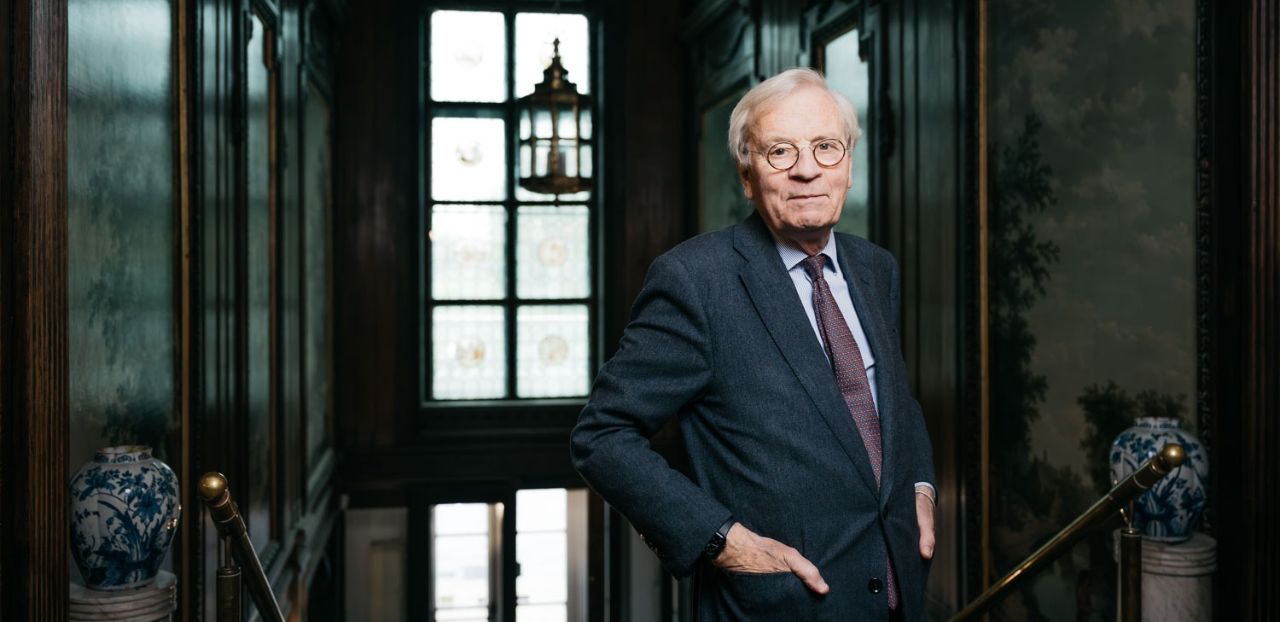
The global order is changing rapidly. The United States is no longer Europe’s self-evident ‘protector,’ China has emerged as a full-fledged world power, and Russia is attempting to reclaim its lost influence. This has far-reaching consequences also for the executives and board members of Dutch companies, says Jaap de Hoop Scheffer, former Minister of Foreign Affairs and former NATO Secretary General. According to him, geopolitics and economics have merged. ‘Boards will have to get used to a new normal that, for the time being, is anything but normal.’
The Clingendael estate basks in the autumn sun. In his office, Jaap de Hoop Scheffer offers his guest Charles Honée (A&O Shearman) a seat with a view of the grounds. ‘The best seat is for the guests.’ Here at Clingendael, De Hoop Scheffer – ‘in the autumn of my career, or perhaps even the early winter’ – serves as chair of the supervisory board. The former minister of foreign affairs has become one of the most authoritative voices in the Netherlands on geopolitics. Boardrooms, too, value De Hoop Scheffer’s insights. As he explains in his conversation with Honée: ‘Six or seven years ago, I would give presentations on geopolitics to boards of directors. Afterward, I would often hear: 'Interesting talk, Jaap, thank you, but now we should get back to our business.' That has changed. Today, this topic is high on virtually every board’s agenda.’
We live in a time of wars, trade tensions, and major geopolitical uncertainty. What has fundamentally changed?
‘More or less everything has changed. Looking back at my own career, I have always been an Atlanticist. I have always remained one, and I have always believed that a strong transatlantic relationship alligns perfectly with an ambitious Europe, and a strong European Union. For a long time, we lived in a world where a single superpower called the shots: the United States. Despite all the mistakes the Americans made – in Vietnam or Iraq – they were ultimately the power that held the international order together. After the fall of the Berlin Wall, a sense emerged in Europe that we had won the battle of history. Francis Fukuyama spoke of ‘The End of History.’ We believed that liberal democracy had triumphed and that the rest of the world would naturally gravitate toward our model. That turned out to be a massive miscalculation. In fact, it made us lazy and complacent.’
Lazy and complacent – what exactly does that look like?
‘For our security, we relied on the Americans; for energy, on the Russians; and for much of our industrial production, on China. The Americans footed the bill for our defense, Russian gas flowed into Europe via Nord Stream, and China became the world’s factory. In hindsight, we took that situation for granted for too long. And we assumed that as long as countries became rich enough, they would eventually want to be like us. We also believed that economic development like China’s would be impossible under an authoritarian system. All that turned out to be wrong. For years, the Americans warned us that we were not investing enough in defense, but we did not see the need for it. After all, globalization was working perfectly; trade was flourishing. I remember talking to Angela Merkel about Nord Stream and saying to her: ‘Frau Bundeskanzlerin, dear Angela, are Nord Stream One and Two not purely geopolitical matters?’ She insisted they were purely economic, Wandel durch Handel – change through trade. We believed the world was malleable and the economy would solve political problems. That world no longer exists. If Fukuyama spoke of the end of history, then we are now living in ‘the end of the end of history.’’
In your view, what have been the most significant geopolitical turning points?
‘The rise of China as a second superpower is without a doubt one of the greatest changes of our time. While the United States was dominant for a long time in economic, political, and military terms, we are now seeing a situation emerge in which China has become its equal in many respects. Then there is Russia. For me, a key moment was in 2007, when Vladimir Putin first openly made it clear at the Munich Security Conference that he did not accept the new world order. There, he laid out his grand vision for a return to a great Russian empire. Then came the 2008 NATO summit in Bucharest, where a dispute arose over Ukraine’s potential future NATO membership. I still remember that summit vividly, because, as secretary general, I was right in the middle of the dispute. Bush and Merkel, in particular, were at serious odds with one another.
A watered-down compromise emerged, stating that Ukraine could ‘someday’ become a member of NATO. The next morning, I spoke with Putin. ‘Secretary General,’ he said, ‘you do realize that this will never happen, do you not?’ With feigned naivety, I asked, ‘What exactly do you mean, Mr. President?’ To which he retorted, almost snapping at me: ‘I assume you have read your own communiqué?’ Shortly thereafter, Russia invaded Georgia. This was followed by the annexation of Crimea in 2014, the war in eastern Ukraine, and, ultimately, the large-scale invasion in February 2022. Looking back, you see a consistent pattern. Putin’s ambition has never changed. He wants his empire back.’
At the same time, Europe’s relationship with the United States is also under strain.
‘That may well be the most significant change. Throughout my entire career, the transatlantic relationship was a stable constant. That sense of certainty has vanished. Even after the blue wave in the midterms, we still have two more years with a U.S. president who thinks in highly transactional terms. He views international politics largely through the lens of deals and immediate interests. I am concerned about that course and about the transatlantic relationship. NATO currently has one absolute priority: preventing the United States from pulling out. That is why I understand and support Mark Rutte’s approach as NATO Secretary General. You may criticize the tone or the tactics, but the reality is that, in these turbulent times, there is hardly any alternative.’
Many European politicians argue that Europe must become more strategically autonomous. Should Europe take a firmer stance toward Washington?
‘Ultimately, yes, but there is a crucial condition attached to that. As long as Europe is unable to defend itself militarily, there is no realistic alternative in security policy to close cooperation with the United States. What Europe must do, however, is set itself the goal of becoming much more independent by around 2030 and beyond. This applies to defense, but certainly also to technology, energy, and industry. In all these areas, we are still far too dependent on others. So, I see two trends happening simultaneously. In terms of security, engagement with the United States remains essential. In other areas, however, we must learn to stand on our own two feet to a far greater extent. But that will also come at a cost.’
Do you believe Europe is capable of that?
‘That depends to a large extent on political developments within Europe itself. In many countries, you see political shifts and increasing polarization. It will be interesting what the upcoming elections in the major European countries will bring. The geopolitical situation calls for a stronger and more decisive Europe, while political developments in many countries seem to be moving in the opposite direction. Still, I see no alternative. Whether it concerns security, technology, energy, or trade: ultimately, European countries will have to cooperate much more closely.’
You explicitly mention technology. Why do you consider digital sovereignty so important?
‘Because strategic autonomy is no longer exclusively political or military. Digital autonomy has become at least as important. In fact, the traditional and digital forms of sovereignty are increasingly converging. Europe is alarmingly behind. Virtually all of our data is stored on American servers – including data from Dutch companies and Dutch government officials. American technology companies dominate a large part of the digital infrastructure on which our economy runs. If an American president wants access to that data, he has the legal means to do so. I do not think that is a desirable situation for Europe, nor for any Dutch company.’
What does Europe have to offer in the digital realm?
‘Far too little. We in Europe have virtually no digital infrastructure of our own. But what perhaps worries me even more is that the European reflex is often one of fragmentation. Take the French AI company Mistral, for example. It is not comparable to OpenAI or Anthropic, but it could serve as the nucleus for a serious European digital strategy. Yet, voices are already emerging saying that every country should focus on building something for itself. If Europe needs to make anything a strategic priority, it must be strengthening our digital sovereignty. Otherwise, we will continue to finance our own dependence.’
What role do you see for governments?
‘It starts with raising awareness. From there, we need much greater collaboration between the public and private sectors. At the same time, we have to be realistic. European governments cannot finance everything. Private capital is also needed. And that is precisely where we run into a European problem. Mario Draghi rightly pointed this out, as long as Europe does not have a true capital markets union, a huge amount of investment capital will remain on the sidelines. That holds us back.’
What does this mean for the future of globalization?
‘The old world of unrestricted globalization and infinitely efficient supply chains is not coming back. That era is behind us. The World Trade Organization (WTO) is on life support. Trade conflicts are on the rise. Sanctions, boycotts, and export restrictions have become part of the exercise of geopolitical power. At the same time, new trade flows are emerging. Europe is seeking closer cooperation with India, Indonesia, and the Mercosur countries. But the most important conclusion remains: geopolitics and geoeconomics have become inextricably linked.’
And with that, geopolitics has made its way into the boardroom?
‘Geopolitics came crashing into the boardroom, is how I put it. Six or seven years ago, I gave presentations on geopolitics to boards of directors. As I mentioned, the response often was: ‘Interesting talk, Jaap, thank you, but now let us get back to business.’ That has changed. Today, this topic is high on virtually every board’s agenda. In all areas, political decisions have a direct impact on business operations. Today, these are no longer political questions, but core business questions.’
What does that mean, in practical terms, for executives and supervisory board members?
‘My primary piece of advice is to make your friends before you need them. Build your relationships well before a crisis arises. An executive who only reaches out to a government agency or Brussels once a problem arises is, in fact, already too late. In today’s world, access to decision-makers is of the utmost importance. I sometimes call this the ‘Sunday evening phone call’ rule. If you can call an official or a policymaker on a Sunday evening because you have already established a relationship, you are speaking to someone directly. On Monday morning, there is an entire bureaucratic apparatus between you. That difference can be crucial.’
The example of ASML keeps coming up …
‘That is because it is a textbook case of how geopolitics today directly impacts a company’s strategy. Look at the debate over the export of chip-making machines to China and the possibility that the U.S. might impose further export restrictions on the company. It immediately illustrates how geopolitics and business operations have become intertwined. Suppose tensions continue to escalate. Then you need to be able to rely on relationships, networks, and political support. Then you need to know your way around The Hague, but certainly Brussels as well. Strategic interests require coalitions. ASML has that well under control, but it is relevant for any company operating internationally.’
What do these times demand of leaders?
‘Greater visibility. I agree with Jan Hommen, former CEO of ING, who has been arguing for years that CEOs need to participate more actively in the public debate. Too many executives remain in the background; they are too invisible. Executives do not need to have an opinion on everything, but they can certainly contribute to the debate based on their practical experience. Leadership these days does not take place solely within the walls of the company.’
The Corporate Governance Code devotes considerable attention to long-term value creation and consideration for all stakeholders. Will that not come under pressure?
‘That is one of the most difficult issues. Europe needs to think about its steel industry, chemical industry, and other strategic sectors. These come with environmental drawbacks, which is why we have long thought: let others handle that. But if you no longer produce steel, you will eventually be unable to produce defense equipment. Some discussions will therefore have to be revisited. What do we want to be able to produce ourselves? What dependencies are we willing to accept? I believe the stakeholder model should be defended wherever possible. But we also have to be honest: under current geopolitical circumstances, some strategic choices create tension. That is when leaders have to make decisions.’
Are you, ultimately, advocating for greater resilience?
‘Yes. We have become a just-in-time society. Everything has to function exactly on schedule. Lactose-free yogurt has to be on the shelf at Albert Heijn at ten to three, not ten past three. But geopolitical shocks are forcing us to become a just-in-case society. That requires a different way of thinking. It means practicing for various scenarios. What happens if a port grinds to a halt? If the energy supply fails? If digital infrastructure is attacked? If critical raw materials suddenly become unavailable? We are not used enough to thinking about these kinds of scenarios, even though the risk is very real. Think of Rotterdam. Former port authority CEO Allard Castelein once pointed out to me just how disruptive it would be if a ship were to end up wedged sideways in the Nieuwe Waterweg. Those are exactly the scenarios you need to practice. Not because they are likely to happen, but because the consequences could be enormous. Governments need to do this. But boards need to do it as well. Resilience must become a core component of governance, in both the public and private sectors.’
If a chair of a supervisory board were to ask for your advice tomorrow, what would your most important recommendations be?
‘First and foremost: get used to the new normal. Or rather, get used to a situation that is anything but normal. There will not be a new, stable world order anytime soon. We are in a transitional phase, and no one knows exactly where it will end. Second: accept that improvisation is becoming an inherent part of leadership. Politicians improvise. Diplomats improvise. Business leaders will have to do the same. The world is changing too fast to think that everything can be planned in advance. Third: invest in relationships – with governments, with Brussels, and with relevant societal stakeholders. And fourth: as a leader, dare to be visible. Explain what geopolitical developments mean for your company and for society. The international landscape is becoming rougher, tougher, and less predictable. This calls for leaders who are not paralyzed by uncertainty but are willing to engage with it, think through scenarios, and improvise where necessary. Ultimately, that is the task facing every board.’
This interview was published in Management Scope 10 2026.
This article was last changed on 17-11-2026