
‘The real tech challenge lies in people’
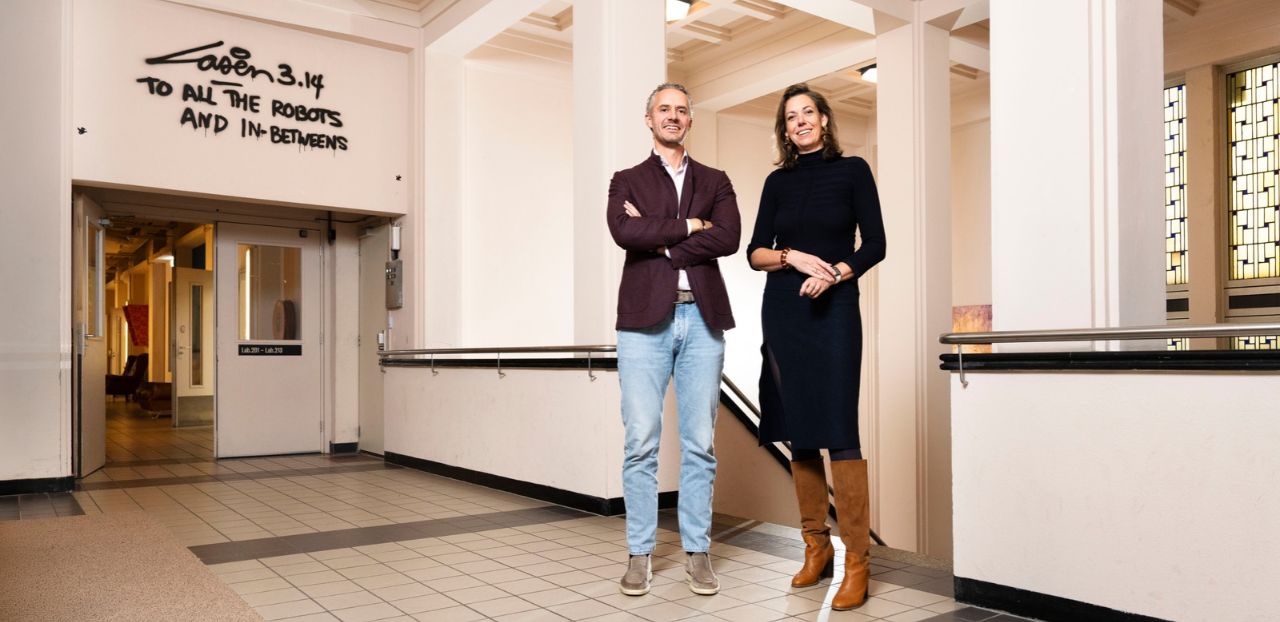
AI is changing not only products and processes, but also the way organizations grow, invest, and engage with people. Sander van Woerden, co-founder of Lexar Partners – an investor in digital companies – believes in the power of teams. ‘Better a strong team in a tough market than a weak team in an attractive one,’ is his motto. For Rina Joosten-Rabou, founder of HR startup and AI company Pera, the key lies in making better use of data related to people. ‘By leveraging that data, we can identify competencies that demonstrably contribute to an organization’s success.’
It takes a bit of searching inside A Lab, a former Shell laboratory in Amsterdam-North that now houses startups and creative entrepreneurs. In this space, which has the vibe of a true incubator, Joosten’s company Pera has a number of ‘desks,’ far removed from its headquarters in Den Bosch. Van Woerden arrives straight from a deal that has just been finalized; the ink is barely dry. Even before the conversation officially begins, the AI entrepreneur and the tech investor are already discussing their respective companies. Pera is an HR scale-up that uses AI, data, and behavioral analysis to identify which competencies contribute to success, enabling organizations to select, develop, and deploy talent. Lexar Partners is an investment firm specializing in technology companies. This serves as a preview of a discussion led by Tjarda Molenaar, director of the Dutch Private Equity and Venture Capital Association (NVP), on the future of work, the role of data, and the question of how organizations can remain competitive in an era where AI is becoming accessible to everyone.
In your opinion, is AI being used correctly?
Joosten-Rabou: ‘Well, not quite yet. What I still often see is companies trying to use AI to optimize existing, suboptimal processes. Many organizations look at their current way of working and then ask themselves where they can 'add' AI. That is actually the worst thing you can do. With AI, you need to step back from the processes and rethink what you are actually trying to achieve. How do I define success? And then you essentially need to redesign your entire process, as if you were starting from scratch. That almost never happens.’
Van Woerden: ‘I recognize that. We discuss with our portfolio companies precisely that AI is not a project, but a strategic theme. There are many end markets where you can do much more based on AI. And by that I do not just mean applying AI to your products or product development, but specifically also to your general processes to eventually become AI-native. That is something we are focusing on specifically with our portfolio companies. A few years ago, entrepreneurs would sometimes give us a blank stare when we brought this up. Now, you see that companies that take this seriously are looking at their processes in a fundamentally different way and, sometimes, they surprise us.’
Could you elaborate on that, based on your own experience?
Joosten-Rabou: ‘When we started Pera, it was standard practice to go through all sorts of steps in the recruitment process. In fact, that is still the case in many organizations: you review a CV, conduct interviews, run an assessment, perform reference checks, and hold yet another interview. And only then do you hire someone. It is a lengthy process with an uncertain outcome. Yet the question you ultimately want to answer is quite simple: will this person be successful in our organization or not? If you can predict that directly, you can redesign the entire process and skip all those steps. That actually applies to every company. Do not start with the process; start with the desired outcome.’
As investors, do you look at companies in a similar way?
Van Woerden: ‘Yes, actually we do. Of course, we look at a company’s current performance. But just as important is the question of whether a company can continue to adapt. We deliberately invest in companies that have already built something, but are still small and agile enough to be able to change. We certainly do not focus on traditional venture companies. These are companies that have generally been around for five to ten years. They have an existing client base, established revenue and profitability, and they have built a solid data model – they have a track record. We can help them grow, but that requires agility. Because in this world, one thing is certain: if you do not change, you will be left behind.’
As an investor, how do you view the impact of AI on these companies?
Van Woerden: ‘No one can predict what the world will look like in five or ten years. But you can systematically consider opportunities and vulnerabilities. To that end, we have developed our own disruption framework, which we use to assess the vulnerability of the product and revenue model, the defensibility of its market position, and its ability to adapt to AI on its own. Ultimately, we invest in companies that have built something unique even in this AI-driven world, but that also have the courage to keep pushing their development forward.’
What changes are you seeing in practice?
Van Woerden: ‘This year, for the first time, we saw executive teams truly embrace AI. The conversation has shifted from technology to business operations. AI is being applied broadly across the entire spectrum of organizations and embraced as part of their overarching strategy.’
Joosten-Rabou: ‘I see that, too. I think many organizations still do not fully grasp that technology is only one part of the story. The real challenge often lies with the people. How do you ensure that employees embrace new technology? What skills do you need? And how do you actually measure which individuals are making a difference? Many organizations still have little insight into this.’
What is still missing in many organizations?
Joosten-Rabou: ‘Insight. Investors scrutinize financial and operational data – rightly so, of course – but people are still the most valuable asset of virtually any organization. And that is often a blind spot. We know from scientific research that people account for somewhere between sixty and sixty-five percent of an organization’s success. At the same time, companies often have surprisingly little data on the factors that actually drive high performance. We should take a much more data-driven approach to analyzing patterns of high performance in organizations. That can boost both productivity and impact.’
Van Woerden: ‘That is a very interesting point. I have immense faith in the power of teams – and therefore of people. I have been saying for years: I would rather have a strong team in a difficult market than a weak team in an attractive one. A strong team will ultimately find a solution, even when the market is not going their way.’
It seems you agree on the enduring importance of people.
Van Woerden: ‘Absolutely. I speak primarily from experience Rina has the data to back it up. For private equity, defining a goal is straightforward, because ultimately, it is about achieving a certain multiple on an investment. But the question is: how do you get there? We use eight value creation axes for this, of which the HR axis is one of the most important to us. We are extremely selective about the management teams we want to partner with as investors. In addition to aligning on ambitions and concrete plans, it simply has to be inspiring and enjoyable to enter into a medium-term partnership with them.
I firmly believe that when people genuinely like one another, the end results are better. That is the foundation for me: being able to have fun together. Then people seek each other out, pick up the phone, and get together to brainstorm – which leads to better outcomes. When the opposite is true, you get absolutely nowhere.’
Joosten-Rabou: ‘That sounds great, Sander, but I would also add: do not let your feelings fool you.’
Why is that? Is intuition overrated?
Joosten-Rabou: ‘Often, yes. People tend to choose others who are similar to them. The question is whether an organization always benefits from that. Is an organization better off with ten Sanders or ten Rinas? It might be comfortable, but probably not the path to success. People overestimate how good they are at assessing others. Look at recruitment. A resume predicts only a limited part of future performance – and the same goes for intelligence. For a long time, those were our best tools But they are suboptimal methods. We now have access to better approaches. We have far superior information available today compared to the past – why would you not use it?’
How does your approach work in practice?
Joosten-Rabou: ‘We have been researching patterns associated with high performance. Our deep-learning AI models analyze, among other things, language use and behavior. We link these to actual business outcomes. Why do some people stay with an organization longer? Why do certain employees generate more revenue? Why do some teams perform better or are more innovative? Using data, we can identify which characteristics and competencies are demonstrably linked to these outcomes. We can then map out where that potential exists within an organization, identify opportunities for development, and determine what this means for areas such as recruitment, professional growth, and team composition. This allows you to make much more targeted decisions about people and organizational development.’
Many executives wonder whether AI will ultimately lead to fewer jobs.
Joosten-Rabou: ‘In my view, that is the wrong question. The relevant question is: how do we increase people’s productivity? How do we help employees succeed in an AI-driven environment? What we are seeing is that it is precisely the so-called ‘soft’ skills that are becoming more important in the AI transition. Communication, collaboration, customer focus, and the ability to learn – these are the competencies that have a significant impact on a company’s productivity. In addition, AI fluency and AI potential are becoming important. Who learns quickly? Who can effectively apply new technology? Knowing this, you can develop talent in a much more targeted way. HR is very often seen as the ‘soft’ side of an organization. But if HR can use a data-driven approach to calculate the benefits of a good people-centered approach, then it suddenly becomes very interesting.’
Van Woerden: ‘I have been searching the market for this insight for years – in HR, in recruitment, in processes. If you can quantify this in financial terms, it becomes truly interesting.’
Joosten-Rabou: ‘We can calculate the effects in monetary impact. I was recently at a company that had invested half a million in leadership programs focused on teamwork. We discovered that teamwork actually correlated negatively with their commercial results. Essentially, they were funding something that was negatively impacting their bottom line. My main point is: do not rely on gut feeling; base your decisions on research.’
Another question: what will set companies apart in the future when everyone has access to the same AI models?
Van Woerden: ‘Customers, and deep integration into their processes. Proprietary data. Trust and a connection to the physical world, such as hardware and services. Technology is becoming increasingly accessible. Anyone can use the same models. The true competitive edge lies in unique data, integrations, and customer relationships. A competitor can build a similar tool, but they cannot simply replicate twenty years of operational knowledge and data. Today we invested in a company that develops geo-information software for fiber-optic networks. As the market leader, they have been managing fiber-optic networks in the Netherlands for over two decades. There is a tangible, physical component to what they do, which is a definite plus these days. In addition, the installers of these networks are already using this tool, giving it significant network reach across the entire industry. These are things that cannot simply be wiped out by a new tool or a new company. In short, it comes down to customers, unique data, integrations, domain expertise, and the team.’
Joosten-Rabou: ‘And culture. Many companies have access to the same technology, yet some succeed while others do not. That often has everything to do with their ability to experiment quickly, make mistakes, and learn from them. Successful organizations embrace uncertainty; they are constantly iterating.’
What does this require of leaders?
Joosten-Rabou: ‘Leadership becomes more important, not less. It all starts with leadership. Leaders largely shape the culture. Can you handle uncertainty? Do you give people the space to experiment? Are you willing to make mistakes visible? Leaders must set the right example here. They, too, must dare to fail and keep going. These are competencies that we also see reflected in the data.’
Van Woerden: ‘And you have to be willing to take risks. The digital age requires investment before the returns become visible. If you are not prepared to make those investments, you run the risk of being overtaken by others.’
What will the team of the future look like?
Joosten-Rabou: ‘I suspect that teams will be smaller than they are today. We have already implemented significant reductions ourselves because agents can take over a large portion of the work. The people who remain are specialists who, thanks to technology, become ten times more productive.’
Van Woerden: ‘I see that too. AI makes organizations much more scalable. Growth no longer has to go hand in hand with a proportional increase in the workforce. In addition, I expect to see an increasing number of hybrid teams made up of both people and agents. I have noticed that companies have already digitally replicated entire workforces. Everyone then has their own agent, which is fully tailored based on what you have done over the past ten or twenty years.’
Joosten-Rabou: ‘At our company, people and agents work together every day. The question is becoming less about how many people you have, and more about which people you need.’
Will we eventually see an AI agent in the boardroom?
Van Woerden: ‘A super agent in the boardroom. It seems inevitable to me. The only question is when.’
Joosten-Rabou: ‘I also think that is going to happen. The one thing you will have to pay very close attention to is governance, because, ultimately, the executive remains responsible for the decision. AI can advise, but responsibility cannot be delegated.’
What is the biggest mistake executives can make today?
Joosten-Rabou: ‘Clinging to existing processes and trying to make them slightly more efficient. Start with the desired outcome, but think about your definition of success and then design from scratch how you want to get there.’
Van Woerden: ‘The biggest mistake executives can make right now is treating AI as a standalone project. AI development affects the entire organization. Anyone who fails to recognize that will lose market share sooner or later. AI does not belong in Appendix B of the business plan. It must be an integral part of the strategy from Chapter One onward.’
This interview was published in Management Scope 10 2026.
This article was last changed on 17-11-2026