
Annette Mosman and Willemien Terpstra: ‘Do not let AI run away with you’
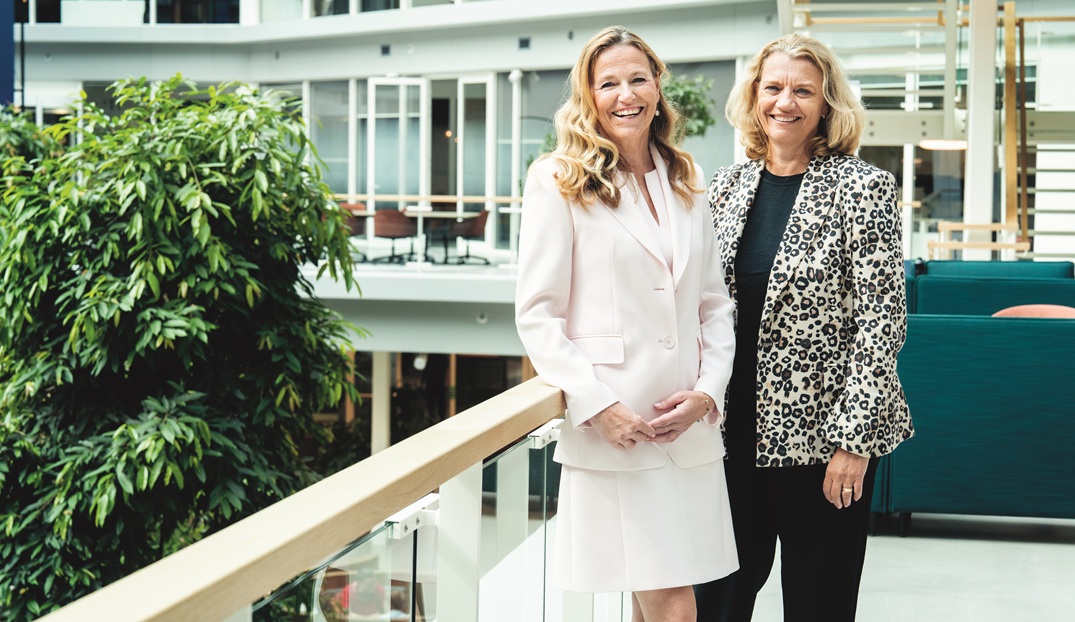
Terpstra and Mosman were on a joint working visit to Silicon Valley recently. Gasunie CEO Willemien Terpstra's visit to her counterpart Annette Mosman at the offices of pension administrator APG in Amsterdam therefore feels like a mini-reunion – complete with a warm embrace.
‘An unexpected bonus from the trip to Silicon Valley which should not be underestimated,’ Terpstra tells Emil Kwaaitaal, AI partner at Deloitte, ‘is that you get to know each other on a personal level too. Of course, I knew Annette was the CEO of APG, but before, I would not have just called her out of the blue. Now I have her direct number. That is nice. Because there are quite a few topics I would like to bounce ideas off of her about. Now that we have made that personal connection, it is easier to do.’
I am curious what your biggest take-away from that trip to Silicon Valley is.
Terpstra: ‘What became very clear to me during this working visit is just how transformative AI is. AI is not so much a technology that affects your IT; AI changes the entire organization. In Silicon Valley, we really got a glimpse into the future. In the US, they are way ahead of us. My sense of urgency has increased enormously as a result of this visit. What has really stuck with me – and what we are now actively putting into practice – is ensuring that AI is implemented company-wide. You have to make sure you don't create lock-ins; a solution for one part of the company that has little use elsewhere in the company.
Mosman: ‘I returned from the US feeling somewhat uneasy. I was amazed by the speed of developments and the incredible investments being made there. I came back feeling that we really need to get moving very quickly. And I, too, took away the key lesson that you have to work with the entire stack, across all layers of the organization, from hardware all the way up to the large language models. And I have learned that the real value lies in the applications, that AI can help advance the business model.’
Your organizations are at the heart of two major, significant transitions: the energy transition for Gasunie and the pension transition for APG. What is the role of AI in those transitions?
Mosman: ‘We are still making relatively little use of AI for the pension transition. That is partly because we began the initial preparations ten years ago, and back then AI was still in its infancy. But thanks to the transition, APG is now ready for the future. All of our participants’ records have been cleaned up according to a data-quality protocol, and we have transitioned to a completely revamped IT environment. You could say we have said goodbye to our old diesel engines and are now fully future-proof. We have thereby laid the foundation to accelerate our progress with AI in the future. We are going to use AI for our participant interactions, our IT delivery, and our investment decisions. And thirdly: we operate in a highly regulated environment, and we will be using AI there as well. Those are the three major strategic challenges we face.’
Terpstra: ‘At Gasunie, everything revolves around energy security and accelerating the energy transition. We always operate within the triangle of ‘affordable, reliable, and sustainable.’ Within that framework, we are increasingly using AI to strengthen decision-making, optimize processes, and achieve a safe, smart, and affordable energy supply. So this affects the entire organization. Consider the possibilities of using AI to enhance our colleagues’ expertise and contribute to smarter maintenance and safer working conditions. We are now facing the next step: making the various applications scalable and integrating AI into all processes. Data quality is important here, but we also need to devote extra energy to governance. How do we ensure AI is properly embedded in our organization? How does it help us deal with increased complexity? That last point is also interesting. The emphasis has always been on energy security. We do not want to compromise on that. But now you also have to look at other factors: competitiveness, affordability, security, and the question of how fast you want to move.’
Mosman: ‘Yes, the governance around AI is extremely important. As a board, you have to carefully consider how you are going to deploy AI, in which areas, and under what conditions. We have data on millions of participants from our eight pension fund clients in our files, including those of ABP participants in the police and defense sectors. You have to handle that with extreme caution. As the board, we need to think about the foundational principles. And at the same time, there must be room to figure out for ourselves where AI adds value. In the early stages of our data governance efforts, we were very much in favor of a one-size-fits-all approach. But we have now moved away from that somewhat. At APG, we have two major business units: pension services and asset management. These are completely different business units with distinct strategies and different operating models. We will have to give these business units more freedom so they can derive optimal value from AI.’
Terpstra: ‘It is the board’s task to give particular consideration to the question: how do you encourage innovation within the framework in which you must safeguard trust and security?’
These are tense times from a geopolitical perspective. How does this influence AI policy?
Mosman: ‘I have noticed that risk appetite has declined even further in recent years, mainly due to geopolitical developments. We have become increasingly aware of the risks associated with, for example, our dependence on US providers. The controversy surrounding Anthropic and Mythos has confirmed this once again. So you are much more aware of these kinds of effects. Ideally, we all want to move towards a sovereign cloud, but that is still a long way off. In the meantime, you do need to understand and manage the risks: know where your data is stored, reduce your dependence on a single provider, and actively seek out European providers.’
I can imagine that sovereignty is also an important issue for you, Willemien?
Terpstra: ‘Absolutely. We are part of the critical infrastructure, and resilience is an extremely important theme. For us, a critical business setup is of crucial importance. At the same time, we have been working on this for sixty years. It is part of our DNA. What became very clear during our visit to the US is that while everyone is indeed talking about the ‘sovereign cloud,’ it is really just a utopia. We will remain dependent on the United States in particular for a very long time. But that should not stop us from mapping out the critical components throughout the entire value chain – and to then make very targeted investment decisions.’
Mosman: ‘I was recently in Paris at a speech by French President Macron, who had just signed a multi-billion contract with SoftBank, including investments in AI. Macron was forceful and emphasized the opportunities for France and Europe. He said: We have the energy. Literally. They are growing thanks to nuclear energy. I think that should apply to the Netherlands as well. It starts with the energy supply.’
Terpstra: ‘I am glad you mention that. When it comes to AI and data centers, we often focus too narrowly on electricity. Data centers need energy, and we can source that from multiple sources: electricity, gas, green gas, and hydrogen. Moreover, we have various infrastructures in place to transport that energy, a large part of which still has ample capacity. When we take a holistic view of the energy system, it often turns out that far more than expected is possible. I believe we actually hold the key. The Netherlands has a unique selling point, after all, namely an extensive gas pipeline system with connections throughout the country and with links to our neighboring countries. I would say: use that infrastructure. We have enormous ambitions for offshore wind. We cannot feed the surplus electricity into the Dutch grid because the infrastructure is not there. But you can, for example, convert that electricity into hydrogen. That way you create additional demand for offshore wind energy, reduce system costs, and make further investments in offshore wind more attractive. That immediately gives you a stronger business case for offshore wind.’
How do you view the balance between achieving short-term successes versus pursuing long-term transformative change?
Mosman: ‘In the short term, we are primarily focused on making the organization AI-literate. I think every corporation in the Netherlands has its own AI environment by now – in our case, a secure, private environment within Copilot. We are now introducing all our people to it, within their current work and existing processes. AI is primarily used to help you to do your work faster, more efficiently, and more easily. We are also providing further training for our leadership team. Soon, we will be taking the team to INSEAD for a few days of training. I think it is important that our leaders drive the transition, and that they bring their people along.’
Terpstra: ‘We, too, are currently focusing primarily on increasing AI literacy and, in addition, on cleaning up data – getting the foundation right. But at the same time, you have to maintain momentum. If you wait until all the data is perfect, in two years’ time we might still not be ready. So we are trying to start in sub-areas and scale up later. We are also encouraging employees to get started with AI. We organize hackathons within the company; with prizes for whoever has the best agent. As the board, we have also completed a number of training sessions ourselves; all very hands-on.’
How is AI changing your work as a CEO? How does it impact your day-to-day activities as the leader of the organization?
Mosman: ‘I find my work as CEO has become more interesting. More interesting, but also more complex. You have far more information at your disposal. And everything moves much faster. You have to make more decisions and make them faster. The interesting thing is that, thanks to AI, you do not have to think as much about how everything works operationally. You have more time for strategic decisions. And you have better insight into the scenarios. But as a CEO, you ultimately still have to understand the underlying processes and be able to interpret the analyses. You have to understand the corporate culture. That is quite a pitfall. No matter how incredibly wonderful and useful AI may be: I am responsible for the decision.’
Terpstra: ‘In a sense, the CEO’s job is becoming more complex, but you can make decisions faster and gain a broader perspective. That broader perspective, in particular, adds a huge value and provides more insights. But in times like these a CEO needs, above all, imagination.’
Mosman: ‘AI also helps me expand my imagination. I regularly use AI as a sparring partner, and you often end up with surprising insights. It also helps me have my thoughts go in unexpected directions. I sometimes upload boardroom documents to the secure AI system. Then I ask: ‘what decision would you have made right now?’ It almost always offers arguments that I had not considered.’
Terpstra: ‘Yes, I also always ask for other perspectives. How would an NGO view this? Or the works council? Or the supervisory board? That is truly enriching.’
Who owns this issue at your company? Is it yourselves?
Terpstra: ‘Certainly. It is absolutely in my hands and on the executive board’s agenda. And that is mainly because it is not the technology that makes the difference, but the speed at which we, as an organization, learn from it. So, it is a change management issue and an operating model issue. And that is by definition a CEO issue. That is why it needs to be business-led.’
Mosman: ‘Yes, it is a CEO issue. It is an executive issue, especially because your entire target operating model changes, and with it your entire company, including all the necessary competencies. How are you going to organize that? HUMAIN is the future: the combination of AI and people. And that, too, makes it a CEO issue. What will your organization look like in the future? Which people will you need? And the core question: how do you use AI to create value? Which makes it also a strategic issue.’
What lessons can you as CEOs learn from each other when it comes to AI?
Terpstra: ‘What I appreciate about my interactions with fellow CEOs is that everyone is grappling with the same dilemmas. Sometimes it feels like you are the only one struggling with something, but fortunately that is not the case, and that helps.
What has been a real eye-opener for me was that someone in the US told me that you should view AI-agents as digital employees who, in the long run – via tokens – will probably be more expensive than your human employee. That was truly a new insight for me. So, you need to think about your governance and the processes – how you will manage these new employees. How can we, as an organization, collaborate effectively with these agents so that we learn faster, predict better, collaborate smarter, and further increase the reliability of our infrastructure?’
Mosman: ‘As CEOs, we are largely in the same boat. Every CEO is navigating a major transformation in a world full of uncertainties. That applies to all of us. And how you do that, how you deal with it, and how you leverage AI in that process – those are the questions that concern us all.’
Terpstra: ‘The theme of collaboration has become more important in transformations in a world full of uncertainties. You cannot do this on your own as a company. Collaboration is essential. Actually, the Netherlands has some strong differentiating assets. We have always had a culture of consultation and consensus-building. We have sometimes experienced that as slowing things down, but it also has many positive elements. If we can utilize that even better, it could be a game-changer for the Netherlands and for Europe.’
What advice would you give to a CEO who still views AI primarily as a technology issue?
Mosman: ‘Do they still exist? I actually find that hard to believe. I would say: come and have a coffee with Willemien and me. But urgently.’
And what is the most important AI insight you would share?
Mosman: ‘That we all need to realize that even in the AI era, it is still about people. AI can simplify things, AI can help us. But it always begins and ends with people. For a CEO, I think it is important to stay in the lead. If you do not take the lead, AI will run away with you. The wisdom still lies with the board. Do not let AI take over.’
Terpstra: ‘I have nothing to add to that, I completely agree.’
This interview was published in Management Scope 07 2026.
This article was last changed on 25-08-2026