
Rob Schuurman (Nedap): ‘Creating funky things that matter’
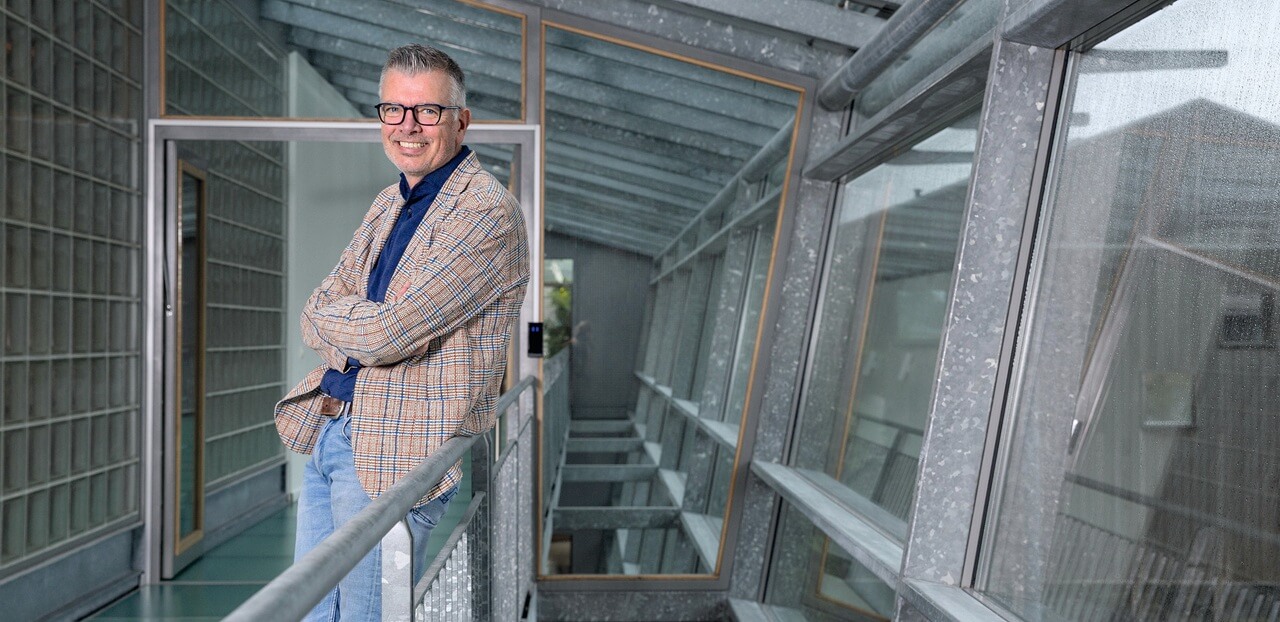
Creating funky things. That is what the new CEO of technology company Nedap loves to do most. But, as he emphatically adds, funky things ‘that matter and make an impact.’ Last April, Rob Schuurman took over the helm from Ruben Wegman, who stepped down after seventeen years as CEO (and nearly thirty years with the company) for health reasons. With Schuurman, Nedap once again chose someone who knows the company like the back of his hand. Still, Schuurman (with over twenty years of service, including as CCO) has no intention of merely minding the store. ‘The pace of technological development is accelerating, and we are keeping up,’ he says in a conversation with Marco Nijenmanting, a partner at executive search and leadership consultancy De Vroedt & Thierry.
It all began in Groenlo, in the deepest reaches of the Achterhoek region. Nearly a hundred years ago, in 1929. Next to the headquarters – a state-of-the-art structure of light, glass, steel, and wood – a single exterior wall from the original building still stands. Photographs in the lobby trace the company’s slow and steady growth into a technology firm, active in four sectors: healthcare, retail, security, and livestock. The lobby houses tangible reminders of past successes and failures alike: old electronic voting machines, ski-lift gates, and other innovations that were once promising but ultimately faded away. Because that is what Nedap excels at, says Schuurman: ‘Generating new ideas. Seeing what works and what does not.’
Is that part of Nedap’s success: trying things out and then having the courage to stop if necessary?
‘Yes, I believe so. People often make a big deal of strategy, but ultimately it boils down to two things: scaling up successful ideas and stopping what does not work. In hindsight it seems as though there was a brilliant master plan in place. For me, strategy is mainly about creating options, choosing the best ones, and letting them grow. And strategy is also about knowing when to call it quits on something.’
Could you give an example of something you decided to discontinue?
‘Because of my background in the temporary staffing industry, I once developed a tool for tracking temporary workers’ hours. It was quite successful, but at a certain point, you are faced with a choice: are you going to go all in on it? I looked at it and realized: this will stay too small; we just cannot scale it up enough. Then you have to stop. Also because you have talented people working on it who would be better utilized elsewhere. Those people are essentially playing in the wrong stadium – a stadium where they simply cannot win. If you put them somewhere else, they can succeed.’
You have been CEO since April, after serving as CCO for just under five years. How did the transition go?
‘It took some getting used to at first. Part of the job was new to me, like liaising with the supervisory board and the shareholders. But, above all, the responsibility feels different. You do have a moment where you think: ‘Oh dear, they just handed me the keys to this entire company.’ And that at a time when technology is evolving at breakneck speed and the geopolitical landscape is anything but stable. That really makes you pause and think for a moment. But, in the end, I settled into my role quite quickly. I have been here for a long time and know the company well. Together with my predecessor, Ruben Wegman, we also ensured a smooth transition. That was important for the company and all its stakeholders.’
Is there also a downside to being an internal candidate?
‘I believe the advantages outweigh the disadvantages. That said, there are certainly pitfalls. The most important question: how do you stay sharp after twenty years? I have to force myself to be extra critical about that, precisely because I helped build much of what we are doing now. That is why it is so important to have capable, critical people around you. I also think I am open to feedback. My colleagues are not afraid to say, ‘Rob, maybe you think this is a good idea mainly because you were the one who started it.’ You need that kind of feedback.’
It struck me that the press release about your appointment states that Nedap has found in you someone who will build on the existing strategy and ensure continuity. If I were to present such a mandate to external CEO candidates, it would come across as ‘mind the store’ ...
‘Yet there is also a clear transformation mandate. It is just that transition is second nature to us. It is part of our DNA. Nedap is now ninety-seven years old. Over that time, markets have come and gone, as have technologies. Our strategy has always been to be able to reinvent ourselves time and again. We have had this strategy for nearly a century. That strategy will not change under my leadership. But that does not mean the company will not evolve.’
Can you elaborate on the direction you envision for the coming years?
‘Times are changing rapidly, particularly due to developments in AI. This creates opportunities to drive markets forwards. To do that, a company must be able to keep pace with the market – or better yet, stay slightly ahead of it. That means we will have to develop products faster and bring them to market more quickly, so we can respond more swiftly to our customers’ needs and thus make a greater impact on their daily work. I want Nedap’s pace to align with the pace of the market. That is why, for example, I have appointed a new CTO, André Foeken. Part of his remit is straightforward: to ensure that our people can spend as much of their time as possible developing technology that delivers value to our customers.’
Is Nedap still a ‘manufacturing company’?
‘I would say we have evolved from an inventor-driven company to a technology company. We are still good at coming up with new things, but also good at selecting which ideas we truly want to scale up. And ultimately, we do one thing above all else: we create funky and impactful solutions that truly matter for our clients.’
What exactly do you mean by that?
‘That our technology helps people in their daily work. Think of healthcare professionals who have more time for the people they care for, dairy farmers who have better insight into the health of their cows, retailers who know exactly which items are in stock, or organizations that can keep their people and buildings safe. We build and scale products and services that make this possible. I call it ‘creating funky things that matter.’’ (Schuurman picks up a framed sign with that text from his desk.) ‘That is my motto. It is what makes this work fun and why people want to work at Nedap: you can see the real-world impact of what you do.’
That sounds a bit like Apple…
‘I am quite happy with that comparison, although the scale is different, of course. We, too, combine hardware and software. In that sense, we are still very much a manufacturing company. We deliberately focus on the combination of devices, sensors, and software, often in a subscription model. I am particularly drawn to that because it allows you to build long-term relationships with clients. That fits with Nedap; we have clients and business partners we have been doing business with for thirty years.’
The organization needs to accelerate and grow. How do you ensure you maintain an entrepreneurial culture? And how do you foster that culture as a leader?
‘Nedap’s foundation is its people. They are, by nature, driven to embrace developing new things. Because of that, I do not have to force or steer too aggressively to get things done. My role is mainly to facilitate the conversation. I ask questions, answer questions, and get a lot of ‘why’ questions myself. Why are we doing this? Why are we choosing this? That sometimes leads to friction or a heated discussion. Some think we are moving too fast, others that we are moving too slowly. But that is all part of it.’
Are you planning to make changes in terms of culture?
‘Just as with my predecessor, our employees and customers are my top priority. I think it is important to bring the outside world in. Technical companies can easily become inward-looking. That is why I often say, ‘I am going to open the window somewhat.’ It is a metaphor for: let us keep looking outward. I have also started paying close attention to accountability. Maybe it is because of the region, but meetings here can be so harmonious that afterward you find yourself thinking: What did we actually agree on, and who is doing what? I have become a bit more explicit about this: clear accountability, clear responsibilities.’
What qualities do you look for in a leader?
‘Four qualities are essential to me: entrepreneurship, independent-mindedness, and conviction. But always balanced with the ability to collaborate. I give people a great deal of responsibility. We operate with autonomous teams that make decisions close to the customer and the market. My role is primarily to facilitate that: providing frameworks, setting direction, and ensuring that people have the means to succeed.’
We previously spoke with Prince Constantijn for Management Scope. He cited ‘aggression’ and ‘hunger’ as two essential leadership qualities. Do you agree?
‘Yes, but I would like to add one more word myself: guts. It is a great word. Having the guts to take on a challenge is incredibly important. Do you see an opportunity? Let us do it.’
Suppose you continue to grow and have 1,800 employees in five years. Which of the core values you mentioned would come under pressure first?
(Laughs:) ‘1,800 employees? That sounds like a corporate! I am going to fight to ensure we do not become a corporate.’
What comes to mind when you hear the word ‘corporate?’
‘Maybe it is a caricature, but when I think of a ‘corporate,’ I picture a bunch of people walking around whose jobs are a complete mystery. People moving binders from A to B, looking as if they are doing something indispensable. I would do absolutely everything in my power to prevent that. I want a company with people I know, with people who are part of the success. If that disappears, that is where the pain begins for me. But then again, maybe I have the wrong idea of what a ‘corporate’ is – that is certainly possible, too.’
And as for growth: you do not necessarily want to reach 1,800 employees?
‘My primary goal is to create more impact for our clients. If we need more people to achieve that, we will hire them. But growing our headcount is not an objective in itself. Besides, I believe AI can help us work smarter. Not because I want fewer people, certainly not, but because it allows us to organize the company more effectively.’
How is AI changing your role as a leader?
‘I think that, thanks to digitization and AI, much of our work is actually becoming more human again. In healthcare, AI will soon eliminate ninety-five percent of the administrative burden, freeing up more time for genuine human contact. The same goes for my work. As AI takes over routine tasks, I will have more time to talk to people, ask questions, and inspire them. Things that AI certainly will not be taking over.’
Nedap is not exactly the most well-known company in the Netherlands. Should you not do something about that?
‘We often say that Nedap is the best-kept secret of the Achterhoek region. I am not sure if brand awareness should be a goal in and of itself. The people who want to work for us know where to find us, and our clients know who we are – whether they are farmers, healthcare institutions, retailers, or security organizations. So, I am not convinced that greater brand awareness is something we should actively strive for.’
And do the Ministers of Economic Affairs or Public Health know who Rob Schuurman is?
‘They certainly know how to find us. They might not know me personally yet, but that will come naturally. We are one of the oldest publicly traded companies in the Netherlands, and we are a market leader in healthcare. So, of course, that makes us an important player in the ecosystem. It goes without saying that we engage with the Ministry of Public Health; our technology helps the healthcare system function more effectively.’
Do you think that, as CEO, you have a role to play in the broader social debate?
‘Yes, one hundred percent. I am still new to this role, but I fully intend to get involved. We take our social responsibility seriously – not just in words, but also in what we build. Take, for example, Nuts, a communication network for the healthcare sector, or Caren, a platform for informal caregivers. These are initiatives that do not generate financial profit, but they do create social value. And that is something I find important.’
Speaking of your social role … Suppose that, in addition to your role as Nedap CEO, you were also the part-time prime minister of the Netherlands – what issue would you tackle right away?
‘One topic that concerns me is young people and AI. AI is putting entry-level roles under significant pressure, and that worries me. If I were the part-time prime minister, I would immediately launch a national AI education program, with the ambition of becoming the best in the world at it. I believe that we in the business community must also take responsibility ourselves; we need to ensure that new entrants to the labor market continue to have opportunities. I think the Netherlands lacks ambition in this area. We love to talk about problems. But we rarely discuss solutions.’
When you look back at your tenure here in a few years … what would you regret if you have not changed it?
‘I would regret it if I had not shown any courage. That would be terrible. I think I would rather tell you, ‘I made a few choices that did not turn out so well,’ than have to admit, ‘I saw the opportunity, but I did not have the guts to seize it.’’
This interview was published in Management Scope 09 2026.
This article was last changed on 27-10-2026