
Charlotte Hanneman (Philips): ‘Turning innovation into growth’
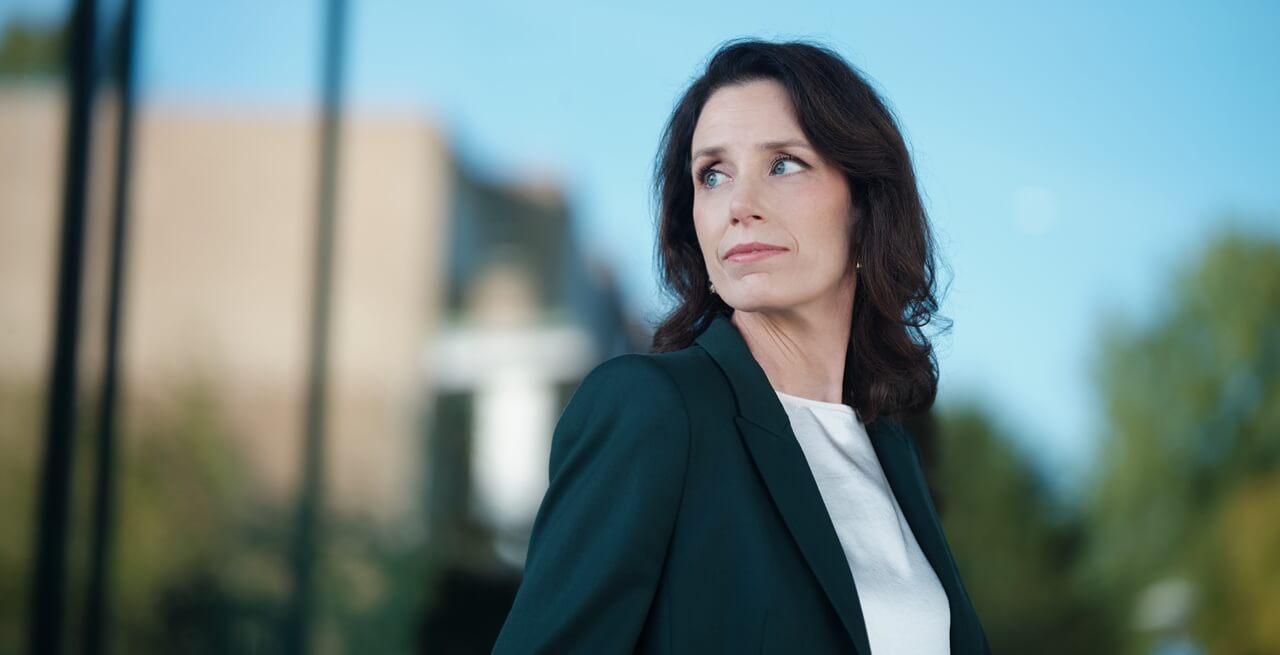
Charlotte Hanneman has spent most of her career in the medtech sector, including roles in France, Japan, and Singapore. Her move to Philips, now two years ago, was a natural progression, yet it also feels ‘very personal,’ she tells interviewer Jur van Ingen, a partner at Deloitte. ‘I was born in Eindhoven. My father worked for Philips for twenty years, and my husband started his career at Philips Sonicare, the division still producing the electric toothbrushes. I could not have foreseen all this, but I find it a wonderful coincidence.’
At the modern Philips headquarters on the Zuidas in Amsterdam, a portrait of Anton Philips by artist Jan Sluijters, with the iconic light tower on the Emmasingel in Eindhoven in the background, serves as a reminder of where the company was founded. It all began with light bulbs and later expanded to consumer electronics, but today the group’s activities are best described under the umbrella of health technology. Moreover, the quintessentially Dutch company now operates globally. Hanneman has a broad mandate as CFO and leads a team of more than 2,500 employees worldwide. ‘With major hubs in the United States, India, the Netherlands, and Panama.’
You have been CFO at Philips for two years now. Looking back on that period, where have you been able to make a difference?
‘To continue performing well, we need to work more efficiently and maintain focus, be clear about what truly takes priority and direct our time, attention, and resources toward that. Especially in a globally operating organization, effective collaboration is absolutely essential. That is why I hold a virtual meeting every Friday with all our business and regional leaders. This way, teams know what others are working on, and bottlenecks can be resolved quickly.
If a regional leader’s order is not approved because certain information is missing, one of the business leaders will almost always know someone who can provide the answers. If a client is looking for a specific product, someone from our supply-chain team – who also joins those calls – can follow up immediately. These short lines of communication not only allow us to respond more quickly, but they also have a ripple effect throughout the rest of the organization. Because we gather around the virtual table every Friday, we have seen the sense of urgency and speed within individual teams truly increase. That combination of focus, collaboration, and pace has made a real difference and is essential given all the geopolitical challenges.’
Speaking of challenges… You took the helm during a period marked by US trade tariffs, damage claims stemming from a large-scale recall of sleep apnea and ventilator devices, and ongoing volatility in the Chinese market. Did you not have some doubts?
‘I am a glass half-full kind of person anyway. Besides, situations such as these present opportunities to change things. The chance to help steer such a wonderful Dutch healthcare company and, together with the team, lead it toward a bright future, makes taking on these challenges well worth it.’
These days, a CFO is no longer just the numbers person. As CFO and a member of the board, how do you bring calm and structure to a complex environment?
‘Given the volatility and uncertainty of the world around us, I have made it a priority to focus on what we at Philips can actually control: in addition to working more efficiently, we must above all prioritize innovation. By bringing our products to market faster, we improve healthcare and accelerate our growth. I find that combination important. I am a firm believer in a growth mindset.
From a CFO perspective, three concepts are key to me: reliability, performance, and confidence/belief. We simply need to do what we promise. We must then translate that into results, both financial and non-financial. For example, when it comes to the quality of our devices. If those first two elements are in place internal confidence builds and customers, patients, and shareholders come to believe that we can deliver.
Focus also requires making tough choices in the allocation of capital and resources. Those choices are not always easy, but they are necessary.
In addition, as the board, we continue to work extremely hard on reducing complexity within Philips. Thanks to AI, we can now analyze and streamline entire work processes more quickly and easily, whether it involves finance or our complex global supply chain, and then significantly simplify them. AI thus offers enormous additional possibilities, but at the same time requires sound governance.
We operate in a regulated industry and play a role in providing critical care, so we are working hard to establish robust governance. Ultimately, we want to move toward a people-led, AI-powered approach – meaning there is always a human in the loop, we always think critically, and we always maintain an overview.’
Philips’ strategic focus is profitable growth toward sustainable value, and it aims to improve 2.5 billion lives per year with its products by 2030. As CFO, how do you strike a balance between profitability and long-term value creation?
‘A significant portion of our growth comes from innovation. We invest nine percent of our sales – 1.7 billion annually – in R&D. That is a higher rate than among our peers. My role is to ensure that this innovation is actually translated into growth. Short-term performance is essential to give long-term confidence to our employees, customers, patients, and, of course, investors, because we are here for the long term. We have been around for 135 years, and it is our responsibility to ensure we are ready for the next 135 years as well.’
Can you give a concrete example of how innovation and growth reinforce each other?
‘One example is our AI-supported software, SmartHeart, which has made scheduling a cardiac MRI much simpler. Performing such an MRI is challenging because the heart is constantly moving. Whereas a lab technician would have to click about 128 times manually to obtain an accurate image, SmartHeart allows them to do so with just three clicks. This simplifies the process and helps improve consistency. As a result, hospitals can scan many more patients per day, thereby shortening waitlists. For us, every additional hospital that purchases the license generates a financial return.
Another, larger example is the SIHREN project, a collaboration with the Indonesian Ministry of Health. The goal is to roll out advanced image-guided therapy systems across all thirty-eight provinces, including in remote areas and the many islands of Indonesia. The first hospitals are already using the technology, and we are now expanding the rollout. To me, this is a wonderful example of how ‘better care for more people’ – our mission – is also a huge growth driver.’
You have spent most of your career in the medtech sector. Is in-depth industry knowledge essential for a CFO?
‘For me personally, I find it very relevant, especially in this sector. You have to deal with specific laws and regulations, for example regarding privacy and the environment. You need to understand how healthcare contracting and hospital financing work. Knowledge of the supply chain for medtech companies is definitely a plus, because that chain is incredibly complex and global and is currently being significantly impacted by trade tariffs. And because it is about patient care, quality comes first. So, as a CFO you will always have to make careful trade-offs in that regard. Of course, there are other ways to learn to understand an industry. It ultimately depends on what a specific company needs; a different background might be just as effective for a particular strategy. But my own experience did certainly make my onboarding much easier.
Moreover, your work becomes more rewarding when you understand the reasoning behind, for instance, a refinancing. I have seen firsthand how fragile life is and how healthcare professionals can make a difference in that regard. I still regularly visit hospitals to observe procedures or surgeries. It is remarkable to see how, in many cases, patients recover quickly after a minimally invasive procedure and are able to leave the hospital again.’
Do you think that CFOs, now that the role is expanding, can or should delegate some of their traditional tasks to the finance team in order to free up more time for more strategic responsibilities?
‘You always have to maintain the big picture, but of course it starts with a good team. I am a firm believer in developing people. That is why we recently launched a program for our most high-potential senior finance leaders that focuses on both content and leadership. It covers topics such as: how do you lead in a world where AI plays an increasingly significant role, and where storytelling is becoming more important? How do you build the best finance team, and become the best leader you can be? So our senior leaders all need to think explicitly beyond the narrow confines of the finance function.’
At Philips Capital Markets Day, I heard you use the word ‘discipline’ several times. Does that characterize you as a CFO?
‘It actually characterizes me as a person, too. To me, discipline means that if you promise something, you have to deliver on it. That is one of the reasons Philips is such a good fit for me, because reliability and responsibility are deeply embedded in our values. I am very pleased that we have met our financial targets for seven consecutive quarters now. At the same time, I realize that in this volatile world, it is not always easy to deliver on your promises, so when you do succeed, recognition is in order. That is why, every quarter during our town hall meetings, I put the business and regional leaders who have reached their targets in the spotlight. I think that is appreciated.’
So, is discipline also a hallmark of your leadership style?
‘Above all, I believe that people are capable of more than they think. Everyone around me senses that I am always pushing them forward. At the same time, I try to do that with warmth and in a way that allows for the occasional stumble, because everyone stumbles at some time. I also see it as my responsibility, especially given my visibility in this role, to open doors for others and give genuine opportunities to people who may not yet be fully ready for a specific role, or who do not yet see it in themselves, but who do have that potential. In the past, managers opened doors for me. Conversely, as a manager, I lobbied for certain women in particular to take on specific roles and encouraged them to simply give it a try. Well, they are still very successful. Sometimes, people just need that final nudge. I try to convey that message both internally and externally, as we truly need everyone on board to realize our ambitions.’
How did it benefit you that managers opened doors for you in the past?
‘I was one of the first female expats sent to France by Organon, the company I worked for at the time. The first few weeks were terrible. The working language was French, and my French was, at best, mediocre. I just could not find a way to break in. After six weeks, and having just sold our house in the Netherlands, I was almost ready to give up and head back home. It was my husband who urged me to try and make it work.
After thinking long and hard about the right approach, I eventually started taking a walk around the office every evening at six pm – since many of my French colleagues started and finished late. I struck up a conversation with everyone I encountered, in my best French. That, as it turned out, was exactly what was needed. Suddenly, they saw the person behind the finance role. The first week, they were surprised when I spoke to them; the second week, they were still a little surprised, but after a few weeks, they understood what I wanted, and I understood what they wanted. From that connection, we started working together. When I left three years later, I found it incredibly difficult to say goodbye. The lesson is that you have to persevere, even when things get uncomfortable. Discomfort is part of the process when you take a leap, and it is a great help when someone encourages you not to give up. I have discovered that there is always a way to turn a new situation into something positive, usually by seeking connection. In that sense, taking a leap into the unknown is a bit like a muscle that you can train.’
You speak passionately about your work. What do you find most rewarding about your role as CFO and board member?
‘If I had to sum it up in one sentence: to, working with others, make an impact, both socially and financially. That is what drives me.’
Interview by Jur van Ingen, finance transformation specialist and partner at Deloitte. Published in Management Scope 09 2026.
This article was last changed on 27-10-2026