
Pieter Duisenberg (Netherlands Court of Audit): ‘A passion for accountability’
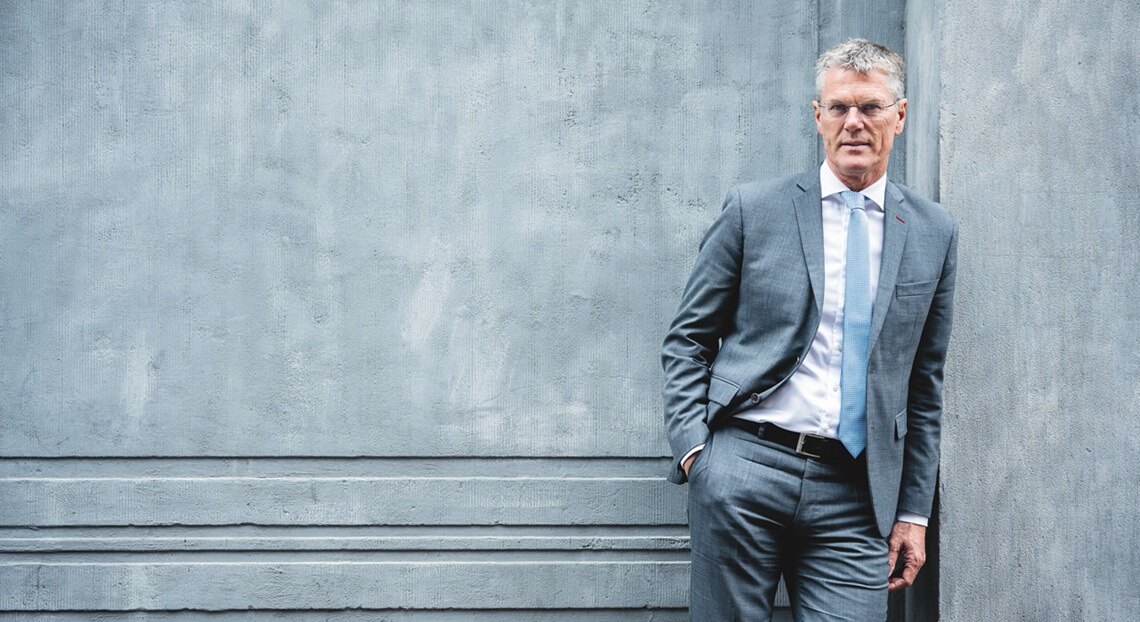
Above Pieter Duisenberg’s door at the Netherlands Court of Audit hangs a single word: results. Since taking office as president in September 2023, he has been emphasizing the importance of this, because: ‘That has been the weak spot for years: our short-term goals on housing, nitrogen, and climate are consistently not being met, causing long-term ambitions to slip out of sight as well.’ Symbolically, the Netherlands Court of Audit website features a photo of Duisenberg addressing parliament with a raised finger during this year’s presentation of the Accountability Report. In this conversation with Vincent Moolenaar, business director of board & governance programs at Nyenrode Business University, however, he primarily extends a hand and asks anyone who is willing to get involved, from executives to citizens, to work together to shape the future of the Netherlands.
After twenty years in various roles at companies including Shell, McKinsey, and Eneco, Pieter Duisenberg entered politics in 2012 and became a member of the House of Representatives for the VVD. After five years in the House, he became chair of Universities of the Netherlands, and since September 1, 2023, he has served as president of the Netherlands Court of Audit, the High Council of State that independently audits the collection and expenditure of the more than 450 billion euros in public funds each year.
You started at the Netherlands Court of Audit nearly three years ago. What has changed in that time?
‘I think I can point to three developments. The first is a shift in what we have our emphasis on. We audit public funds for legality, effectiveness, and efficiency. Legality concerns whether the rules were followed, effectiveness concerns whether policy delivers the desired results, and efficiency concerns the relationship between results and costs. In terms of legality, we score well by international standards, above 99 percent. Effectiveness is something different. The question here is if the intended results have been achieved. Efficiency asks whether that result was worth the cost. For years, our weak spot lay precisely in the results. In our most recent accountability audit, we established that many short-term goals were not met – for example, in the areas of flexible housing, housing for the elderly, and criminal justice – at virtually every ministry. But with that many long-term goals also slipped out of sight.
That is why we created the dashboard, ‘Blik op Nederland’ (A view on the Netherlands) this year. It features ten key themes of broad prosperity, such as the economy, healthcare, housing, nature, and the environment. We will revisit it annually.
It would be good if the cabinet itself were to create such a dashboard and, just as many companies do, display it prominently everywhere, from the website to the coffee machine: ‘This is what we are aiming for, and this is where we stand.’ Because standing still never comes without a cost; it costs the Netherlands much more than the national budget reflects: it literally means ‘sorry, there are no homes available’ or ‘you will after all not receive a power connection.’ That is why we are – and much more forcefully than before – emphasizing the importance of results. Just look at the titles of our accountability reports: three years ago, ‘Think big, act realistic,’ last year it was ‘Do what you promise,’ and this year ‘Performing for the future.’ Those titles show the shift in emphasis.’
And the second and third developments?
The second is institutional, less visible to the general public, but equally important. The House of Representatives approved a motion by Van der Lee and Van Berkel to transfer the certifying audit tasks of the government’s annual accounts – until now the responsibility of the Central Government Audit Service – to us, under the so-called Slootweg model. We will thus become the government’s external auditor, and the Central Government Audit Service will henceforth focus exclusively on internal audit. This arrangement of internal and external audit is already common practice internationally among governments as well as in the private sector. This new audit framework is to take effect starting with the 2028 audit year. I believe this will be highly beneficial for the independence of our institution and, in turn, contribute to the resilience of the democratic rule of law. It is a historic step.
The third point I would like to mention is the impact of technology, digitization, and AI – including on our own auditing process. It is already having a significant impact on our work and will become increasingly more important.’
As a member of parliament, you were already focused on accountability. Is your position at the Netherlands Court of Audit a logical next step?
‘Yes. I brought my passion for accountability with me to the public sector in 2012, when I moved from the private sector to parliament. Together with fellow MP Paul van Meenen, I developed a method at the time to help to decipher the accountability documents. MPs often found these too complex, but it is not rocket science; you just need to work through it methodically. At its core, the method asks three simple questions, the ‘three Ws’: what did the government want to achieve, what did it do to achieve it, and what did it cost? That method is now included in the House’s rules of procedure and is used annually by about twenty rapporteurs – MPs who review the annual reports of ministries on behalf of their committees. That work is not glamorous – it will not land you on the front page of the newspaper – but it is vital for the House’s oversight role. I also introduced the V100 back then: one hundred people from the general public participate in discussions about the accountability documents. That accountability day still exists, with a different target group each year: this year it is young people, previously, it was people from implementing organizations and small and medium-sized business owners.’
Why does accountability receive so much less attention than planning?
‘That is an imbalance in our democracy. Prinsjesdag gets all the attention: the hats, the carriage, the Budget Memorandum, days of news coverage. On Accountability Day, which I personally prefer to call Results Day, it is far too quiet. While that is precisely what it should be about. At home, when you are renovating a kitchen, you do not pop open a bottle of champagne when you get the contractor’s estimate, do you? You do that once the kitchen is finished, once the result has been achieved.
Part of the reason is because the political world does not really embrace the idea that results matter just as much as promises. In politics, the focus is strongly about the vision for society, on where you want to go. Anyone who sets a specific goal and fails to meet it, quickly comes under fire in the House of Representatives, so a vague ambition is politically safer. In addition, certain ways of working are not conducive to results – for example, the Netherlands is one of the few countries to still operate using a cash accounting system, and no distinction is made between costs or investments with long-term returns. Furthermore: if voters were to evaluate political parties on their actual performance every four years, rather than solely on their promises, that alone would make a huge difference – and the media could certainly help with that.’
What is the alternative?
‘Together with the other High Councils of State, the Council of State and the National Ombudsman, we advocate for a realistic government: one that does what it promises and promises only that what it can actually deliver. A government that sets ambitious, but concrete, realistic goals. One that takes into account whether something is in fact feasible. And a different culture: when a goal is missed, what comes first should be the question of what went wrong, not an immediate political crisis. A government that wants to be results-oriented must, above all, become a learning government. With a budget and accountability cycle that more closely resembles that of a business: from long-term plan to annual plan, identifying risks, and the continuous cycle of planning, results, and course correction. You could view that cycle as a steady heartbeat within democracy.’
What is needed to embed that heartbeat into the way the House of Representatives oversees the government?
‘It starts with asking very disciplined questions up front. Not just about promises and letters to the House, but about concrete short- and long term objectives: what funding is, involved, what risks do we foresee. And then, when it comes time to report – a year later, but also four years later – that must be a fixed process in which we hold the government accountable.
The House has already called for this in recent years, including through the Van der Lee motion, which asked the government to present concrete objectives so that the House can monitor the cabinet. This was not achieved under the previous cabinet, but the minister of finance has now announced that it will be included in the upcoming Budget Memorandum.’
Is this approach to setting goals also conceivable on a larger scale within the central government – that is, standardizing the entire process of setting goals and providing accountability, as large companies do?
‘That is certainly feasible. A good starting point is what the Cabinet is currently planning to do with the six task forces it has appointed, chaired by the Prime Minister himself. With these task forces, Cabinet aims to achieve major results on issues such as housing, nitrogen emissions, and the economy. This provides a uniform framework for demonstrating which goals we have set, what results we are achieving, how funds are managed, and what the risks are – which offers a tremendous opportunity to organize this harmoniously across the entire Cabinet and realize our shared ambitions. To achieve this, the House of Representatives should also work less in silos and monitor these challenges in a cross-committee manner. It also requires a different culture: more courage to make big decisions and greater acceptance of risks. Learning from what is not going well yet, without immediately screaming bloody murder at the microphone, and working together to identify where adjustments are needed.’
What can the business community learn from the government, and vice versa?
‘I advocate for more cross-pollination between the private sector and the public sector, so that both worlds develop more understanding and respect for each other. At the same time, I caution against simply applying corporate logic to the government. Governing the public sector is many times more complex than running a company: there are far more stakeholders and far more conflicting interests to balance. Take higher education: there are doubts about the many English-language programs at our universities, while at the same time we need highly educated knowledge workers for the major transitions. You see that kind of tension constantly. That is why we, as the Court of Audit, try not only to assess retrospectively whether goals have been achieved, but also to indicate our views on the set goals and risks as early as the budget phase – regarding asylum costs, for example, we warned that an expected savings target was unrealistic because more expensive emergency accommodation would inevitably follow.
I would like to see the business community invest just as strongly in public values as the government is expected to do – think of a societal license to operate, in addition to your legal license and the requirements of the capital markets. As a company, you cannot hide behind regulations when the question is whether you have acted in the public interest, for example regarding emissions. That reciprocity also comes into play when I see members of the House of Representatives or the Cabinet who have an incredibly hard time to get back into the workforce after their political careers end. Anyone from the business world who complains that too little business experience is entering politics is being hypocritical if they do not give those same people a chance upon their return.’
How can the Netherlands regain the ability to make great strides?
‘The Netherlands had to collaborate at lightning speed on the LNG terminals in Eemshaven after the outbreak of the war in Ukraine. At that time, everyone laid their cards on the table: ministries, provinces, state-owned enterprises, and the companies already there all stepped up because there was a shared, urgent goal: the ships had to be brought in to ensure the security of gas supply.
We need that same spirit of working together for the major leaps and transitions in the areas of housing, nitrogen, and future prosperity. And that requires not only the government to step forward, but also the business community: the umbrella organizations, but also individual companies and executives. I see initiatives like NL2025, in which entrepreneurs and executives come together to work together on those transitions, and I consider that a very positive development. More of that, please. I wish more executives would simply stand up and speak out, rather than – as with that famous image of the tinted van with CEOs on their way to the Catshuis – preferring not to be seen.
In my introductory speech in the House of Representatives this year, I referred to the decision by Thorbecke and the then House of Representatives to dig the Nieuwe Waterweg, so that Rotterdam would have a direct connection to the sea. There was no business case for it. But the Netherlands was lagging behind in industrial growth, and it had to be done. As Thorbecke put it at the time: ‘This is a daring undertaking, but it is an undertaking we must dare.’ The Waterway ultimately cost six times as much as promised. But look at the Port of Rotterdam and what it has meant for our economy. We need that kind of courageous decision-making again.’
You took such a leap yourself in 2012, when you made the switch from the business world to the House of Representatives. What tipped the scales?
‘Of course, I had a hundred reasons to say ‘no.’ But my sister had passed away shortly before I was approached by the VVD. I thought: ‘there might not be a later,’ keeping in mind the motto I have hanging on the wall here: the Frisian phrase ‘Slûge soe ek, mar hy stoar earder,’ which roughly translates to ‘who hesitates too long, is too late.’ So I took the leap. I sometimes compare it to standing on the edge of a ten-meter diving board. If you have carefully considered the risks of things going wrong, you are actually more likely to take the leap than if you do not know that risk. In that case, your risk analysis actually encourages the leap, rather than being a reason to back out. And that applies just as much to an individual career move as it does to a country that needs to focus more on long-term goals.’
How optimistic are you about the Netherlands?
‘I am positive about what we as the Netherlands can achieve. We have been stuck for too long, but with the task forces the cabinet has now established, I expect a breakthrough. People who want to work together to break through this stagnation, are stepping up. That gives me hope.’
This interview was published in Management Scope 07 2026.
This article was last changed on 25-08-2026