
Michel Verwoest (TVM): ‘Electrification to survive’
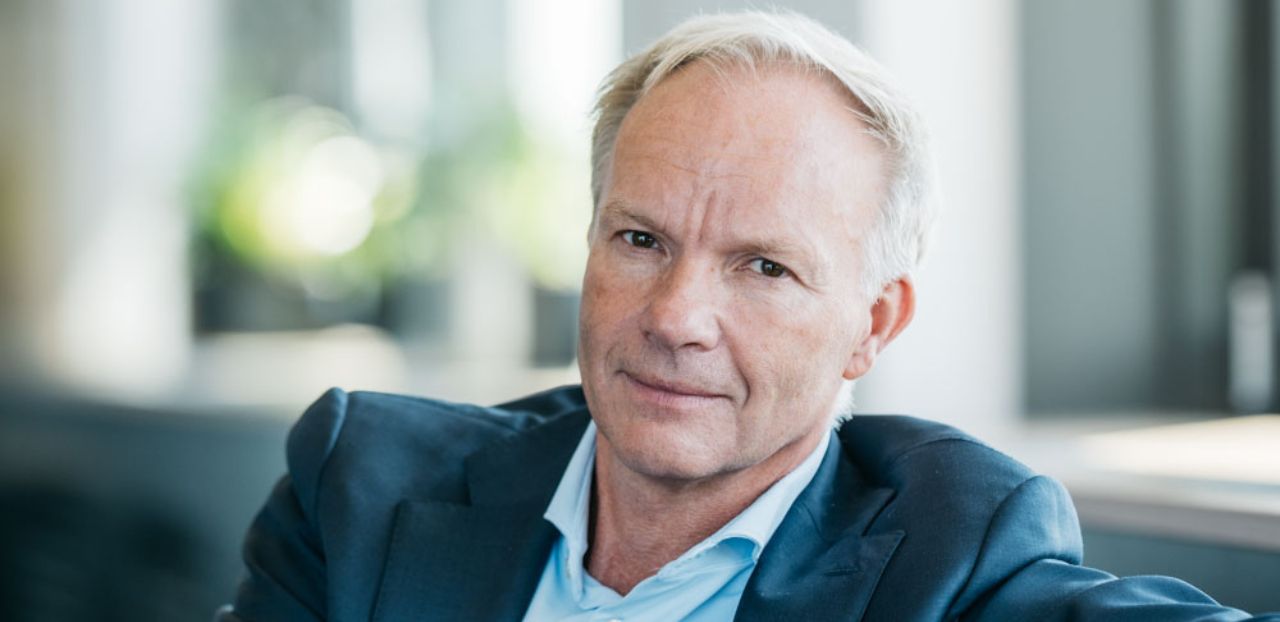
The Netherlands runs on transportation. Without trucks, supermarket shelves would run empty within a few days and hospitals would no longer receive their medicine deliveries. This vulnerability is not new, but it is particularly relevant now that the sector must electrify. Michel Verwoest, chairman of the board of the cooperative transport insurer TVM, witnesses how his members have to pull out all stops to achieve this energy transition. In this conversation with Frank Meens, Head of Commercial Operations at Vattenfall, Verwoest explains the key developments in the transport sector, why a gradual transition using HVO (hydrotreated vegetable oil, a renewable diesel, ed.) can serve as an intermediate step, and what the energy transition in the transportation sector demands of the leadership within his own cooperative.
Transportation is sometimes mentioned in the same breath as gas, water, and electricity. How essential is the sector actually to the Netherlands?
‘Without transportation, nothing happens in the Netherlands – and, in fact, throughout all of Europe. Imagine two days without transportation: supermarket shelves would be empty, construction sites would come to a standstill, and hospitals would run out of medication. Transportation does indeed belong in the same category as gas, water, electricity, energy, and the internet: the most basic services that keep the Netherlands running.
The Netherlands is also a hub within Europe, thanks to the Port of Rotterdam and Schiphol Airport. Schiphol serves not only as a passenger hub but also as a cargo hub. My concern is not that the demand for transportation will disappear – consumption is only increasing.’
So the demand for transport is not abating. What is changing in the sector, then?
‘What is changing is the business model for transportation and logistics. The most significant change is the energy transition: with more electric trucks, you can increasingly make the difference through energy management and reducing energy costs. It no longer is just about covering kilometers. I think that the transporter of the future might well become more of an energy manager than a road manager.’
Can you explain that with an example?
‘Take a transport company with fifty vehicles that drive 400 kilometers every day. That company consumes about as much energy as a small village. In the cost price of transportation, labor and fuel or energy are the two major expenses, while the margin is often no more than one or two percent. The moment your energy costs are five percent higher or lower than your competitor’s, you are in or out of business.If you practice good energy management – when you charge, where you source your energy, whether you are partially self-sufficient – that makes a big difference in the price per kilowatt, which in turn makes the rest of your business more attractive. If you do not, every job becomes a risk, because you are not operating at cost. Sometimes there is actually more money to be earned from energy management than from the truck itself.’
So, how does this change the risk entrepreneurs face compared to the current diesel market?
‘In the diesel world, there is more or less a level playing field. If something happens in the Strait of Hormuz or in Ukraine, the fuel price rises roughly equally for everyone. With electricity, the impact depends on your own contract and your ability to manage it. If you have your own wind turbine, solar panels, or batteries – or if you can charge at your customer’s location – price fluctuations barely affect you. If you rely on the public grid without your own alternative, then you are vulnerable.
I expect that businesses that have control over their energy management will thrive in the future, while those unable to invest in it – for example, because they face grid congestion – will face greater challenges. In the past, the distance to a highway interchange determined the value of a distribution location; now, available grid capacity is often more important.’
Is electric driving then the only way forward, or is there still room for hydrogen and other fuels?
‘Hydrogen is still rarely used for regular road transport – at most for very heavy transport, inland waterway transportation, and heavy industry. An electric truck is currently still two to three times more expensive than a diesel model, and the same applies to a hydrogen truck. Hydrogen refueling stations are scarce and insufficiently subsidized, while electric trucks now have a range of about 800 kilometers and there are more charging stations.
As far as I am concerned, HVO – a renewable fuel that can simply be used in existing diesel engines – is the interim solution. This fuel significantly reduces CO₂ emissions without requiring an immediate investment in new vehicles. The sector is already facing a massive investment challenge. This intermediate step is necessary because grid congestion is the bottleneck: it is not resolving quickly enough to allow for a complete switch to electric. If policymakers were to gradually accept HVO alongside electric vehicles, the transition would get off to a much smoother start. Right now, it feels like an all-or-nothing choice for business owners, and that leads to paralysis.’
Yet electric driving is already growing rapidly. Where is this acceleration coming from if the infrastructure is not ready yet?
‘Starting next year, electric driving will often be more cost-effective per kilometer in terms of total cost of ownership, because diesel is expensive and a per-kilometer fee will be added. That is driving the acceleration, but the impetus is coming from the supply chain. Major retailers like Jumbo, Albert Heijn, Lidl, and IKEA want to become more sustainable, and their carbon footprint starts with transportation. They require their suppliers to use electric vehicles and pay a per-kilometer allowance for this. Things are moving at lightning speed at those companies.
If you are a moving company in Apeldoorn, the private customer mainly wants the cheapest moving box, and electrification barely plays a role. If you are a company in The Hague moving government agencies all week long, the client demands an electric vehicle, and you have to go along with it. If the supply chain demands it, things move fast – if the client does not demand it, progress lags behind.’
Is waiting not an option, then, for entrepreneurs who are still hesitant?
‘Waiting is the worst thing the transportation sector can do right now. If you have a hundred trucks, you do not have to convert thirty of them to electric right away. Start with five and learn: how does this change my scheduling, my investment strategy, and my conversations with customers? Companies that start with this build up knowledge and can scale up faster later on. Those who wait and see out of fear of exactly how it will turn out, will soon be too late.
Companies that take up the challenge get excited and start looking at their transportation more creatively. Drivers sometimes say that diesel runs through their veins. But once you have gotten used to electric vehicles for a while, you might actually find them more enjoyable than diesel.’
What is TVM’s own role in this transition – what concrete contribution can an insurer make here?
‘The most important thing is that our people know the sector and the business owners personally. We are essentially part of the transportation sector that also provides insurance, and that enables us to fine-tune risks very precisely. The challenges business owners face are changing, and we want to help them navigate them. For example, we offer zero-emission insurance: if the manufacturer's warranty no longer covers an electric truck’s battery, we assume part of that risk. And we offer a comprehensive insurance package for charging stations. For us, this represents a manageable risk across our entire portfolio; for the business owner, it can be the deciding factor in purchasing that electric truck.
We also solve practical problems. Through the TVM charging card, transportation companies can use each other's charging stations. Owning a charging station is a significant investment that sits idle for much of the day because the trucks are on the road. We facilitate members charging at each other's stations, at a price they set themselves but which must be lower than the public grid rate. This increases the utilization of charging stations and shortens the payback period of the investment.’
TVM is a cooperative. What does a member actually experience when things go wrong?
‘Last year, one of our members was hit by a major fire: the office, workshop, and trucks were all destroyed. Financial compensation does not help if, in the meantime, you lose your customers because you cannot deliver for a few days. That very Friday afternoon, our people were already on site, helping the business owner take all the necessary steps to get back up and running as quickly as possible. That weekend, we arranged for replacement storage space with other members and transferred the systems so the company could schedule deliveries again by Monday morning.
Afterward, a colleague took it upon himself to spend nine months restoring the business owner’s miniature trucks, which had been damaged in the fire – a collection he had built up over many years. A year later, we returned them to him as a symbol. That is the kind of thing that explains why our customer satisfaction rate is roughly twice as high as the industry average.’
Digitalization and AI are playing an increasingly crucial role. Not only at transport companies, but also at TVM, I suspect. What role do they play at your insurance company?
‘We have set up a small, young team – I jokingly call them the CEOs of the future – that operates independently from existing processes and is envisioning an insurer built from the ground up on AI. They started with five clients: build a new insurer from the client's perspective. That has been going on for half a year now, and the initial results are nothing short of surprising.
We used to want everything structured into a claims form, but a driver does not think in terms of a form. One of the ideas is that he or she will soon be able to verbally describe what happened, and AI will process that and link it to the policy terms. In the past, we mainly focused on how to digitize the claim form itself. With an idea like this, we are relying more on customer data, and that requires a fundamentally different way of thinking. Digitizing existing processes might yield a twenty to thirty percent efficiency gain. With AI, you can redesign the entire process. That can lead to faster processes and greater customer satisfaction.’
What do all these changes – energy, the labor market, technology – ultimately require of the leadership of a company like TVM?
‘For a very long time, we operated in a world where you could still make gradual plans for three or five years. That is over. Leadership now requires that you be able to manage both evolution and revolution simultaneously, and that you remain open to what is happening in your environment. These days, in-depth knowledge resides with a small, specialized group of people within the organization – no longer just at the top with the board. Your task as a leader is to facilitate, connect, and disseminate that knowledge.
That is why we are steering TVM towards five strategic themes, each led by a duo from the board of directors together with business owners, with market targets that we adjust as soon as the assumptions change. Every Wednesday afternoon, we have a strategy meeting: of the three hours, two are devoted to discussing bottlenecks and decisions, and one hour to progress and budget. That works better than the large, multi-year project plans of the past.
Sustainability is not the only challenge. The labor market is at least as significant: an aging population, the driver shortage, autonomous driving, and the influx of new workers. You need to have a ten-year plan for this already, without betting everything on a single technology or scenario – you have to keep your options open so you can accelerate as soon as necessary. Ultimately, this transition can only succeed if transportation companies, insurers, energy companies, and the government work together. Only then can we ensure that stores remain stocked, medications arrive, and goods are delivered at the right time at the right place.’
This interview was published in Management Scope 08 2026.
This article was last changed on 22-09-2026