
‘A modern leader needs a strong sense of reality’
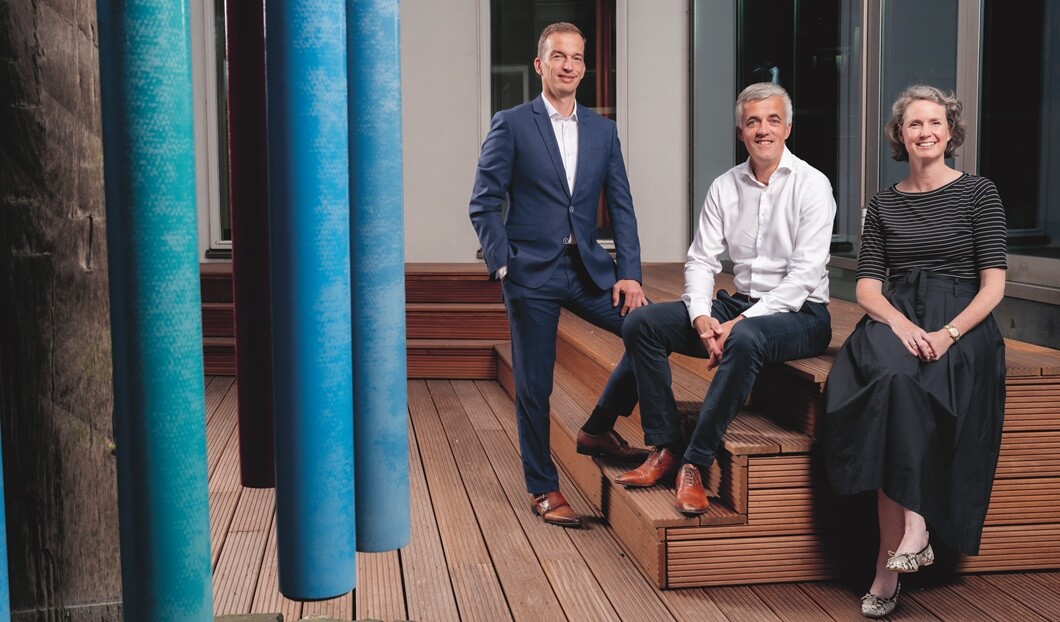
The conversation takes place in the Groningen Seaports office, atop the Baaisterhoofd, perhaps the most beautiful spot in Delfzijl. ‘A different view every day. The seals sometimes swim by here.’ From his office, CEO Bart Jan Hoevers looks out to the left towards the sea channel, in the direction of Eemshaven. Rows of wind turbines stand on the horizon. To the right, across the water, lies Germany with the industrial city of Emden. It is an area with both challenges and opportunities. Weite Oldenziel, born and raised in Groningen and a guest of Hoevers: ‘In the Netherlands, this is seen as a backward region. A problem area.’ Oldenziel sees it differently: ‘If you zoom out, this is just a place in Europe, coincidentally in this region. The specific location is not particularly exciting or fascinating to us.’
Both men have been working in the North for a long time, they tell moderator Willemijn Broerse of interim management and strategic consultancy firm Boer & Croon. Hoevers served on the Gasunie board of directors for a long time before making the switch to Groningen Seaports last year. ‘I really wanted to continue working in this region. And I wanted to remain active at the intersection of public and private sectors. I found that here. There is a lot of energy in this organization and in this region.’
Oldenziel heads the pharmaceutical company Ofichem, the company founded in Ter Apel by his father. Oldenziel: ‘My father was a true Groninger. If you can say something in one word, there is no need to use two. He had actually come to the conclusion that his company no longer had a future. China took over the entire business in no time. Just before his unexpected death in 2006, he said: ‘We will need a bulldozer to move this.’ After his death, I was forced to take over the company. I studied the market thoroughly and initiated a number of strategic shifts. We established a number of trading companies. They set out to do exactly what my father always fought against with his manufacturing company, namely importing from China and India and exporting to the rest of the world. We reinvested the money we earned from that back into the production company, which now operates much more in the niche segment of the pharmaceutical market.’
That immediately makes clear what you are dealing with as leaders in a changing world. What change or development is occupying you the most at the moment? And what are your concerns?
Oldenziel: ‘Without a doubt, the geopolitical landscape. And especially the race between China and the US and the question of how Europe can remain relevant. And especially as the Netherlands within Europe, or as the Northern Netherlands within Europe. I sometimes feel that we are a bit naïve in Europe. That we are still resting on the laurels of the success we have had over the past centuries. I also feel that political decision-making in Europe is rather reactive. Everything is ‘in response to.’ If we decide to adopt the NATO norm of five percent, we do so in response to Trump. If we draw up an energy plan, we do so in response to Russia’s invasion of Ukraine. If a COVID-19 pandemic strikes, we only start thinking about the supply chain. In a company, you develop a multi-year strategy. You create a plan, with a vision and objectives. That seems to be lacking in politics.’
Hoevers: ‘I am primarily focused on long-term investments. And I partly recognize what Weite is saying: when crisis situations arise, sometimes different considerations are suddenly taken into account. Yet I have also seen that crisis situations, in particular, can act as a massive catalyst. Russia’s invasion of Ukraine accelerated thinking about energy market autonomy. A real acute crisis puts you in action mode immediately. Maintaining momentum in long-term, multi-year processes is extraordinarily difficult. Take the installation of offshore wind farms, for example. That is a complex tender process – you really need stamina for that. And a vision. For politicians, the quick fix is often more appealing than the long term.’
What do you think the role of the government should be, and what is the role of entrepreneurs?
Oldenziel: ‘The government too often acts like an entrepreneur: reacting to the turbulent waters. But in principle, the government should not focus on the waves, but on the course toward the horizon. You would expect a government to have a long-term vision. In that regard, we could certainly take a cue from China. A week and a half ago, I was there again, and I was astonished by the developments. In Shanghai, seventy percent of traffic is electric; virtually all roads have been built in the past twenty years. You can say a lot about it, but the fact is that China has a vision. When you see how slow decision-making is here, what the discussions are about, and how politicians are constantly preoccupied with trivialities - that does worry me. We are lagging behind in everything.’
And how do you navigate such a landscape as an entrepreneur, as a CEO?
Oldenziel: ‘By anticipating. As an entrepreneur, you have a vision and a plan. And you try to stick to them. Then it is about responding to whatever comes your way, but always with the bigger picture in mind. You cannot do more than that.’
How does that apply to Groningen Seaports?
Hoevers: ‘We operate in a context with public shareholders. And as a company with government shareholders, I actually think it is good that we are given the leeway to make our own long-term plans. And to take control ourselves. And, of course, you have to do that in line with the objective that applies to you. We need to further develop the ports of Delfzijl and Eemshaven here. But we can develop our own vision for that. We are closely aligned with the government, but at the same time, we can develop our own plans.’
Let us zoom in on the theme of ‘leadership in a changing world.’ Because every transition also involves letting go of old certainties. I am curious to hear your perspective on this.
Hoevers: ‘I think we need to recognize, above all, that there are many things we have no control over. We must acknowledge that we live in a complex world and that we face uncertainties. A leader does not necessarily have to make the perfect assessment of what is going to happen; a leader must, above all, have the resilience to deal with different situations and to adapt. If asked where exactly things are headed, I immediately admit that I do not know either. But I do know which direction to choose. I spend a lot of time weighing the various considerations and scenarios.’
Oldenziel: ‘I think that, as a leader, you must above all dare to show vulnerability. You also need to take a good, hard look at yourself in the mirror regularly and dare to ask whether you are still the right person in the right place. You need to ask others for feedback. Above all, you must be able to deal with uncertainty. For a company, there is no guarantee that it will still be around next month or next year. Ultimately, your biggest role is to ensure the long-term continuity of your company.’
You also have to make decisions even when you are not really sure they will turn out well. That can be discomforting, I imagine…
Hoevers: ‘Certainly. But as long as you can explain what you are doing, it works. Your story has to add up. You need to be able to make clear the vision behind your investments. And in doing so, you have to acknowledge that there are assumptions involved. For me, that transparency works better than taking a very definitive stance. I consider a sense of reality an important quality for a modern leader. And you have to remain humble, recognizing that you are just a small player in the enormous global turmoil.’
Oldenziel: ‘Every now and then, it is pretty lonely at the top. I experience a chronic sense of unease. That is inherent in the role. After all, I am not only the CEO of the company, but also the owner. As CEO, you can be fired by the shareholders or the supervisory board; then you look for something else and move on. But as the owner, you bear an extra responsibility for the company, for the employees, and for all stakeholders. It is a huge responsibility. At the end of the year, you cannot go knock on someone's door and say you are short on funds. If things really go wrong, the only place you can go to is the food bank. That is a crucial difference in modus operandi.’
Hoevers: ‘For the first eight months, I was the sole director here. I recently gained a co-director, and I immediately realized how much nicer that is. It is a relief to be able to bounce ideas off each other, to set a course together, and to keep each other on our toes. When you are the only one at the top of the pyramid, it is much more complicated.’
Oldenziel: ‘That is, of course, part of what makes me uncomfortable. Of course, I have people around me. I discuss everything with my CFO and with the management team, but at the end of the day, you are on your own and you have to make the final call.’
Words like ‘loneliness’ are part of that too…
Oldenziel: ‘Yes, certainly. In a way, yes. But you should not make it more dramatic than it is. It is an element of the profession that is to an extent enjoyable. If you cannot handle it, this is not the job for you.’
And if you get stuck on something, you go horseback riding?
Oldenziel: ‘Well, not during work hours. I am a bit too Calvinistic for that. It is not done. But taking a bit of distance helps. The best ideas come, for example, on the plane, when I am traveling and can view things almost literally from a bird’s eye perspective.’
Do you become more directive in times of uncertainty, or not?
Oldenziel: ‘Perhaps somewhat. The question is also: what is the uncertainty? Something is always happening in the world. It always is uncertain times. Within our group, we tried to distribute the risks. So, if one company is not doing so well, another is doing better. We did this very deliberately to ensure long-term continuity. What is a threat to one business unit is an opportunity for another. Our trading companies, for example, benefit from turmoil; they thrive on it. Whereas a manufacturing company does not benefit from it at all. So, there is always something happening somewhere.’
Hoevers: ‘It is particularly important to make it very clear within the organization that new themes are being introduced. For us, sustainability was the top item on the agenda for a long time. At a certain point, another theme was added: strategic autonomy. Those agendas overlap to some extent: offshore wind is important for both. But what are we doing, for example, to make our ports more resilient? That is truly a new theme. Three years ago, we would not have thought that the Ministry of Defense would become a potential client. A client like that shows up on your doorstep out of the blue, and then you have to figure out how to deal with it. You will have to explain to the organization that the strategic frameworks and strategic goals have changed as a result.’
Where do you see opportunities for the Netherlands or for the Northern Netherlands?
Hoevers: ‘In the areas that have made our country great: by making certain innovations practical. We need to have a number of disciplines in which we excel. The Wennink Report has laid a good foundation. It will come down to stimulating innovation, education, and R&D. A government will also have to be willing to fail. Not everything will succeed.’
Oldenziel: ‘We also need to see the bright side. We are a wealthy country for a reason. We have certain infrastructure, a certain mindset, and a certain level of education. We have few religious or political restrictions. So, we actually have quite a lot here in the Netherlands. But we do need to be willing to grow in certain areas. You can have universities and infrastructure, but you also need to ensure there is a capital market to develop things. You have to make it fiscally easier to invest in something. And the government needs to move along.
Take my field: drug development. The Netherlands is very keen to have R&D laboratories. But they have to do something to make that happen. I was recently talking to someone from an American pharmaceutical company. He was very firm: if the Netherlands does not buy our products, we are not going to set up an R&D center here. But other countries do. There is a huge discrepancy between what is said here and what is actually done. Does that bother me? No. We produce for customers in Japan. For customers in the US. Those are countries that put their money where their mouth is. We are based in the Netherlands, but we produce very little for the Dutch market. We would love to do so, but if it is not feasible, then so be it. It is somewhat paradoxical, though – wanting R&D but not buying the products.’
To conclude, one last question: If we fast-forward a few years… when will you feel you have done a good job?
Oldenziel: ‘When the plan we devised is fully realized – in every respect. It is not that difficult: you come up with an idea and then ensure the execution step by step. We should not overcomplicate things. Someone said to me recently: ‘All that nonsense about a vision. Entrepreneurship is just like swimming: you set a course, you dive in, every now and then you stick your head above water for a breath, and the rest of the time you have to paddle really hard underwater.’ That, I thought, was well said.’
Hoevers: ‘I partly agree. But sometimes you stick your head above water only to find the environment has changed. Or the tide has gone out and you are stuck in the mud. Even then, you have a role to fulfill – that is leadership. When I look back in five years, I hope I will have done just that. That, given the geopolitical and social developments, we have seized our opportunities.’
This article was originally published in Management Scope 07 2026.
This article was last changed on 25-08-2026