
Ingrid de Swart (a.s.r.): ‘This job is even more intense than I thought’
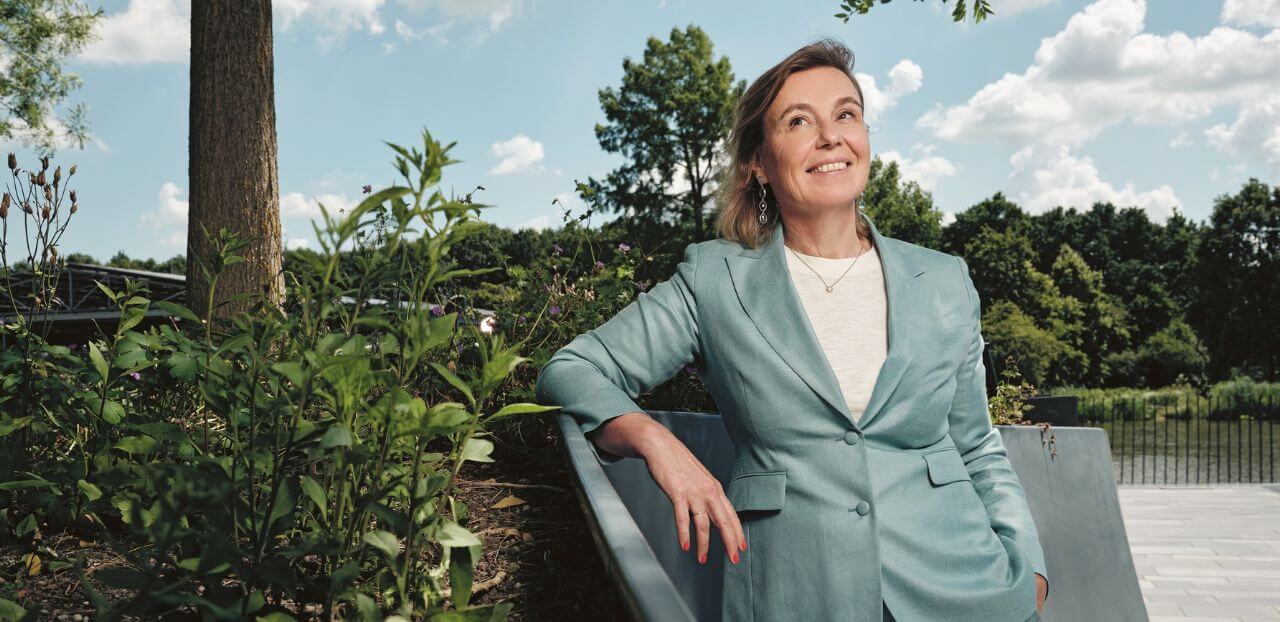
The successor to ‘Mister a.s.r.’ Jos Baeten spent the months leading up to her appointment and the first weeks in her new role primarily conducting dozens of meetings: with employees, fellow CEOs, the supervisory board, and investors. But slowly but surely, the preparations are coming to an end. Ingrid de Swart – who has been on the executive board of a.s.r. since 2019 – will present the new strategy for the next three years on December 1. ‘I feel a kind of pre-game tension,’ she says about it.
Alexander Tamminga, partner at consulting firm Kearney, sits down with De Swart to discuss her preparations for her new role, the things that have surprised her, her leadership style, her role in the public debate, and lucky cats. ‘What strikes me about my new position is that there are so many firsts. For everything.’
You are the successor to one of the longest-serving CEOs in the Netherlands, Jos Baeten. Do you still have much contact with him?
‘Jos and I both invested a lot of effort in ensuring a smooth transition. That went very well. I speak to Jos once a week on average. But those conversations are not necessarily just work-related. I know him well; we worked together very closely for nearly seven years, so we share a part of our lives. Of course, we are both curious about how the other is doing. For me, it is taking some getting used to in my new role, but I can imagine it takes some getting used to for him as well. He has been doing this work for years. Making the transition from that intensity to a normal rhythm of life is quite a transition.’
Your intended appointment at a.s.r. was announced in the fall of 2025. What did you do in the months leading up to your final appointment?
‘I found that period to be unique. On the one hand, I was still fully engaged in my old role, and specifically with finalizing the integration of Aegon Netherlands into a.s.r.. In the final phase of such a process, the somewhat tougher issues always come up. So that was challenging, but we managed to get it all done in good time. At the same time, I also knew I had to prepare for what was to come.
The advantage of such a transitional period is that everyone knows you are going to be the new CEO, but you are not CEO yet. I used that time to talk to a lot of people. For example, I had conversations with about ten fellow CEOs. From the insurance industry, but also from other sectors: the supermarket industry, the biotech industry, IT – people from the Netherlands and abroad. I mainly wanted to hear from them how they prepared for the role. And also what they see as important issues.’
What lessons did you take away?
‘They all emphasized, for example, that it is important to take good care of yourself: eat well, exercise, and get enough sleep. They all urged me to make sure to invest in building a strong relationship with the supervisory board. A third and obvious lesson concerned the team. It is extremely important to put together a strong, well-suited team. I certainly did that. It was clear from the start that CFO Ewout Hollegien and I wanted to do this together as the executive board.
The advantage of being an internal candidate is that I knew everyone here and have been working with them for quite some time. As a result, we were able to staff the team largely with internal candidates. I am very proud that we succeeded in doing so and that the a.s.r. colleagues were the best candidates for the roles. I also consider it important that we were able to bring even more diversity to the team.’
And your relationship with the supervisory board? Have you been able to work on that yet?
‘When there is a change in leadership at an organization, you have to take some time to find your footing together again. The supervisory board has placed its trust in me to lead this company. That is already a great starting point. But then you have to ensure that you use that trust well. That is why it is important to communicate with one another effectively, to get on the same page. That is why supervisory board chair Joop Wijn and I both took time to invest in our relationship.’
So, there were discussions with fellow CEOs, with your team, and with the supervisory board. Who else did you speak with?
‘I am still in the middle of a summer tour among all a.s.r. employees, to hear what is going on and what everyone is working on. We went to London with our top twenty-five executives to visit a number of companies that are already quite far along in their adoption of AI. I have spoken with several strategy consultants. And recently, I also did a sort of reversed roadshow. I have been talking with our investors and with analysts. I especially listened to how they view a.s.r.. That was very insightful.’
Have you also discovered things in your new role that you had not anticipated?
‘You have all kinds of ideas and expectations, and yet you can never be fully prepared. What I have not been able to fully anticipate or prepare for is that this job is more intense than I thought. I expected that switching gears would be important, and it is. But I have to be more ‘on’ than what I am used to. The spotlight is always on you, even when you are not saying anything. That is new to me. I address groups more often than before, and while I am totally used to standing in front of groups, it now sometimes is two, three, or four times a day. At the moment, I cannot quite tell whether that is because I am new or if it is just part of the job.
Another thing that strikes me is that there are so many ‘first times.’ For everything. And with all those first times, you have to take a moment to think about how you are going to handle it. Am I going to do it differently than my predecessor? Or am I going to continue what we have been doing? Those are constant decision points. You have to pause and reflect on them each time. I find that very intense. I have gained a new group of stakeholders. And I have many more CEO-to-CEO meetings, which I obviously did not have before. So far, I am really enjoying it all, but there are very few moments when you are not ‘on.’’
You also had to hand over tasks that you previously managed yourself …
‘We have redistributed the responsibilities on the board. In addition to COO Life, Willem van den Berg, Robert van der Schaaf has been appointed COO Non-Life. He hit the ground running right away. My other former responsibilities have been divided among the other colleagues on the management board. These are people in whom I have great confidence, so I can entrust my old responsibilities to them with peace of mind.
Robert has taken a lot of the pressure off me during my first weeks as CEO. From my old portfolio, I have kept IT with me, because I am convinced that technology is such an important driver of transformation that it is truly a top priority. Take AI, for example: I have ideas about it, and I have strong opinions on the matter. Everyone here knows that. Because I am now CEO and have decided to keep IT close to me, it immediately sends a very clear message that we are going to make this a priority.’
What do you want to happen? Can you be more specific?
‘That we truly embrace AI and that we will see it integrated in all of a.s.r.’s processes. AI will become a permanent new colleague for everyone. And at the team level, we will have many opportunities to exchange knowledge and to really do things differently together, to make things better. IT/AI accounts for about thirty percent of the transition, while seventy percent comes from colleagues – from adoption.
I was already driving this movement when I was COO. Back then, people were already willing to listen to me. But I have noticed that now that I am CEO, my words carry more weight, and the leadership transition is also creating momentum. People are paying more attention to me. I did not expect that to happen right away. So I do have to weigh how I say things, because my words carry more weight. I really want to capitalize on this momentum. I want my first few times at bat to be good. That is a pressure I am putting on myself: to simply get off to the best possible start.’
What do you want to achieve in your first few months?
‘The planning period for our current strategy ends at the end of this year. The completion of the Aegon integration and the CEO transition is a fantastic moment to reassess the strategy. We are working hard on that with the new team. I think it is important that we work together to ensure the long-term continuity of this company. We will communicate exactly how we are going to do that – and where we will be focusing our efforts – to the market on December 1, during our capital markets day.
The month of December will be crucial for further communicating this strategic realignment internally, as well as to our advisors and clients. We are in an excellent position. I have had the privilege of taking the reins of a company with a rock-solid foundation. That gives us the freedom to be entrepreneurial. Now it is about making the right choices at the right pace.’
December 1 is an exciting moment. There are certainly expectations for the new leadership.
‘December 1 is indeed, and I will not beat around the bush, an important date. It is a moment of truth. And the publication of our half-year results is, of course, also a key moment. So it is good that I have already done that reversed roadshow, allowing them to get to know me a bit better.
I am looking forward to December 1, because it is also fun to build this together. I already feel a kind of pre-game tension. It is intimidating, but also enjoyable. It gives me a lot of energy, partly because you can really focus on moving forward. You can work toward something new.’
What kind of leader is Ingrid de Swart, really?
‘The supervisory board commended me for my connecting style. And I recognize myself in that. I like to connect people with one another and I like connecting people to goals. I am at my very best when certain results need to be achieved while also benefitting the customer. The combination of customer focus, people focus, result focus, and technology – those are the things that define me the most.
I think I am also known as a good listener. Beyond that, I have no trouble making decisions. I am steadfast. Clear. With a bit of tough love. So it is nice to have empathy, but I also want to be clear about the boundaries.’
How do you present yourself as a leader within the company?
‘I have given a lot of thought about how I want to communicate internally. I believe inspiration is important – that you need to be engaging, and that people want to follow you. Of course, we had an intranet, a staff newsletter, and employee sessions here, but I wanted to add something more contemporary. Now, every now and then, I post a personal entry in the leadership corner on Viva Engage, an Instagram-like feature within Microsoft Teams. There, I share a bit about myself – both about what I am working on here and what keeps me occupied at home. A combination of business and personal. For example, I talked about my guilty pleasure and encouraged my colleagues to share theirs too.’
Your guilty pleasure? Tell us…
‘I love lucky cats – you know, those waving Japanese lucky cats. I collect them. I have 150 in total, in all sorts of colors. Or no, actually, now there 152, because I got two more from people in the company. The lucky cat brings good fortune and prosperity. Yes, I am a little superstitious. I often carry a lucky cat with me when I have to do something nerve-wracking.’
Today, too?
‘Not today. I do not find this conversation with Management Scope all that nerve-wracking. But if I have to deliver on something – then yes. And I notice that when you tell your colleagues that you are a little superstitious and share personal things, you quickly build a connection.’
Do you actually have a mentor or a coach?
‘I like being coached by young people. We hire about ten new trainees here every year, fresh out of university. We always ask them to give a pitch to the management board. And I ask a few of them to become my mentors. So, every year, I have three trainees who serve as my cross mentors. They tell me what stands out to them, what surprises them, and how they would approach things. They hold up a mirror to me. And I notice that this becomes increasingly important as you get older. It is also a useful way to keep yourself open to new influences from other generations.’
a.s.r. is an organization that has always been at the heart of society. That will presumably not change. Will you also become more actively involved in the social debate?
‘By definition, a company plays an important role in the social context. Especially when it comes to insurance. It is my conviction is that an insurer ensures the primary economy can function. We are the safety net for primary economic activities. We often act as facilitators for entrepreneurs or enable people to do things they enjoy – such as travelling or finding a place to live. And that means that, by definition, as an insurer, you have to be firmly rooted in society.
I also see an important role for myself when it comes to debates on sustainable employability in the Netherlands. We are, of course, a major disability insurance provider. I have been concerned for some time now about how the system in the Netherlands functions. I am concerned about the fact that many young people are mentally overloaded and struggling with all kinds of burnout symptoms.
The same goes for issues such as financial self-sufficiency or the housing shortage. I therefore definitely want to contribute ideas to finding a solution. You can certainly expect me to get involved in the debate.’
This interview was published in Management Scope 07 2026.
This article was last changed on 25-08-2026