
‘Startups and corporates can strengthen each other’
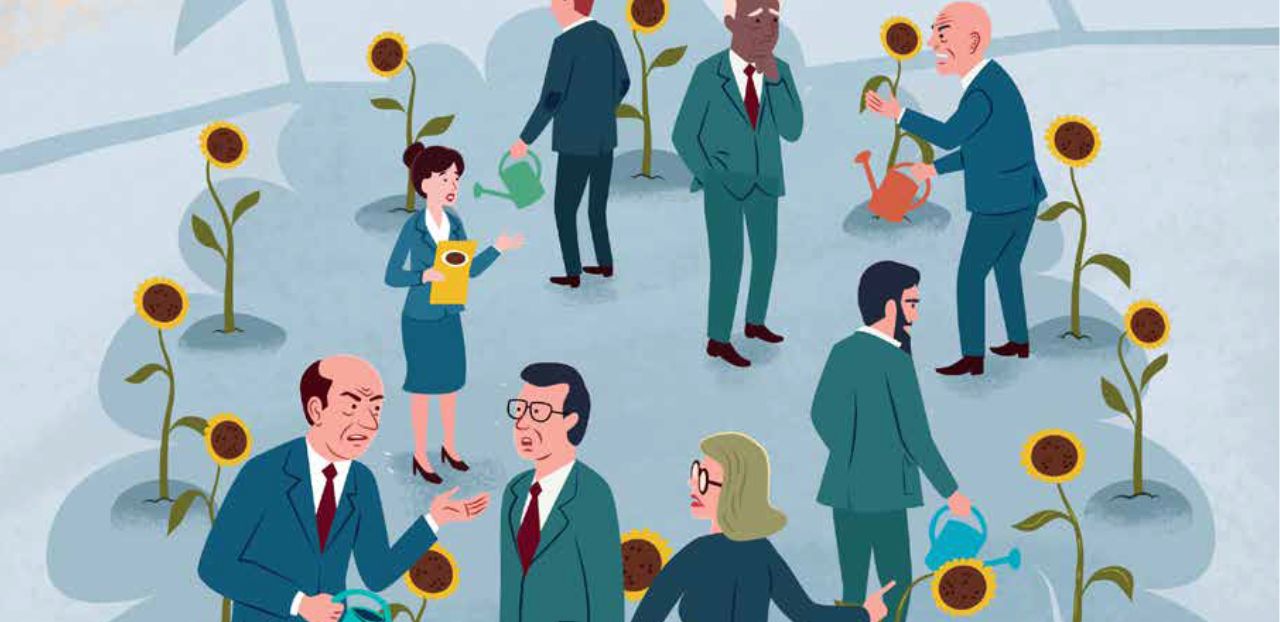
Why is the Netherlands successful at producing promising startups, yet fail to help these companies grow into the champions of tomorrow? Spanning these two extremes – from a fledgling idea to major commercial success – lies a long and fragile chain. And that is a persistent problem, as former ASML CEO Peter Wennink noted in late 2025. This scaling-up challenge is particularly evident in the sector at the intersection of agrifood and biotech.
To understand where the bottlenecks lie, what is needed to strengthen the value chain, and how we can make the Netherlands more innovative in line with the Wennink report, two industry insiders are sitting down for a conversation. Maarten Goossens is a founding partner at Anterra Capital, a specialized agrifoodtech investor with offices in Amsterdam and Boston. Anterra makes early-stage investments in technology companies that use digital and biotechnology to make the global food system more sustainable.
Yves Boland has been chief technology officer (CTO) of Corbion since September 2025. Corbion is an Amsterdam-listed company that develops and produces biobased and sustainable solutions on an industrial scale for a wide range of markets, including food, healthcare, and industrial applications. In his role as CTO, Boland’s primary responsibility is to maintain Corbion’s technological edge and accelerate innovation.
In an interview with Juul Vaandrager, deputy director of the NVP, they pinpoint the bottlenecks within the Dutch and European innovation ecosystems. Goossens and Boland also explain how investors and companies can best collaborate to create a fertile environment for innovative companies.
The Netherlands excels in scientific research and, partly as a result, has an impressive number of startups. Why, then, do promising innovations so often stall?
Goossens: ‘For us as venture capitalists, regulation is the biggest bottleneck. It is harder to scale a company in the Netherlands and in Europe than it is in the US. To give an example: Vestaron, a biotech company that uses natural peptides to develop biological pesticides, developed its products in the US. There, it took two years to get them registered, whereas in Europe the process would have taken five years. We see many biotech companies moving to the US for this reason. A second problem is the fragmentation of the European market: each country has its own regulations and market, whereas the US offers one large market. That said, the language barrier is less of an issue these days, thanks to AI.’
We often hear from startups that they can raise capital more quickly in the US. Does that apply to you too?
Goossens: ‘Definitely. But that is linked to regulations and market heterogeneity. If those were the same as in the US, capital would flow more easily here too. Incidentally, the European market is at least as good when it comes to talent and R&D. In some areas, it is even better than in America.’
What is the situation for Corbion? What are the main challenges for you during the scale-up phase?
Boland: ‘Regulations are indeed one factor. In addition, companies in the scale-up phase often move to the US to be closer to the physical market. That has become more important now that the global market is fragmenting into geopolitical blocs. Where things get really difficult is the industrialization phase. Even in the US, this is a challenge in food biotech: the costs of scaling up facilities rise rapidly. During the pilot plant phase, early adopters are still willing to pay more for a more expensive, more sustainable product. But commercial upscaling is more challenging. You only start making money once you are serving the broader, more price-sensitive market. That is only possible at scale and with efficiency.
As a corporate, we can build on existing facilities, but significant investments are also needed to develop and roll out groundbreaking – and potentially disruptive – technologies that allow us to differentiate ourselves and maintain healthy margins. A startup often spends a fortune to take that same step, while also bearing the commercial risk.
You could outsource production to a third party, but as soon as you leave the high-value markets, such as pharmaceuticals or specialized applications, every link in the chain costs money. In the bio-based economy, this double risk quickly becomes excessive, especially since you are competing directly with synthetic alternatives and everyone in the chain needs to make a living.’
How could you better manage those risks?
Goossens: ‘Look at China. We focus heavily on the US, but China is already a major player in biotech. China is now the global leader in the development of new drugs and is expected to take the lead in more sectors. China also demonstrates the importance of a long-term political horizon for building infrastructure. That country thinks in terms of ten-year periods, whereas in the Netherlands a new cabinet takes office every four years, or sooner, causing budgets and priorities to shift rapidly.’
Boland: ‘The question is whether Europe can succeed in establishing long-term agendas. That is also the core of Mario Draghi’s report on strengthening European competitiveness: how do we ensure an ecosystem and investments that are not called into question every time a new government takes office? Otherwise, the ecosystem will remain fragile.’
Suppose Corbion could free up 300 million euros tomorrow for a new biobased production facility: what would the Netherlands – or Europe – have to offer to get it built here?
Boland: ‘The Netherlands has an edge because we have a large pool of qualified talent here and a great deal of expertise in the field of food safety. We would also assess whether the plant can operate cost-effectively. Energy is the biggest cost factor here – especially since the factory of the future will rely on AI, sensors, and machine learning to extract more value from the same amount of raw material. It would help if we could make long-term agreements with the government regarding energy prices, other raw materials, and a level playing field for imports from outside Europe. To make a factory in the Netherlands as cost-efficient as one in a lower-cost location, we would likely need to invest thirty to forty percent more in that additional technology. In that case, we need a guarantee that the framework conditions will not change halfway through; otherwise, we would be taking an irresponsible risk. It is up to the Netherlands and Europe to create competitive conditions.’
What is the situation for investors? When is the Netherlands an attractive option for a portfolio company?
Goossens: ‘For us, it is a bit more nuanced. A company that has successfully grown here up to and including the Series C round – the phase in which a startup has already proven its viability and is raising capital to scale up further – does not just pack up and leave. It may, however, decide to build a production facility in, say, India, because costs there are one-third of what they are in the Netherlands or the EU. As long as labor and energy costs differ so significantly, as an investor I would not recommend continuing to produce here.’
Could those differences narrow, and would that be a reason to stay in the Netherlands?
Goossens: ‘Yes, if we can utilize cheaper alternative energy sources. Thanks to AI, labor costs may be able to come down. This is already happening in R&D. For example, AI shortens the research processes for innovations in animal health, which reduces the capital required. That trend will continue. If AI enables us to become more efficient, it could bring us back to the EU or the Netherlands.’
Is it important to build factories in Europe, or is that primarily an economic decision?
Boland: ‘From a corporate perspective, I would say a resounding yes. There is a growing need to mitigate risks associated with raw materials and critical components. Major customers in Europe and the United States place great value on secure and reliable supply chains and are selectively willing to pay a premium for them when it comes to critical components. They also sometimes support reindustrialization in their region. Without its own production capacity, Europe becomes dependent on other countries, leaving us with little more than a service-based economy, at relatively high costs. The market will not solve this on its own; it always opts for the cheapest location. If we want to retain certain types of production in Europe, governments will have to provide guidance and create incentives.’
How does the collaboration between investors, startups, and companies work, and are there areas for improvement?
Goossens: ‘We often work closely with larger companies to identify where their strengths lie and where opportunities exist. We also act as an incubator ourselves: about one-third of our portfolio was established in partnership with existing players in the food and animal health sectors, ensuring we know there is a market and understand the critical requirements early on. We often see that a good idea originates at a university, two or three people develop it further, only then to discover that a corporate partner has limitations in the production process that prevent the innovation from being integrated into an existing factory.’
Boland: ‘Startups have brilliant ideas, while corporates have market access and customer knowledge. Both players can significantly strengthen one another. But startups often do not realize what it means to produce at scale. Getting involved early on is therefore important to help them get started with market knowledge and insight into regulations. The chances of success are greatest when everyone shares the same vision. You have to manage expectations right from the start: how do you allocate future value, who gets what, who contributes what? Without a shared understanding of the potential and of how long it will take to get there, things tend to fall apart. Think of the ambitious startup for whom the sky’s the limit, versus a corporate that is more cautious for a number of reasons. It is precisely in that tension that things often go wrong. But if you do manage to bring them together successfully, magic happens.’
When does Corbion decide to invest in a promising company?
Boland: ‘If we are interested in a new technology, we prefer to gain some influence early on. We often make a co-investment: with a limited amount, we can work with the entrepreneur to explore and test whether the technology works. We are cautious about committing fully – we do not want to give the impression that it is already a Corbion company – and prefer to keep our options open. Generally, we are only interested once a technology has been proven.’
Without market demand, scaling up is difficult. How important is a launching customer?
Boland: ‘Finding that first customer is extremely important. We learn a great deal from the experience. But it is also tricky, because it can reinforce assumptions that are not accurate. The value proposition for the rest of the market may be different. So, you have to be clear about who that customer actually is – and who it is not.’
Goossens: ‘Agreed. Relying on a single customer is risky because they are not necessarily representative. It is about validation: you have to test whether there is sufficient market demand. You first need to thoroughly understand what is actually needed, and only then start looking for that customer.’
Where will the future leaders in your sector come from?
Boland: ‘You can never predict it exactly, but innovations sometimes become promising because an existing product is under pressure – due to regulations, rising costs, or climate change. Take omega-3 for aquaculture: this ingredient is added to fish feed when farming salmon, for example. Traditionally, it has been extracted from fish oil derived from wild fish. Demand continues to rise sharply, while supply remains volatile, limited, and insufficiently predictable. Climate change is causing more frequent El Niño periods, which disrupt fish stocks off the coast of South America – a major source of fish oil. As supply and demand diverge, an alternative technology, such as omega-3 from algae fermentation, could take over the market.’
Goossens: ‘I strongly believe in the potential of our research institutions. Wageningen is a leader in the fields of agriculture and food science. Delft excels in industrial biotechnology, in fermentation and enzymes, and Leiden in the broader life sciences. I expect many breakthroughs to emerge from these three knowledge clusters, specifically in precision fermentation, methane reduction in livestock farming, and solutions to the nitrogen crisis.’
If you could change one thing to enable food and biotech companies in the Netherlands to scale up, what would it be?
Boland: ‘Most industrial subsidies focus on CO2 or emissions reduction. The government could also provide support for measures that ready a factory for the twenty-first century, such as digitization and machine learning to maximize efficiency. In a complex process like fermentation, optimizing operations leads to higher output, which improves both economic efficiency and the environmental footprint. There are ways to become more sustainable and efficient beyond just electrification – heat recovery, for instance. Funding for a broader range of solutions would benefit the entire sector.’
Goossens: ‘Food and biotech are not currently attracting much attention. In 2021, around fifty billion dollars were invested globally in the agrifood ecosystem; in recent years, that figure has hovered around sixteen billion dollar. Yet methane reduction and nitrogen fixation offer key solutions to major societal challenges. It is therefore crucial to move our sector higher up the investment agenda.
This interview was published in Management Scope 08 2026.
This article was last changed on 22-09-2026