
Jorge Vazquez (Randstad): ‘Non-negotiable investments’
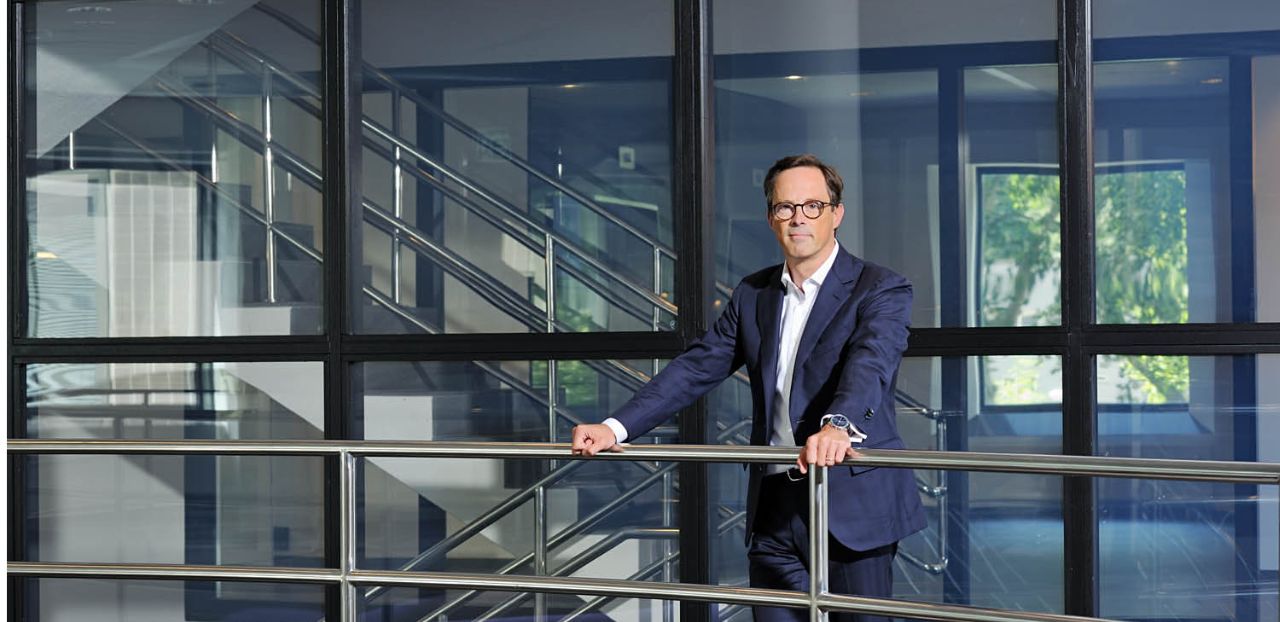
Jorge Vazquez has been with Randstad for fifteen years and has served as CFO and a member of the executive board since April 2023. Prior to this, he led the group’s control and strategy departments, among others, and was responsible for the company’s operations in Southern Europe and Latin America. He became CFO just as Randstad was seeking answers to the rapidly changing labor market in the wake of COVID–19, a period which often proved challenging. But he worked hard to make the company stronger and more future-proof. The new ‘Partner for Talent’ strategy is paying off: after a modest profit in 2025 (291 million euros on revenue of 23.1 billion), Randstad has managed to return to growth. In the second quarter of this year, net profit stood at 84 million euros on revenue of 5.9 billion, and the outlook for the rest of the year is favorable.
In a conversation with Mohamed Bouker, a partner at Deloitte, Vazquez discusses the difficult years following the pandemic and how, as CFO, he contributed to the current recovery.
The past few years – roughly 2023 to 2025 – were challenging for Randstad. What was the cause of that?
‘There is a structural cause, which can be traced directly to the aftermath of the pandemic. During and immediately after the pandemic, many organizations were hiring permanent personnel en masse. In 2021 and 2022, we saw astronomical waves of recruitment. At the same time, large numbers of employees were quitting their jobs and moving to other positions – the Great Resignation, as it was called at the time. These two trends reinforced each other: the more people left, the harder companies had to recruit to fill the vacancies.
That catch-up effort came at a price. In the two or three years that followed, labor markets worldwide were virtually frozen because companies had become overstaffed as a result of their own hiring efforts. They drastically scaled back their use of flexible staff, temporary workers, and freelancers – and that naturally affected us as a provider of flexible personnel. That said, I believe in never wasting a good crisis. In healthy and easy times, it is tempting to spread yourself too thin and become complacent. A period of headwinds forces and helps an organization to make sharper, bolder choices. We did just that.’
Geopolitical tensions, trade unrest, and the threat that AI will render (entire) occupational groups obsolete do not always seem to work in your favor. How do you view that?
‘It is a turbulent time, certainly. But that often works in our favor. Imagine if everyone in the world who wanted to work had a job, was perfectly happy with it, and possessed exactly the right skills so their employer had nothing to complain about either. What would be left for us to do? It is precisely the dynamics of the labor market – the turnover, the churn, the constant creative disruption of the economy – that fuel the demand for a partner like Randstad. Without that movement, our reason for existing disappears. Look at the rise of AI, currently the most significant trend. That rise creates uncertainty, but those who help companies adapt benefits from that very uncertainty. In the United States, for example, demand for permanent staff is picking up again, purchasing managers' indices are climbing, and companies are once again investing in people.’
Particularly in the Netherlands, Randstad is still often seen primarily as a temporary staffing agency – a company in a sector considered highly cyclical. This raises the question: is this upturn not only temporary?
‘We need to move beyond that limited perception. Randstad is a strong provider of flexible work, but just as strong in permanent recruitment. For companies, we manage large parts of recruitment teams, right down to their company websites and LinkedIn pages. Often, a job applicant does not even realize they are speaking with a Randstad employee. These are contracts lasting three- to five-years. We are a talent company that helps businesses identify the skills needed to achieve their goals and strategy, and then helps them find, attract, and develop those people.’
Does this mean Randstad has become demonstrably less cyclical?
‘In a few ways, yes. To begin with, we are broadening our service portfolio. We are shifting the emphasis from purely interim and temporary staffing to services with a longer duration: career mobility, outplacement, and the complete takeover and management of multi-year HR and recruitment processes through outsourcing contracts. Those types of services are far less vulnerable to economic ups and downs than temporary placements.
Second, we are being more selective. Instead of trying to grow a little bit everywhere, we are building scale in a targeted manner in sectors where the demand for talent is structurally high and largely unaffected by economic cycles, such as healthcare – including through the acquisition of the Zorgwerk platform – and sectors that rely on technical professionals. This discipline has a name: field steering, our process for continuously determining where money and people should – and should not – be deployed. At its core, capital reallocation – withdrawing money and people from areas without growth and deploying them where growth does exist – is at least as important as the initial allocation of that capital. We hold few physical assets, but spend around 3.5 billion euros annually on operating costs. Through field steering, we immediately withdraw resources from teams or regions where no growth is expected in the next three to six months and deploy them right away where that growth does exist.
In addition, we look five to ten years ahead for each country to anticipate future talent shortages, so we can build capacity early on. And we are digitizing: our digital marketplaces connect talent and customers faster and directly. In the United States, seventy percent of our field workers now look for jobs outside of office hours, via the app. This reduces the cost-to-serve – the cost of keeping our people employed – and makes us less dependent on physical staffing at local branches.’
What was your role in all this?
‘A dual one. First, we had to get through the difficult period following the COVID-19 crisis, when stagnation set in. Whereas a traditional cyclical company would immediately start cutting back on all kinds of expenses during a downturn, we chose to press ahead with various investments in IT and digitization. I strongly advocated that these investments were non-negotiable, come hell or high water.
At the same time, I consistently pushed for field steering: immediately shifting OPEX and capacity away from teams with no real growth prospects and redirecting them to growth segments and promising activities. This prevented capital from leaking into low-yield activities, which also brought employees more enjoyment and satisfaction in their work.’
Does other key performance indicators (KPIs) play a role in this as well?
‘Yes. Our traditional financial KPIs – growth, margin, profit – remain just as important; that is a must. But in addition, we have also started to focus intensely on what I call promise KPIs – metrics for the promises we make to clients and talent: the time it takes to fill a position, or the time it takes us to respond to an inquiry. The redeployment rate – the percentage of people we place directly into a next assignment – is another such promise KPI. A high redeployment rate lowers recruitment costs and boosts talent loyalty. By focusing on these KPIs, Randstad contributes to higher customer satisfaction and loyalty, and the company becomes less cyclical.’
What qualities make a CFO ‘the ultimate number two’ alongside the CEO?
‘Listening, first and foremost. We were given two ears and one mouth, so use them in that proportion. A CFO who immediately shoots down the CEO’s ideas with financial objections closes the door to exploration. It is better to create space for ideas first, and only then be clear about what is needed for a plan to succeed. Setting the agenda is truly a shared responsibility, while the CFO is responsible for execution. Finance goes beyond a facilitating role; it also contributes to shaping the organization’s culture. I see myself in that role as a steward, a manager, but also as a catalyst. I want people to find it inspiring to walk into my office. If people dread a meeting with finance, your organization is missing out on opportunities. It is precisely that openness that gives me the authority to say ‘no’ when it really matters. Then everyone knows: if I pull the emergency brake, it is serious.’
You have a finance team that is strong both in substance and strategy. How does such a team ideally function?
‘Primarily by leaving ownership with the business and giving finance the role of facilitator. In addition, we are not only strategically involved but also play an operational role in the value chain – for example, by processing payroll for two million people each year. We provide data on labor market trends and other information, build the framework, and ensure discipline. Our management teams and account teams can then make their decisions based on that. We could have made those decisions ourselves, do not get me wrong. It is not that hard to say, ‘Look, healthcare is a promising sector.’ But it makes a huge difference whether a few finance specialists make that claim or whether a team of business leaders reaches that conclusion on their own and is convinced of the need to capitalize on the opportunities that healthcare offers. Such a team is far more motivated than one that has to roll out an imposed plan.’
What keeps you up at night, given all the changes taking place?
‘Perhaps the question of whether we are continuing to innovate enough. Not because I am worried about it, but because I find it a fascinating topic. I like to look to completely different industries for inspiration. Our sector can learn so much from how a consultancy firm like Deloitte markets itself to major clients, or from how Amazon built its marketplace. But what ultimately preoccupies me the most are our employees: how to keep your team enthusiastic and motivated in times of uncertainty, despite all the bad news cropping up everywhere. As a leader, you have to keep fueling that energy. That, too, might keep me awake at times – though not because it worries me.’
You are looking back on fifteen years at Randstad and thirty years in finance. What advice would you give to young finance professionals?
‘Be data-minded and be a good storyteller – that is, someone who knows how to convey the strategic story behind the numbers. If you have the right solution-oriented mindset, you can position yourself to be part of almost any strategic discussion. And there has never been a more exciting time to work in finance than right now.’
The role of CFO is incredibly demanding. How do you stay healthy and energetic?
‘The most important rule is simple: above all, do not take yourself too seriously. I am also a real family person and spend a lot of time with my close friends. To keep learning, I am an avid reader. Which also helps me unwind mentally.’
This interview was published in Management Scope 08 2026.
This article was last changed on 22-09-2026