
Factor strategic dependency into every decision
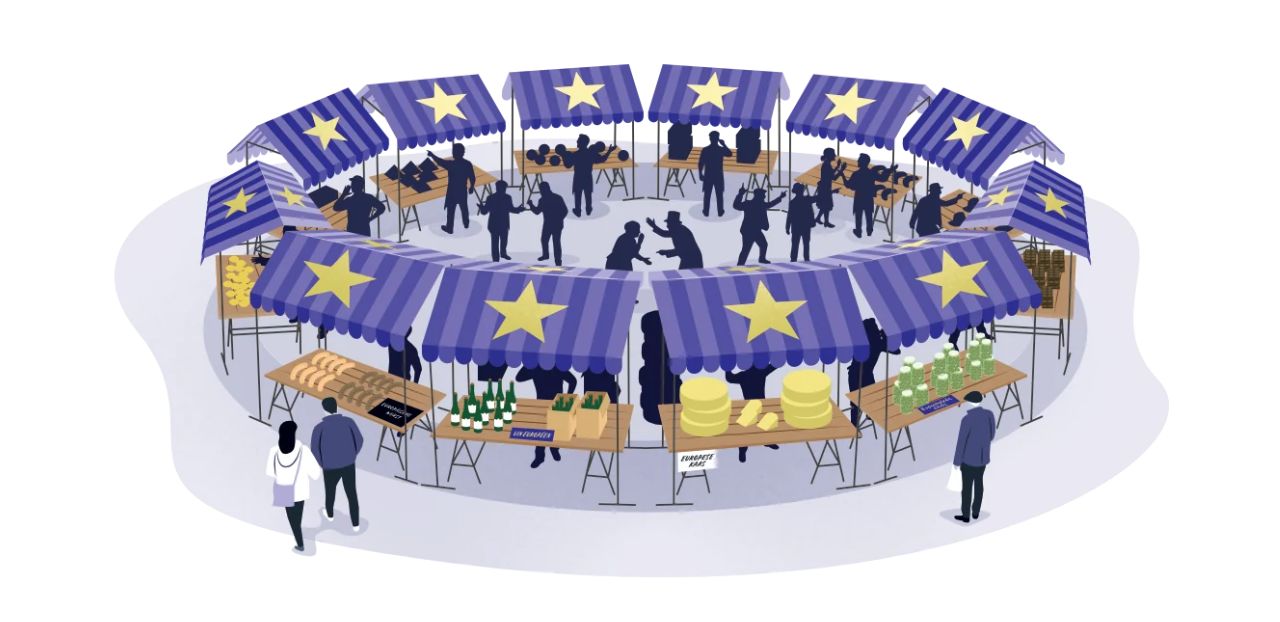
Ever since the United States snapped close its security umbrella, dark clouds have been gathering over Europe. Old certainties are fading, trade conflicts and wars dominate the headlines, and authoritarian leaders set the global agenda. While it may seem that the power politics of U.S. President Trump and Chinese leader Xi Jinping have fragmented the global order, the root cause runs deeper. Both China and the U.S. are committed to the dominance of their own industries. The struggle centers on who will become the industrial superpower: who can produce for themselves, who possesses the technology, and who has to buy from others. This industrial struggle constitutes the geo-economic context of the fragmenting world order, in which Europe risks bearing the brunt of the consequences.
There is a way for Europe to free itself from this stranglehold: by becoming more autonomous and re-industrializing. Europe must also cooperate more closely with other middle powers such as Brazil, Japan, and Canada. In this way, we can shift the geo-economic center of gravity. This calls for a renewed geopolitical strategy. It is not only politicians and policymakers who must act; corporate executives, supervisory board members, and investors also play a vital role in strengthening the position of the Netherlands and Europe as a whole.
Clinging to the globalization mindset
Firstly, it is important to understand how Europe ended up in its current situation. Until the end of the Cold War, superpowers were keen to gain control of physical hubs – think of the Suez Canal or the Bosphorus. After the Cold War, globalization and overseas free trade put an end to this type of geographical struggle. Economic interdependence effectively erased geopolitics from the global landscape. Yet, this did not result in a level playing field; instead, it gave rise to new choke points, or control points, in the global economy.
These are not geostrategic in nature, but economic: they involve (big) tech, the processing of raw materials, the monetary system and semiconductors. Countries are increasingly using these economic control points to achieve political objectives, forcing other countries onto the defensive. These countries find it difficult to know how to defend themselves against economic control points that are weaponized. The answer is that these countries, too, must engage in geopolitics. Secure access to raw materials, ensure control over waterways, or create other means of exerting pressure.
Europe, in particular, remained too long fixated on the idea of globalization. While geopolitics made its return to the global stage, we continued to believe in positive relations with America, Russia, and China. The fact that these proved far less robust than expected has come as such a shock that Europe is now in need of relationship therapy.
Geopolitical skills in the boardroom
A new geopolitical strategy can only succeed if the business community comes on board. This requires a fundamental shift in the boardroom. Until now, geopolitics and corporate leadership have been two separate worlds, each with its own language. Geopolitics is about power, security, and geography: who controls a waterway and which country imposes export restrictions. In the boardroom, the focus is on numbers: an investment decision is made on the basis of costs, margins, and projected returns.
In today’s climate, directors and supervisory board members must also take geopolitical considerations into account in their decisions. This requires commensurability, a term derived from philosophy. It is a matter of bridging the differences between two worlds that express themselves in different terms: that of power and that of returns. This means that strategic interdependence must be factored into the cost-benefit analyses and that directors must acquire geopolitical knowledge.
This is a significant challenge. But it is the key to anchoring the Netherlands – and, by extension, Europe – in the new world order. Bringing together geopolitics and business economics requires a broader framework for decision-making in the boardroom and among policymakers.
- Conduct a geopolitical disruption assessment: Identify the geopolitical disruption risks facing your company and value chain. Uncover the points of control held by other powers and the underlying interests they could exploit to achieve political objectives.
- Quantify geopolitical risks so that they can be more effectively incorporated into due diligence and investment decisions. With the help of AI and insights from the insurance industry, significant steps has been taken in recent years to make this possible.
- Think in terms of scenarios, mitigate risks, and always diversify. Depending on the value chain in which the company operates, identify key links and suppliers in the Netherlands, Europe, and other middle powers such as Brazil, Mexico, South Korea, India, or Japan. Consider restructuring value chains.
- Explicitly prioritize the robustness of your value chains. That robustness and greater stability may come at a cost. It could mean that you sometimes have to settle for lower margins. Nevertheless, it is worth opting for investments and partners that ensure more robust production and value chains and are less dependent on China or Russia. In doing so, as a company, you help build strategic European autonomy and avoid becoming a pawn in geopolitical maneuvering.
- Seek collaboration. Until the 1990s, the Netherlands and Europe were home to more conglomerates. Large companies were more horizontally and vertically integrated and manufactured a diverse range of goods. Margins per product group were lower, but the production chains were more robust. Today, companies have specialized. They represent a smaller part of the value chain and are therefore more vulnerable to suppliers and customers. These conglomerates will not return, but companies can emulate their strength by collaborating at the European level within the production chain – for example, through consortia with joint procurement. This is how we increase our geo-economic power.
- Explicitly incorporate geopolitics into the boardroom to embed the above points in business operations, for example through the audit or risk committee. Assign responsibility to a specific board member. When determining the composition of the executive board and the supervisory board, assess whether there is geopolitical expertise at the table. If not, it may be wise to bring that expertise in on a structural basis, through a consultant or a new appointment.
- Executives and policymakers must know how to fight back. If a country uses an economic leverage point to harm a company or an economy, they must expect to be on the receiving end of targeted countermeasures.
More boldness in investment
Investors, institutional asset managers, and policymakers also play a key role. Europe is grappling with a massive investment shortfall, which prevents startups and scale-ups from scaling up. To remove this barrier, more venture capital must be made available as a matter of urgency. The lack of capital is partly due to regulation, high energy prices, and a fragmented single market, but also a lack of boldness among investors. They need to take more risks and accept potentially lower returns in exchange for more robust production chains and strategic autonomy.
Companies and investors cannot do this alone. Europe must integrate further. Although social cohesion is currently elusive, we will have to rise above our differences and define our identity. The question is not whether we all feel European, but whether we feel more European than Russian, American, or Chinese.
Further integration means a single European market where a product can be rolled out in one go. It means a single capital union that allows for the free flow of capital, and standardized regulations, so that businesses do not have to set up a legal entity in every country. A single Europe also means less bureaucracy and lower energy prices. This would enable companies to scale up more quickly and allow European champions to emerge.
Europe’s strong assets
Europe is not powerless. We hold strong assets, but we must play them to our advantage. The first asset is the European consumer market, which ranks as one of the largest markets in the world. Many countries want to sell here. We can choose to grant access only to those who abide by our rules: who operate on a level playing field and do not receive state subsidies. The second asset is capital. Europe has thousands of billions of euros sitting idle. A great deal of capital is also being invested outside Europe, whilst we would be better off channeling these financial resources into our own industry and into potential European champions. A third asset is technological expertise. ASML, for example. Without the lithography machines from Eindhoven, chipmakers cannot produce their most advanced processors. That gives us influence. If we deploy the technology wisely, partners will become more aligned with European interests.
The conclusion is that business economics is, these days, also geopolitics. While there is no such thing as a perfect handbook for business, one thing is certain: executives and board members must become commensurate: it is essential to understand both the world of business economics and the world of geopolitics – which expresses itself in an entirely different vocabulary. This is already embedded in our Dutch mercantile spirit. Diversify. Think in terms of scenarios. Make mistakes. Collaborate. Weigh up the options. And seize the moment. In short: make geopolitics tangible.
This article was published in Management Scope 10 2026.