
Ron Keller: ‘The geopolitical reset will take decades’
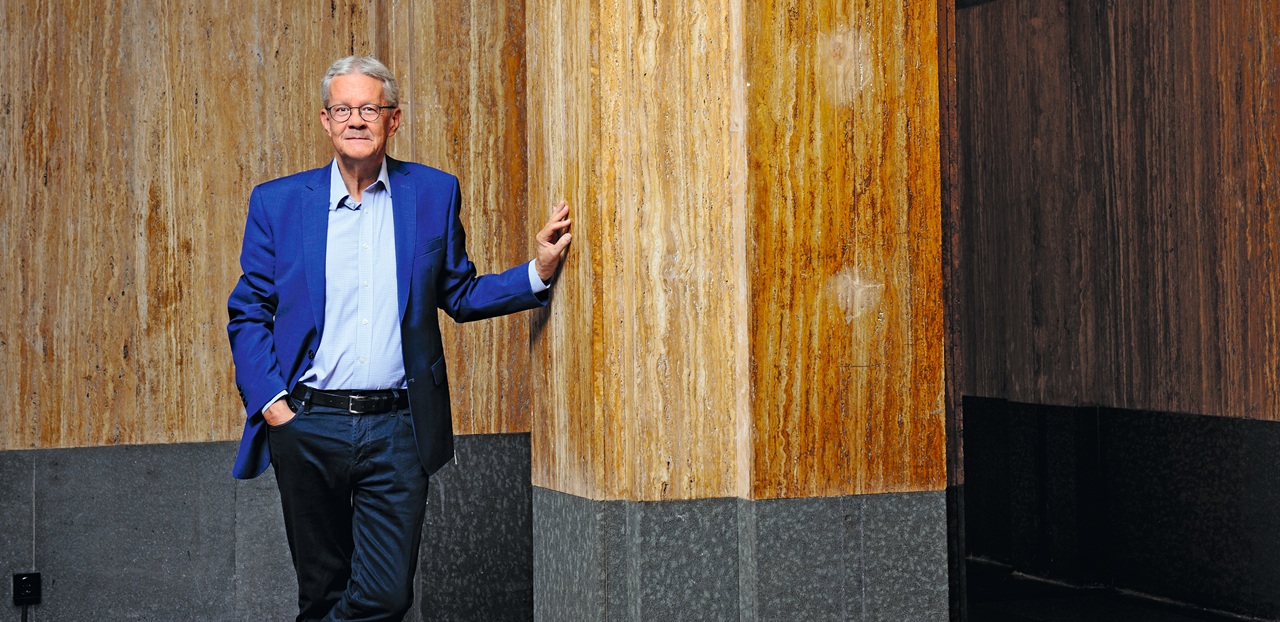
In a previous life, Ron Keller witnessed firsthand how international politicians played a role in shaping the course of history. He served as ambassador for the Netherlands to Ukraine, Russia, Turkey, and China. During his ambassadorship in Russia from 2009 to 2013, he met Putin more than once and lived the experience Moscow had of the end of the Cold War. Or rather, how it continued to simmer beneath the surface.
The former top diplomat began his career at the Ministry of Finance. He held various positions at the IMF and the World Bank and, among other things, chaired the committee responsible for establishing the euro system. According to Keller that was ‘a project that resulted from geopolitical power shifts, namely the unification of Germany and France's ensuing fears. The French wanted Germany to relinquish the Deutschmark.’ With his extensive geopolitical and financial-economic knowledge, Keller now advises companies and organizations, which, judging by his busy schedule, are keen to make use of his expertise. In addition, the former diplomat regularly appears as a strategic analyst in the media. Keller is not entirely optimistic. ‘We are living in a time of a new global reset, a period in which power relations are being redefined. Such a reset rarely happens without shocks. I have never been so concerned about the risk of escalation’. Nevertheless, he believes there is a way out of the crisis. ‘Make Europe more decisive, safer, and more prosperous by finally completing the internal market. Work on European political and economic integration’. According to Keller, the Netherlands can play a leading role in this. His message ties in well with the annual Game Changers seminar of the Dutch Private Equity and Venture Capital Association (NVP), where Keller is one of the speakers and will discuss current developments on the world stage. Keller's insights are enlightening, peppered with personal anecdotes and sometimes unorthodox, as becomes apparent during a conversation with NVP director Tjarda Molenaar.
The two meet in De Rode Olifant, the stately building adjacent to the Malieveld and opposite Keller's former employer, the Ministry of Finance. It was originally built as Esso’s headquarters and, according to the brief, had to be taller than that of its competitor Shell. Thanks to this history, the building proves a fitting location for a conversation about power, influence, and changing world orders.
You started as ambassador to Ukraine in 2005 and to Russia in 2009. Looking back on that time with the knowledge you have now, how do you view it?
‘It was a few years after the end of the Cold War. In Europe, we breathed a sigh of relief. We were euphoric that the Berlin Wall had fallen. In line with Francis Fukuyama's book The End of History, we believed that democracy had triumphed. Markets opened up, and globalization seemed the path to peace. But like every major reset in history, the Cold War had winners and losers. While we thought the Russians were happy with their liberation, they felt humiliated. They perceived the companies and NGOs we sent to Russia to help as interference. Meanwhile, Europe and America grew apart, even though we Europeans did not want to acknowledge it. Those underlying tensions did not disappear; they simmered beneath the surface. As a result, the friction between the power blocs were never resolved. In fact, the Cold War never ended.’
Do you also see the Americans as losers of the Cold War?
‘In 1989, I was in Washington with Wim Kok, the then Minister of Finance. To our surprise, the American reacted with shock to the end of the Cold War. People thought it was terrible. Why? There was great fear that after the fall of the wall, Europe would become more successful than the US. In a globalizing world, countries such as China, India, and Brazil could also emerge as new centers of power. I remember the Washington Post writing: ‘We will not allow this to happen’. At the time, I thought the journalist in question misunderstood the zeitgeist. But fifteen years later, I realized that the sentiment was genuine,. I was ambassador to Ukraine at the time, and also ambassador to NATO. The US was determined to have Ukraine in NATO. The Ukrainians themselves were reluctant because they knew it would lead to tensions with Russia. While Europe dreamed of economic integration, the Americans and Russians thought very differently. The Americans did not want to abolish NATO; on the contrary, they wanted to expand it. The Russians, on the other hand, refused to allow their sphere of influence to be reduced. In short, the US and Russia never stopped the Cold War. The clash between these two worlds is now playing out in Ukraine.’
What could Europe have done differently?
‘We did not properly consider the perspectives of other countries. How they viewed the end of the Cold War. Europe firmly believed that open markets and economic cooperation would automatically lead to peace. The European Union continued to expand with the idea that more member countries translated to being safer from Russia. That was a misconception; the EU is not a military alliance. That is what NATO is for. Russia did not like that. I realized this during my time as ambassador. I saw the resentment grow. The didactic way in which the West exported its norms and values led to anger in Moscow. That same anger is now is now flying towards Ukraine in the form of drones and missiles. Europe has completely underestimated this. At the strategic level, we failed to do two important things. We expanded the European Union, but we did not deepen it. After 1990, new countries joined, but political and economic integration was hardly strengthened. We have the euro, but we abandoned plans to complete the internal market, and we put the creation of a common capital market on hold. A huge mistake. Political integration also failed to materialize. There is no common foreign policy, no common defense policy, no common innovation policy. We thought globalization would bring us peace and prosperity. That idea turned out to be naive.’
To strengthen Europe's current position, we should strive for strategic autonomy. What does that mean?
‘It sounds good: wanting to be less dependent on other countries. But it is a weak proposition. We do not even begin to realize what this means in concrete terms. Should we keep that one chip factory in Nijmegen, build our own Google platform? That is hardly feasible economically. Let me give you an example: suppose we no longer import medicines from India. How do you organize that in the market? Are you going to subsidize European companies and impose high tariffs on Indian drug manufacturers? Would consumer then be willing to pay twenty times as much for their pills? Autonomy comes at a price. Politicians rarely dare to say that out loud. And even then, outsourcing will continue – simply because it is cheaper elsewhere. Those are the laws of the market. If you try to prohibit that with rules or tariffs, companies will say: you know what, Europe? We are leaving.’
Are you saying that strategic autonomy is unrealistic?
‘Let me highlight the other side of the story. We no longer live in the world of thirty years ago, where we could blindly rely on international partners. In the coming decades, let us assume the next eighty years, we must reckon with increasing fragmentation, rivalry, and geopolitical competition. So, we will indeed have to rebuild our own strategic sectors – from defense to medicine and technology. We will have to invest heavily. The costs of defense are only just beginning to sink in with politicians and citizens, but the price tag of strategic autonomy is still largely invisible.’
What would your advice be to European policymakers and companies?
‘Invest in the new economy, do not cling to the past. This is an old truth. Shipbuilding is not coming back to the Netherlands, the automotive industry is not coming back to Germany; in short, leave it to cheaper Southeast Asia. Do not use your resources desperately to keep old sectors afloat. Focus on new technologies, innovation, and knowledge development. Europe still has a strong foundation in this area – we are one of the most innovative regions in the world. The Netherlands also ranks high on the lists. The only way to make Europe more effective, secure, and prosperous is to finally complete the internal market. Remove those barriers. We have enormous opportunities. As Mario Draghi wrote in his fabulous report: harness the power of the European market. This will give Europe a huge boost, economically, strategically, and politically. We must also strengthen our defense. But we must do so more intelligently than in the past. Not a small Dutch, Luxembourgish, or German army, but a joint European army.’
What is needed to take that step?
‘Leadership. European leaders must be less timid and dare to look beyond their national borders. It is difficult: within the European Union, countries still protect their own sectors. Every country has an argument: protecting an industry, preserving jobs, defending national strategic interests. And Brussels can often do little about it. When one country introduces a new rule, the next one follows – a chain reaction of national reflexes. Yet history shows that things can and sometimes must be different. When William of Orange realized that divisions between the people of Utrecht, Friesland, and Gelderland would mean the downfall of the low lands, he called for cooperation. Only then could we drive out the Spanish. William of Orange demonstrated what leadership is: when a threat is a threat to everyone, only unity and cooperation can lead to freedom.’
Do you see signs that Europe is moving in that direction?
‘Slowly, but too slowly. There are still too many national reflexes and too little European thinking. As an open trading nation, the Netherlands should be at the forefront of deepening the internal market. If, for example, eight countries start as a kind of coalition of the willing, that is a start. But then Europe must dare to take action: with majority decision-making, fewer vetoes, and a greater focus on our shared future.’
What does this reality mean for investors and entrepreneurs?
‘They need to take geopolitical risks more seriously. These are currently underestimated rather than overestimated. Many companies still live under the illusion that things will turn out fine. But the world has become structurally more unstable; the 'geopolitical reset' will take decades. That calls for resilience: shorter supply chains where possible, but also financial buffers, flexible strategies, and scenarios for weather catastrophes. Create a bigger umbrella.’
In the new world order, there is much talk of China’s rise as a superpower that will take over the world.
‘That image is incorrect. Economically speaking, China is more likely to be on a dead-end track. Many think that the country is growing into a new superpower, certainly in the field of technology and artificial intelligence. That is largely American propaganda – intended to stoke fear and hold together a Western alliance. Of course, China is a global power, but if you study it closely, you see that the country is structurally stuck.’
How do you substantiate that?
‘China's economy runs on two engines. The first, the export engine, was started under Chinese party leader Deng Xiaoping in the 1980s. He decided to start producing for the global market. From toys to textiles – it did not matter, as long as it brought in currency. The second engine was domestic investment: infrastructure, railways, bridges, houses. Both engines made China great, but now they are faltering. Labor costs in the export-producing sectors have risen gradually and now sharply, causing production to shift to Vietnam and Myanmar. The construction engine has also come to a standstill: most Chinese already have a home, and high-speed rail lines extend to even the most remote provinces. Enormous overcapacity has developed, leading to ghost towns, empty office buildings, and bridges that lead nowhere. I remember a city where there are nine bridges over the Yangtze within a kilometer. To alleviate this overcapacity, China tried to export its infrastructure projects via the so-called New Silk Road. That seems well considered, but there is no strategy behind it. Countries in Africa or Asia were given railways and ports without any economic logic behind it. In Kenya, for example, there is a high-speed railway line that runs from nowhere to nowhere.’
But is China not investing heavily in artificial intelligence and high-tech?
‘Certainly, but that is not organic innovation. It is copying, adapting, scaling up - not inventing. Confucianism, which is characterized by obedience, still prevails in China. Children learn early on that the teacher is always right. That is disastrous for creative thinking, and therefore for fundamental innovation. That is why China has been ranked around twenty-fifth in the world rankings of innovative countries for decades, despite billions in investments. Innovation requires freedom of thought, and that is something they do not have. China will remain large, but will never become dominant.’
How should we deal with China?
‘We tend to overestimate China. We see drones, chips, and artificial intelligence, and conclude that they ahead of us. But all that technology originally came from the West. Moreover, the Americans have been trying to push China back structurally for fifteen years – with trade restrictions, sanctions, and export bans. I am not saying the country is weak, but that its growth model is becoming exhausted. And that is crucial for Europe to understand: we must not act out of fear of China, but out of an understanding of the underlying trends. Anyone who understands these trends sees that the future lies not in imitation or isolation, but in collaboration and innovation based on our own strengths.’
This interview was published in Management Scope 10 2025.
This article was last changed on 18-11-2025