Resilience as a public-private matter
Our society is proving more vulnerable than we often realize. War, hybrid threats, climate change, polarization, and disinformation are leaving their mark on our daily lives from the outside, while our mental and physical resilience is under pressure from within. The sense of stability we took for granted for decades is crumbling.
Yet these vulnerabilities also offer opportunities. The Netherlands has the knowledge, creativity, and collaborative capacity to adapt, but it will require commitment from everyone. Rob Bauer, former chairman of NATO’s Military Committee and Deloitte Edge Fellow since June 2025, and Deloitte partner Kim Vrielink emphasize that identifying risks is not enough. Action must be taken.
Finding a new balance of power
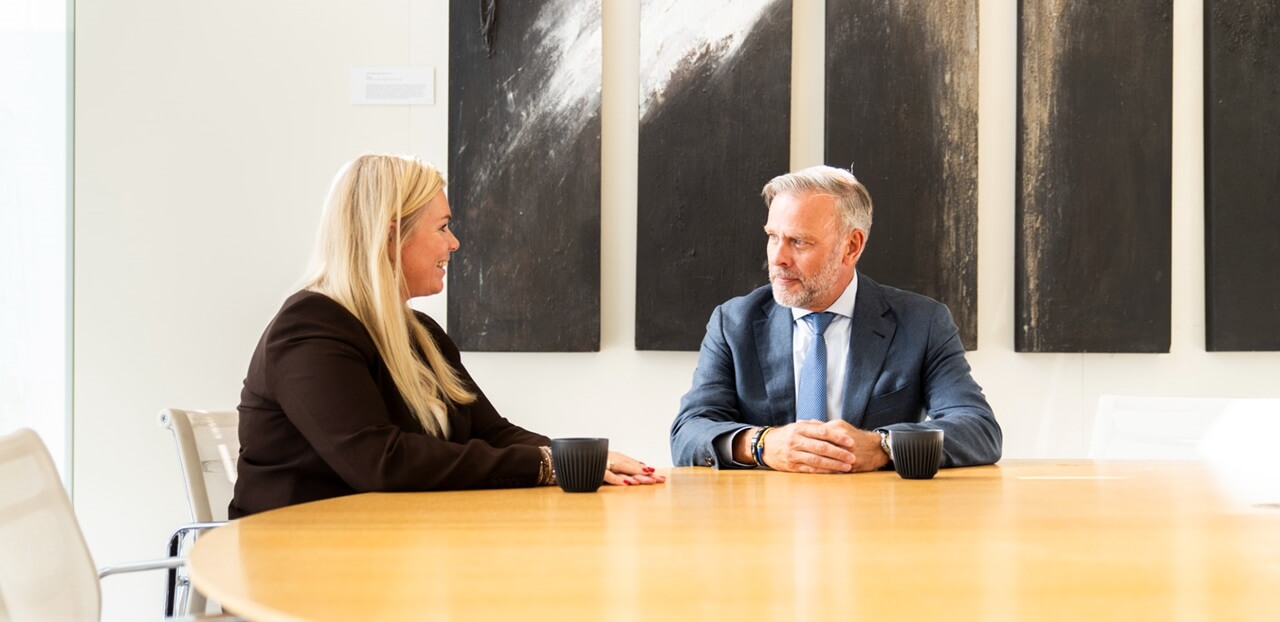
In a conversation on the fourteenth floor of the Deloitte office, while the heat of the summer day is palpable, Bauer outlines the changing world order. ‘It is about finding a new balance of power between the United States and China. Regional conflicts are part of this. Since 2008, the US has not always responded to crises such as Georgia, Crimea, and Syria. Russia and China learned from this: if the US, traditionally the world's ‘policeman,’ no longer intervenes, it creates opportunity for them. Putin started presenting situations such as the illegal annexation of Crimea and the closure of the Sea of Azov, as faits accomplis, with effectively no reaction from the international community.’
What are the consequences?
Bauer: ‘The international rules-based order and the entire position of the UN are under serious pressure. In the past, the United Nations intervened when international rules were violated. Now this is happening less and less. Two permanent members, Russia and China, are blocking solutions with their vetoes, rendering the Security Council powerless. World trade was based on international agreements and rules. The idea was that if countries were economically dependent on each other, there would never be another war. We viewed the world as our ‘playing field’ where capital, labor, and raw materials were perpetually available for us to combine where it was most lucrative, bolstered by the international legal order. But that foundation is crumbling. Putin is literally shifting borders. It was not Gazprom, with whom the West did business, that turned off the gas tap, but Putin himself. For more and more countries, the international legal order became something belonging to the West, something they no longer automatically wanted to be part of. Companies now realize that the global economy no longer really exists. It is becoming increasingly regional. If, for example, you are no longer legally protected in the BRICS countries - a partnership between Brazil, Russia, India, China, South Africa, Iran, Egypt, Ethiopia, the United Arab Emirates, and Indonesia - you have to ask yourself whether you can or want to continue producing there. In my experience, many companies are thinking about this tactically, but not yet very strategically. They are looking at the next four quarters, but not at five to ten years. Our joint mission is to make society aware that short-term thinking is no longer sufficient. The lowest price can no longer automatically be the deciding factor.’
Major strategic decisions
This new reality of course also offers opportunities, Vrielink emphasizes. ‘For Europe, this opens up possibilities to produce more for its own market, among other things. But that requires major strategic decisions that cannot be taken lightly. The realism in the scenarios from the defense world, where Rob comes from, is very different from that in the business world. They have to deal with numerous other interests. Cost alone, as in outsourcing, cannot be the decisive factor. Factors such as geopolitical stability and security of supply should also be taken into account. For many companies, this scenario is not yet concrete enough. It is often avoided or postponed to the long term. This is understandable, because it is quite complex to start thinking in a fundamentally different way. When do you make that change? Why do you do it? And for which component? Moreover, it involves long-term investments, such as where to build your factories.’
The open economy and society that characterize the Netherlands make our country extra vulnerable to international tensions. In the field of cybersecurity, we seem to be gradually understanding this better, Bauer observes. ‘We have become more robust: dual routers, dual data storage, measures like that. There are many things you have to arrange, and that costs money. Companies now understand that this is necessary. Ultimately, the customer pays for it.’
We cannot rule out a physical attack either. ‘Russia knows exactly which bridges our tanks need to cross and will bomb those as first offensive. The government did not want to invest in extra-strong bridges because of costs. That, fortunately, is changing - albeit too slowly. The focus on efficiency is so deeply ingrained that we sometimes cannot even think in terms of effectiveness anymore.’
But does that not require an almost complete system change?
Bauer: ‘Exactly!’ He quotes the American historian Timothy Snyder. ‘The only thing the free market cannot do is bring freedom. It is built on freedom. For that, you need a foundation of freedom and stability, and therefore well-functioning armed forces and a strong deterrent. All of this seemed so self-evident that we forgot how important this foundation is for a healthy economy.’ Eighty years of peace have, in a sense, spoiled us and weakened our resilience. Bauer compares it to a day at the beach. ‘Imagine you are relaxing on the beach, enjoying the sun and blue skies, when suddenly people tell you that a tsunami is coming. Sure, many of us would think that it is highly unlikely. That is how we deal with threats we have never experienced ourselves. We are quick to dismiss them as exaggerated, call it fearmongering, and think that everything will work out just fine.’
Vrielink: ‘For a long time, we were able to believe that everything was controllable and predictable, that we could reduce risks to zero. And if things went wrong, there was always someone else to blame. The reflex is that that will not happen here, or, the government will save us.’
Bauer: ‘Everyone complains that there are too few people working in healthcare. But part of the solution lies within ourselves. If we are all willing to work harder and longer, we will already solve part of the problem.’
The tanker in the Suez Canal
That reflex to think that ‘it will resolve itself’ is one of the most underestimated risks. We will have to do it ourselves, and together, Vrielink emphasizes. ‘Social resilience does not only depend on military strength, but also on other factors, such as energy, food, and cyber security, and the availability of medicines.’ Bauer adds that in the 1990s we went too far in privatizing government tasks. ‘The assumption was that the market would do everything better. This was successful in telecommunications, for example, but not in many other areas. By outsourcing so much, we have made ourselves dependent on one or a few private actors.’ He outlines how vulnerable this makes us. ‘A single incident can trigger a chain reaction: a tanker blocking the Suez Canal, and European companies grind to a halt.’
Geopolitics also poses major risks. ‘The West is largely dependent on China for raw materials for our sustainable energy supply. Just as Putin turned off the gas tap, China can do the same. You can bet they will do so at some point. And if we have phased out our fossil fuels completely by then, we will be stranded.’
Vrielink: ‘With strategic choices, we must therefore always take security aspects and associated risks into account.’
This dependency is not limited to energy.
Bauer: ‘The coronavirus crisis showed what happens when healthcare and production are largely outsourced to the market. If we no longer produce medicines here, we are too dependent on imports from China.’
‘But COVID also showed what is possible when it really matters,’ emphasizes Vrielink. The government acted as a facilitator and removed investment risks for companies. This created space for entrepreneurship, pragmatism, and creativity. Within eight months, several vaccines were on the market, whereas normally this takes years. Other parties built a large-scale network of testing and vaccination sites, complete with staff, at speed. A crisis forces you to find solutions together.’
The new balance between government and market
A new balance is, therefore, needed between business and government. ‘This means empowering each other and doing what you are good at. For example, the government takes on the coordination of major interventions. Companies, on the other hand, are strong in implementation and production, which helps in taking the pressure off the government,’ says Vrielink. Part of the solution lies in strengthened private-public partnerships. ‘Sectors are also stronger if they engage in dialogue with the government about what they need to become more resilient.’
Bauer: ‘No party can bear a risk as well as the government. Public money took us to the moon. The coronavirus vaccines could be developed because the government assumed the risk. The same will have to happen with the current security crisis. But then the private sector will also need to make a significant effort. It is a matter of and-and. Simply put: if the government invests in factory buildings and accelerates permits, it enables the business community to build the tanks we may need in a few years’ time much faster. Companies can then effectively deploy their expertise and personnel to realize this.’
Vrielink: 'In this way, the government is not so much investing in the business community as facilitating the business community in strengthening our collective security.’
From me to us
In short, society needs a change of mindset: 'We will have to make the transition from me-centered thinking to we-centered thinking. More trust in each other and in the government. Taking joint responsibility for tackling the challenges that lie ahead. We need more solidarity.’
Vrielink and Bauer draw a parallel with the climate issue. That discussion took at least fifteen years before it was taken seriously. ‘But now CEOs dare to say: it is about the future of our children. And we now have an acute security crisis on top of that.’ Moreover, these challenges are closely intertwined: nothing is better for sustainability and the climate than preventing war.
The difference with Covid 19? This time, we can see the crisis coming. So we have the opportunity to prepare.
Bauer: ‘The Netherlands is an entrepreneurial, innovative, and knowledge-intensive country, with a strong government and sufficient resources. If anyone can do this, it is us. But then we have to join forces and do what is necessary.’
Is that what is meant by the whole-of-society concept?
‘Exactly!’ says Vrielink. Bauer gives the example of companies developing scenarios for a possible power outage. ‘How can a supermarket ensure that it can stay open for more than a few days? If generators are needed, is there fuel, and how do we get it? And what if the emergency scenario occurs in an environmental zone? How do you prevent regulations from getting in the way of a solution?’
Vrielink: ‘Given certain scenarios, some regulations will have to be temporarily suspended or adjusted. This requires the government, sectors, and companies to discuss everything in detail. Now we have the time to think through scenarios and see what we need from each other to properly prepare for such emergencies. So that we will be prepared when necessary.’
There is plenty of inspiration, both from abroad and at home. For example, a pilot project was conducted in the Rotterdam-Bloemhof municipalities, a collaboration between Deloitte, the Municipality of Rotterdam, the Rotterdam-Rijnmond Safety Region, the Red Cross, and Albert Heijn. In a simulation session, residents and stakeholders explored the scenario of a prolonged power outage. The goal: to develop an approach that strengthens the community’s resilience. By playing through scenarios together, you increase your preparedness. These insights are also replicable and scalable for other municipalities.
We must focus on the opportunities, Vrielink concludes. The more we focus on solidarity, the greater our resilience will be. And that is always a good thing. ‘Call a contact in a foreign country and ask how they are handling things. It might feel vulnerable, but in this case, showing vulnerability is a sign of strength. Do not see each other as competitors but see each other first and foremost as allies.’
Interview by Kim Vrielink, Partner at Deloitte and specialized in whole-of-society en weerbaarheid. Published in Management Scope 08 2025.
This article was last changed on 23-09-2025