
The relationship between CEO and CFO requires constant nurturing
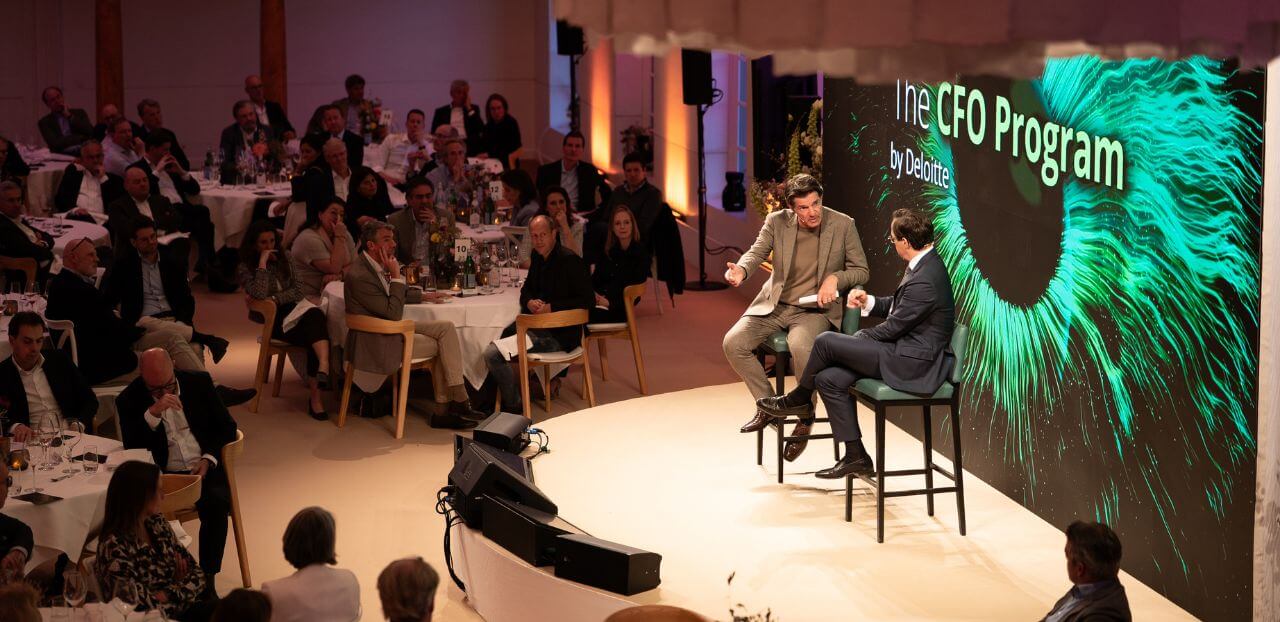
Reviewing the themes of recent Deloitte CFO dinners gives a startling realization of just how turbulent and volatile the world in which companies have been operating these last years, has been. A summary: in 2022, the central question was how to embed sustainability at the heart of the organization, partly driven by the impending CSRD directive. The following year – with the war in Ukraine in full swing, energy prices skyrocketing, and sharp inflation – the focus was on resilience in uncertain times. In 2024, how to deal with the challenges and opportunities of, among other things, artificial intelligence. In 2025, the escalating trade war with the United States caused great uncertainty, and the theme was Navigating Through Global Dilemmas. Now, once again, the war in the Middle East initiated by Israel and the United States is hitting the global economy hard. And let us not forget 2021 and 2022, when the CFO dinner could not take place due to the COVID pandemic.
‘On the bright side, one could argue that our resilience has been well-honed by now, and that we are therefore better prepared for what lies ahead,’ says Deloitte partner Mohamed Bouker.
The theme of the 2026 CFO dinner – Navigating Executive Leadership: The CEO-CFO dynamic – may not seem directly connected with this rollercoaster of events, but it is precisely in turbulent times that it is important for the CEO and CFO to operate like a well-oiled machine and make the right strategic choices together. The somewhat boring CFO who focuses primarily on financial responsibilities and legal obligations no longer exists. That might have been true twenty years ago for the CFO 1.0 but given everything happening in the world and all the macroeconomic uncertainties, a CFO really can no longer focus exclusively on accounting and bury themselves in a spreadsheet, was the consensus among those present.
To lead effectively in these times, the CEO and CFO will need to find a balance between visionary leadership and financial discipline, so that organizations can grow, innovate, and build resilience. Resilience, according to Bouker, ‘no longer is a differentiating factor, but the entry ticket to becoming a member of the board of directors.’
Keep investing
The approximately sixty CFOs (and a few CEOs) who have gathered for dinner are all too aware that times are tough. The event’s host and moderator, Twan Huys, asks keynote speaker Klaas Knot, former president of De Nederlandsche Bank, to rate the current state of the world on a danger scale from one (total chaos) to ten (everything is going well). Knot does not get beyond a ‘three or four, in any case a resounding failing grade.’ Because, ‘All the institutions we built after the Second World War to achieve control and balance in the global political and economic order are at stake. The relationship with the United States has changed fundamentally from a system based on international rules to a system where might makes right. From win-win to a zero-sum game. From multilateralism to a transactional relationship. From stable cooperation to vying for the last drop.’
And so, Europe will have to become strategically more autonomous and less vulnerable, he emphasizes in his lecture as ‘many of the disruptions of recent years originate elsewhere, while the blows are felt most acutely within the European Union.’
Knot sees a crucial role for the business community here. ‘In uncertain times, there may be a tendency to wait and see and sit on your cash, but in the long run, that is not a good idea. No pain no gain, no risk no reward.’ Especially now, is his message to the CFOs in attendance, companies must invest heavily in areas such as digitization and AI, as well as the green transition. ‘Only in this way can we eventually address the challenges that lie ahead.’
Building trust
How often does a CEO tell a CFO to take a foot off the ‘investment brake’? Twan Huys puts the question to speakers Annemiek van Melick, CFO of NN, and Jorge Vazguez, CFO at Randstad. Not that often anymore, it turns out. The role and responsibilities of the CFO are clear, they state, but ultimately most CFOs today see themselves as working closely with the CEO when it comes to investments, such as in AI and technology, and seizing opportunities.
Good collaboration with the CEO is no longer just a functional necessity, but has become a strategic requirement. To form a powerful duo together, mutual trust is crucial – but that such trust exists is not a given. It requires constant effort. The bond between CEO and CFO, as in a personal relationship, must be strengthened by making time for each other.
Because the CEO is ultimately the leader of the team, there is always a certain degree of dependence inherent in the CFO role. At the same time, the CFO must be able to stand his or her ground and strategically explain a course of action. The question of what a CFO should do if he or she cannot see eye to eye with the CEO is therefore on the minds of many participants at this event. From his role as CEO of Enexis, Rutger de Leeuw states that it is primarily about remaining true to your norms and values. ‘If a line is crossed there, that can be a reason to leave.’
At the same time, he emphasizes that while the CEO and CFO are indeed the driving force of the board, what ultimately matters is how the entire board functions. ‘You are part of the team dynamic.’
‘A good team knows what goal it is working towards,’ observes panelist Rob van Wingerden – a multi-supervisory board member and chairman of the Dutch Corporate Governance Code. ‘If you do not get along personally, but you have the same goal in mind, almost all friction can be resolved.’
‘You can resolve a conflict by leaving the team or, as CEO, by dismissing someone from the team,’ adds the third panelist Mariette de Bruin of The Changery, who, as a leadership coach, guides organizations through transformation. ‘But often there is a deeper systemic problem. If that one person leaves, the system is still there. The dynamics within the team need to be managed continuously. Many teams perform very well when there is a crisis, because a crisis can have a unifying effect. But then, when the focus returns to the long-term strategy, the differences and tensions between members surface again.’
Being vulnerable
Rob van Wingerden touches on a core issue that is underestimated in many boardrooms: you do not build trust in times of crisis, but precisely when everything is going well. ‘If you have to start when in crisis, you are too late.’ According to him, trust begins with the image you have of the other person. Not just as a professional, but as a human being.
In the boardroom, personalities often remain carefully concealed; vulnerability is rarely given space. And yet that is precisely where the key lies. True trust arises when board members dare to share not only their strengths but also their insecurities. When it feels safe enough to show your true self – and to accept that in others as well. That requires conscious leadership. It requires small, seemingly simple rituals that have a big impact. Van Wingerden himself has made it a habit to start with a sincere question: ‘How was your weekend?’ Or to wrap up by reflecting on whether everyone truly had a chance to speak their mind. It may seem awkward, but it is precisely in those moments that connection is formed. Leadership begins with setting a good example. Those who take the first step create space for others. This begins with the CEO-CFO team. And so, step by step, a culture grows in which trust is not an abstract concept, but a daily reality. A reality that is more crucial than ever in today’s turbulent and uncertain context.
Does the average CEO or CFO have enough self-awareness to work on that trust, reflects moderator Twan Huys. ‘That is a process, and it differs from person to person,’ notes Rutger de Leeuw. ‘That is why it is important to develop a common language around themes such as your role in the team, the way you give feedback, your pitfalls, your part in conflicts, and your part in the system.’
There are good tools for that, adds Van Wingerden. ‘For example, have everyone fill out a behavioral analysis tool like DISC to discover your primary communication style. Of course, not everything is accurate, but if you all do that and discuss the results with each other, it does provide valuable insights and gives you a framework for engaging in deeper dialogue with one another.’
Self-awareness is crucial for functioning optimally as a CEO-CFO team and as a board of directors, emphasizes Mariette de Bruin. ‘There is a reason why many leaders are in the positions they are. Often, they learned early in life to shoulder great responsibility. I often ask people what they learned in their very first team, their family of origin. The patterns you developed there regarding, for example, harmony or conflict, trust or distrust, acting alone or together, you continue to repeat throughout your life (often unconsciously), including in the boardroom. It is important to be aware of this, because then you also have the choice to handle it differently. For this reason, as a leader, you have to look in the mirror every now and then and face your own ego, to be able to contribute to a culture where people feel free and safe to utilize their full potential.’
Stay positive
It can be concluded that the classic stereotypes of the CEO as an extroverted personality and the CFO as a thoughtful, quiet force no longer exist. Their relationship has become a true partnership, partly due to the uncertain geopolitical situation. With this in mind, Annemiek van Melick, CFO at NN, has a call to action: ‘Do not focus only on the negative news that has been flooding us lately. Look for silver linings and make sure you maintain an optimistic outlook within your organization, whether that is by taking advantage of new developments or by being agile, but above all, ensure that a touch of positivism remains.’
This article was published in Management Scope 05 2026.