
Gavin van Boekel (Heijmans): ‘The CEO-CFO partnership has become more important’
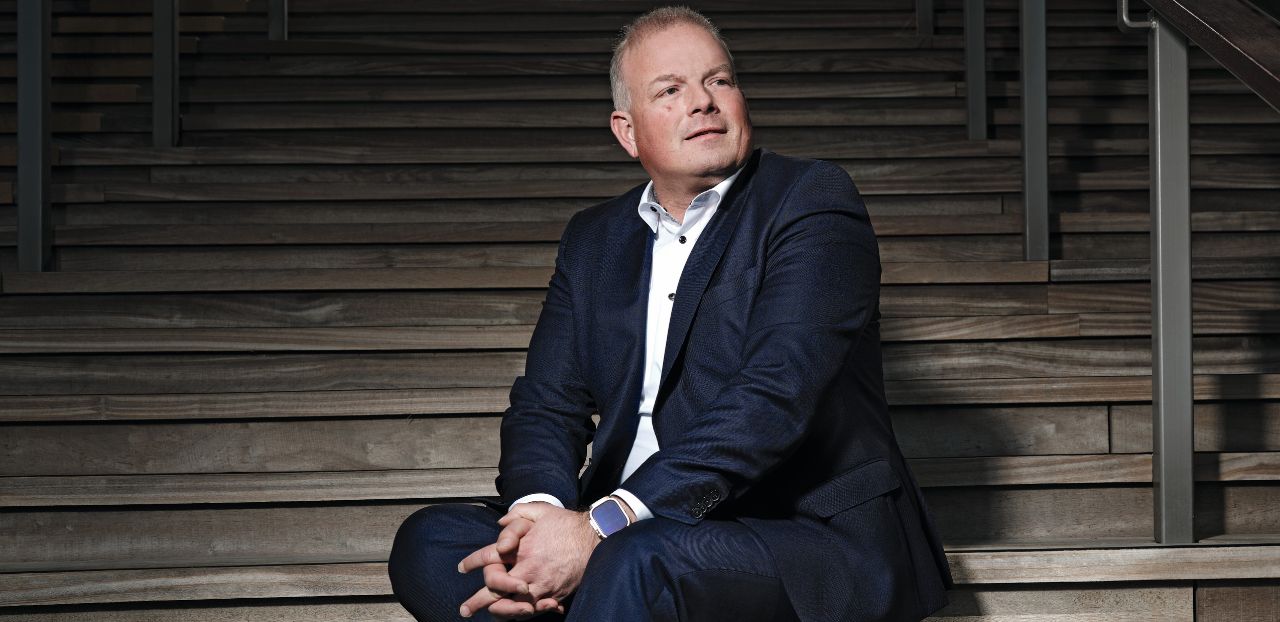
Gavin van Boekel worked in various roles for Unilever for no less than twenty-one years before becoming CFO of Heijmans in 2021. For him, the move to the construction industry was less significant than it might have seemed to the outside world. ‘Call it a lack of imagination, but I need to work for a company that makes something tangible, whether that is an ice cream or a building. On top of that, in my last job at Unilever, I flew all over the world. Now it is nice—also for those at home—to work for a quintessentially Dutch company and wake up before the alarm clock, rather than from the alarm clock.’
The main trigger for switching companies and sectors was the potential he saw for Heijmans’ future. ‘When I look at the construction industry, and I do not mean to be disparaging, it is a sector that has been stacking bricks for quite some time. In my view, the major changes due to increased demand and the dwindling number of skilled workers are only just beginning to take shape. I am someone who thrives on change, so I said to Ton Hillen: if you want change, I am your man. If you want more of a business as usual, you could better look for another CFO, because that is not my strong suit. Ton certainly had the ambition to bring about change. That is how I ended up here, and after four and a half years, I am still extremely satisfied.’
Gavin van Boekel’s conversation with Mohamed Bouker, partner at Deloitte, ties in with Deloitte’s 2026 CFO Dinner, which focuses on the changing role of the CFO and the dynamics of the CEO-CFO relationship. Van Boekel experienced firsthand just how crucial a good working relationship between this duo is during his career at Unilever. ‘I once had an experience where, as CFO, I did not click with the CEO. That was not pleasant for me, but it was even more difficult for the people who reported to us. I wanted to avoid a repeat of that at all costs, so even before I joined, I had many conversations with Ton to get to know each other and make sure we really had that connection.’
As the board, you are jointly responsible for Heijmans’ strategic direction. Can you tell us a bit more about how you reach decisions?
‘Precisely because there are only the two of us, I think it is important to seek out that proverbial friction. I would find it very dangerous if we were constantly in agreement. Then you become each other’s echo chamber. We are fairly complementary, but we also really try to approach problems and dilemmas from different angles. We often deliberately take opposing perspectives. If Ton reasons from a blue perspective, I take the red stance, and vice versa.
Especially when external circumstances, such as the current geopolitical situation, force you to confront certain issues, one of the major pitfalls in the boardroom is to focus too much on those immediate problems. That only makes things more hectic, whereas to stay on course, you actually need to take a step back. That is why we consciously try to create moments for reflection and deeper conversation. For example, we have recently been discussing the Ministry of Defense’s investment stimulus more frequently. What does that mean for Heijmans, and for which projects are we going to bid? Are we going to immediately and solely pursue Defense contracts, or do we first consider the long-term impact on our business operations? Or when it comes to rising diesel prices: how do we help subcontractors with those increased costs without going under ourselves? Discussions like these require just a little more time than a quick run-through. Every now and then, you need time to reflect before reaching a clear decision, that while tranquility is a scarce commodity, especially in times like these.’
How do you actually find the time for that?
‘That requires more planning these days than it did six months ago. Generally, Ton and I are both at the office in Rosmalen a few days a week. That makes it easy to pop into each other’s offices, but those five minutes in between are not enough. We usually arrive at eight o'clock and then try to brainstorm for an hour with the door closed, or we have lunch together. Those moments do not just happen by themselves. You have to consciously create and cherish them.’
If you really disagree with each other, how do you prevent it from getting personal?
‘In the past four and a half years, I have never experienced it getting personal. Of course, we sometimes have heated discussions, but the foundation is that you trust and respect each other. If things get really tough on the substance and we realize that continuing the discussion is not productive for the moment, we park the conversation, sleep on it, and continue the next day. We call that letting it simmer. It is rare that we do not reach a conclusion within the same week. Sometimes it leans more in my direction, other times in his. The point is to arrive at the best outcome together, to achieve the synergy of one and one makes three.
We do, however, make a distinction between inside and outside the room. Outwardly, we are in principle always in agreement and present a united front. By now, we can also read each other's body language. When we are in a group, a hand gesture or a glance is enough to know that we do not quite agree. We then set the topic aside for later, to avoid getting into a discussion with each other in the group. You simply do not want that.’
How do you evaluate whether things are still going well on a personal level?
‘We try to have dinner together twice a year and then talk only about what is or is not going well in our collaboration, what we appreciate about each other, and what irritates us. We deliberately do not talk about the business side, to prevent ending up inadvertently discussing operations after all. By the way, I think it is easier to maintain and even strengthen the bond between us when, as in our case, the company is doing quite well. Just like in a personal relationship, things only really get challenging when there is a lot of pressure.’
You have been working together for four and a half years now. Looking back, which team achievement are you most proud of?
‘The course we charted for Heijmans. Ton has worked in the construction sector his entire life and is a project person through and through. Unilever, where I come from, is an organization that breathes processes. In the beginning, we did not really understand each other's world or each other’s language. It took quite a bit of time and discussion before we were certain that we shared the same vision for Heijmans, namely that we want to transition from a project organization to a projects and processes company. Now that the direction and the end goal are broadly clear, that brings peace of mind, even though in this world it is quite difficult to say exactly what that future will look like.’
What needs to change to turn Heijmans into a projects and processes-based organization?
‘In a project organization you start from scratch with every project. It is very black-and-white. Every bridge, so to speak, is custom-made. In a process-based organization, certain elements of that bridge are specific to that location, and that still requires customization. At the same time, many other elements are simply standard. The question, therefore, is how we can continue to handle what makes a project unique and what is important to customers in a project-oriented way, and how we can handle the things that are not or less important in a kind of assembly-line way, like a kind of small factory. Call it playing with Lego blocks.
The rationale behind that change is simply the aging population. Due to the enormous challenges in housing construction, defense, and roads, among other areas, we are facing a massive amount of work over the next ten years, while the number of employees in construction will only decrease.
I often call it a dromedary: there is a hump somewhere among the fifty to fifty-five-year-olds. They will be retiring in ten years, while we will not be able to replace that number of people at the front end. If you want to do more work with fewer people, you have to start building in a different way to still boost productivity.’
Whereas the CFO used to look mainly backward, he is now also expected to look ahead and contribute to strategy and value creation. Do you still see yourself as the financial conscience of Heijmans despite this?
‘A CFO cannot possibly be the financial conscience on his or her own. As a CFO, you can certainly drive financial discipline, but ultimately it is about the culture. I think it is more important to instill that culture within the organization than for the CFO to be the line of defense. Of course, if a company has a major control issue or is struggling financially, the CFO is still primarily held responsible. That risk is part of our role. At the same time, I think that nowadays it is actually up to us to look at strategic issues through a financial lens. Is something feasible or not? If it is not feasible, should we make different choices, or should we make it possible anyway? And how? A CFO just scolding the others and saying ‘nyet’ all the time… that does not work anymore.’
In that light, do you see yourself more as an executive with financial responsibility, or as a CFO on the board?
‘I would describe myself as an executive with a financial background. Less than half the people reporting to me are in finance & control. The rest are in communications, legal affairs, IT, sustainability… For me, that makes the role more enjoyable than it used to be. There is probably a self-selecting mechanism at play there as well. People who enjoy that breadth tend to seek it out much more. I have noticed that my peers at other listed companies all feel somewhat the same way about it, partly because the world is changing. These days, the world engages much more with me as a board member than as the person responsible for accounting and controlling at Heijmans. I suspect that the CEO-CFO tandem has become more important because executive boards have generally become smaller, partly due to increased governance requirements. Moreover, the complexity and volatility of the world require that you make fewer long-term plans and, above all, stay on a strategic course. That also demands different qualities from a financial professional than twenty years ago, when we simply used to create thick budget books and long-term plans that we would then implement. That was still possible back then because the environment was stable and predictable enough. In the past, the discussion focused mainly on the end result; now it is mainly about managing the drivers – because the outcome itself has become much less predictable.’
Heijmans has ambitious sustainability goals and aims to be net-zero as early as 2040. How does it feel to lead that transition?
‘During my time at Unilever, I really did become a bit of a disciple of Paul Polman. I have unwavering faith in sustainable value creation. If you are a large construction company such as Heijmans and can have such a significant impact on the Dutch economy, you have to make that impact. At Unilever, I learned to factor the social value of everything you do into the decisions you make. I am trying to instill this at Heijmans as well, because it leads to better discussions than if you only look at the bottom-line profit. As the board, Ton and I emphatically convey that message, even if we sometimes get pushback from shareholders. Fortunately, we do not have to have that discussion all too often. Our story attracts its own investors, and investors seek out our story. In fact, I often hear that people greatly appreciate the authenticity of our story.’
This interview was published in Management Scope 05 2026.
This article was last changed on 19-05-2026