
The governance triangle in dialogue
In practice, in many organizations the works council is only consulted once a decision has effectively already been made. Employee participation thus becomes a formal step at the end of a process.
Yet the works council or employee representative body could be involved at an earlier stage. Indeed, they should be involved, if it were up to the initiators of the Driehoek in Dialoog (‘Triangle in Dialogue’) pilot program: the Alliance for Employee Participation and Governance (AMG), the NR Governance Foundation, and the Goldschmeding Foundation. Since last year, eleven organizations from a range of sectors have been testing a specially developed toolbox designed to promote better dialogue between management, the supervisory board and the works council. On 9 December, a conference at the Social and Economic Council (SER) will mark the end of the pilot period. The toolbox will be made public at the end of 2026, allowing a wider audience to engage with the program.
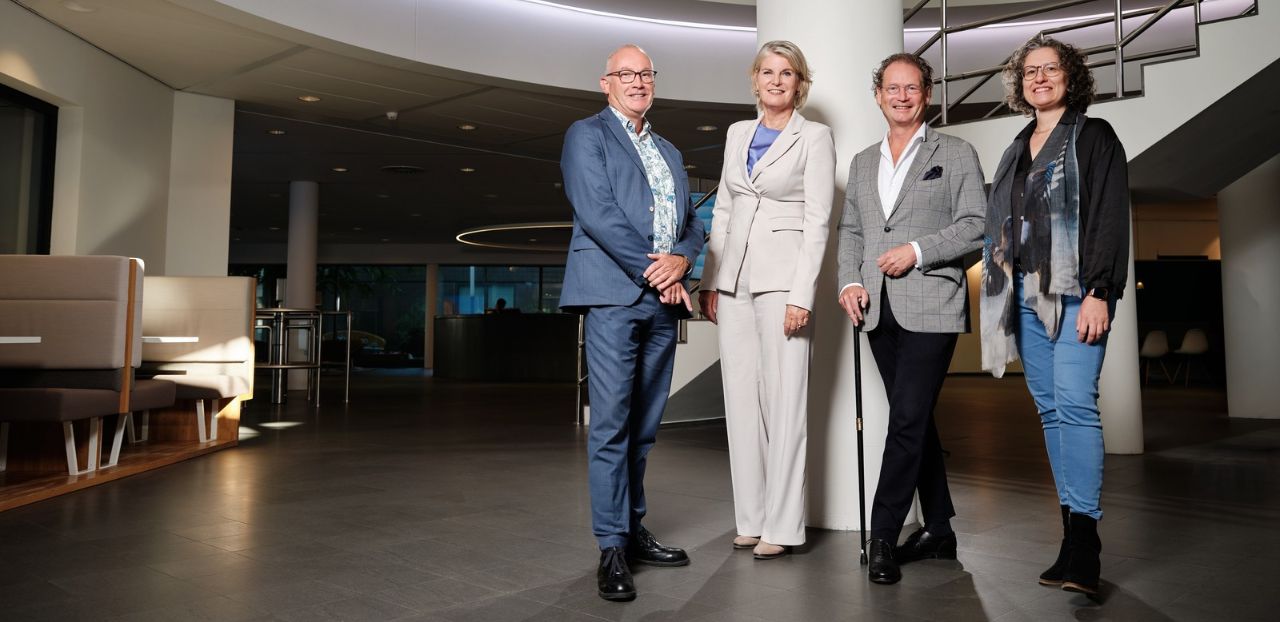
Dorine Wekking, chair of the Alliance for Employee Participation and Governance and project leader of the Driehoek in Dialoog pilot program, will discuss the experiences of the past year with three participants. Maarten van Beek is chief purpose & strategy officer at ING Netherlands and former CHRO of ING Retail Bank, chairs the supervisory board at the UAF (Foundation for Refugee Students) and a supervisory board member at the NPO (Dutch Public Broadcasting). Aukje Kuypers has been managing director of Koninklijke Kuijpers since 2013 – a 105-year-old company specializing in sustainable technology with over 1,500 employees – and named Businesswoman of the Year in 2018. Adwin Krijger is the chair of the works council at ISS Facility Services and key account manager for food services at the same company.
To each of you, the question: why did you put your hand up for Driehoek in Dialoog? What was the specific reason your organization decided to take part in this pilot?
Kuypers: ‘Olaf Smits van Waesberghe from NR Governance called me to say there was a need for a very hands-on company to join the program. We are exactly that kind of company, full of people who get things done. That gave us the chance to assess: what do you need to function effectively in employee participation and to engage in that dialogue? Are we indeed doing a good job, and are there things we are missing?’
Krijger: ‘Our previous chair came into contact with the program through a presentation at Nyenrode. As a works council, we had long felt that we wanted to develop further, while also recognizing that we could further strengthen our cooperation and connection with our management and the supervisory board. We were therefore delighted to join the program. So, the initiative really did come from the works council.’
Van Beek: ‘For me, a concern – or, to put it positively, an ambition – regarding NGOs and small to medium-sized enterprises (SMEs) played a part. Smaller organizations, which are often highly professional in what they do but whose governance structures is sometimes less tightly organized. Especially with only one managing director, a well-positioned works council and a well-functioning tripartite partnership are crucial. As Herman Tjeenk Willink so aptly describes in his book Groter denken, kleiner doen (‘Think Bigger, Act Smaller’), it is all about power and countervailing power. In a multi-member executive board, this already exists, because the various members keep each other on their toes. With a single-member board, the works council is essential to fulfil that role.’
Is it not a given that the works council should be involved in all kinds of decisions at an early stage?
Krijger: ‘No, that does not happen automatically. As a works council, you have to position yourselves in such a way that the boardroom takes you into account. Fortunately, we have an excellent relationship with our executive director. As we developed, we realized that for certain initiatives, we could have been involved much earlier in the process. The feedback we received showed, above all, that there was still room for improvement in the levels of management below the executive board when it came to awareness of employee participation: operational managers develop plans without always thinking directly about employee participation. By adopting a confident stance, adhering strictly to the law and established processes, and informing those intermediate levels when they need to consult us, this has improved significantly. Issues are now proactively brought to our attention, even regarding topics that will not come into play until 2027.’
Van Beek: ‘As a supervisory board member, you are only present within an organization five or six times a year. You remain at a distance, which makes it more challenging to understand what is going on within an organization. This is precisely why good contact with a works council is so important. Firstly, because it allows the supervisory board to stay in touch with what is happening within the organization. But it also works the other way round: I can share our meeting agenda with the works council in advance and ask which points or concerns they would like to bring to our attention. This is valuable for a supervisory board and can improve the decisions made by the management board. It also requires trust. Trust between the supervisory board, the management board, and the works council. In a well-functioning tripartite relationship, the parties respect the fact that, in the interest of the common good, there is also separate contact between the various parties. The supervisory board, in its role as employer, can, for example, seek feedback from the works council for a director’s 360-degree appraisal. It is important, however, that this is done transparently, and that the executive is aware of it.
That is why I also attach great value to the supervisory board member appointed on the recommendation of the works council. For the works council, the nominee committee member is the first point of contact within the supervisory board – a direct link that does not need to go through the executive. This enables the works council to bring an issue directly to the attention of the supervisory board members, or to ask them to raise a specific point during our meeting. As a result, the supervisory board members can ask the right questions and thus help the executive board make better decisions.’
What elements are required for the parties to truly find common ground at that strategic level? Is that primarily the responsibility of the executive?
Krijger: ‘Everyone within this triangle has their own, very important role to play. Management and the supervisory board must be open to this and have the confidence to give the works council space, based on the realization that you are pursuing the same business objectives. After all, as a works council, we also want a healthy company. There is sometimes a misconception that a works council does not exist for the sake of the organization. But our goals are practically the same as those of management; only the perspectives and influences differ.
As a works council, you must also have the courage to claim that space. In an international organization such as ISS, the overarching policy direction is determined at the top, but the strategic action points are defined locally. That is where we, as a works council, can have influence. A major win for us is that we are now invited by management to join their strategic planning sessions to translate that policy into concrete local actions. That lies well outside my personal comfort zone, and I find it both exhilarating and quite daunting. But ultimately, it is quite brilliant! And I have noticed that it makes us, as an organization, stronger.’
Van Beek: ‘It places a particular demand on management, who must act as orchestrator, to involve the works council early on, share information in a timely manner, and treat them as an equal partner. This is in line with our Rhineland model, which is rooted in equality: everyone has their role and have to take it. The supervisory board must ensure that the system as a whole functions effectively, intervening only when something goes wrong.
Incidentally, I am a huge fan of the Rhineland model, the ‘polder’ approach, especially now that the Netherlands is becoming increasingly polarized. In Anglo-Saxon- organizations, the focus is often on constant, rapid action. But this does not always have the desired result: it very often becomes a frantic, breathless scramble. It is better to engage in substantive dialogue, as this builds a foundation of support for your decisions. We must continue to nurture the Rhineland model and explain it clearly to leaders who may be less familiar with it. Not only because it is deeply embedded in Dutch culture, or because it enables companies to make better decisions, but also because the Rhineland model is well-suited to tackling major societal issues, such as climate change, the energy transition, and polarization. No one can solve these on their own. You do not have to agree on everything, but everyone must have had the chance to contribute.’
Kuypers: ‘At the time, as an executive, I took the initiative to make the discussion more strategic and substantive. When I started fifteen years ago, for example, discussions sometimes still centered on matters such as safety footwear. I said at the time: that obviously needs to be properly arranged. But as an executive, I need a sparring partner to discuss our long-term ambitions. I want to be able to have that dialogue on an equal footing. We then deliberately trained everyone and made clear agreements on how and when we would inform the employee representation body. It took time to get into that rhythm because we are so operationally focused. We now announce topics well in advance. As a result, our discussions are much more substantive. As an ‘action-oriented’ company, we still need to learn to slow down and go into much greater depth on specific topics, but we have noticed that, at the end of the day, it does help tremendously.
The toolbox contains instruments that can assist with this. Tools that are not about procedures, but about relationships: spending a day away from the office, without any reorganization on the agenda, to discuss why you consider the employee participation council important and why you care about this company. When you understand these things about one another, you also understand each other’s behavior at the negotiating table.’
Early involvement also means receiving information that is not yet finalized. How do you deal with that, and how do you keep the dialogue going when things get a bit rough?
Van Beek: ‘Early strategic involvement requires a high degree of confidentiality. If a director involves the works council in scenarios, some of which will never make it to the finish line, the works council gains access to sensitive information that cannot simply be shared with its members. That is the price for having an early say in the direction the company takes. It also requires a works council that is well-informed and knowledgeable. In turn, directors must be able to trust that preliminary ideas will not be used against them at a later stage.’
Krijger: ‘A genuine conversation begins with being critical and asking probing questions. Listen carefully to what is being said, but above all, to what is not being said. A director cannot, or is not always allowed to, communicate everything. Having a genuine conversation means getting to the underlying motivations. That is challenging for us, but I also understand that it is difficult for a director to reveal exactly what is on their mind.
During one meeting on a specific topic, we noticed that emotions were running high as a result of the discussion. As chair, I found that moment intense, because you see someone stepping outside their comfort zone. Later, we sat down with our CEO to discuss it further: what were the underlying thoughts, and why this topic evokes such strong emotions. Precisely because we did not avoid that, the mutual trust has grown enormously. The fact that there is some friction is part of the process; it is good to bring a difficult topic to the table. In any case, it brought us closer to the heart of the matter.’
Works council work takes time and requires expertise. How do you organize this in practical terms, and how do you ensure people are motivated to commit to it?
Krijger: ‘In my role as a key account manager, I have a fairly flexible schedule. This allows me to effectively combine my position with the role of chair. Since January, we have had an administrative secretary for the works council, which is a huge help. And I see works council work as an incredible way to develop your skills: you get to know organizations and learn to negotiate and deal with conflicting interests. We consciously focus on that. We have fifteen seats.
Right now, elections for our works council are taking place, and we have around thirty-two candidates. It is hard to believe – many organizations have to really struggle just to fill their seats.’
What do you wish for the future of governance triangles in the Netherlands?
Kuypers: ‘I hope that organizations taking part will come to realize that we are stronger when we work together. As a triangle, you stand together to build a thriving, future-proof organization, and this approach provides the tools to do just that.’
Krijger: ‘I hope the business world and society at large become more humane. In politics, things often go wrong because of self-interest, whereas people in the workplace simply want a well-organized environment in which to work and live. For me, the Works Councils Act (WOR) is the foundation; what matters is what we build upon that together.’
Van Beek: ‘I hope the Netherlands will maintain and nurture its Rhineland consensus-based model, the poldermodel, for the next 100 years, and take pride in it. Power and countervailing power: that is a valuable principle to continue to cherish.’
This article was last changed on 17-11-2026