
Laura van Geest (AFM): ‘Taking your intuition seriously’
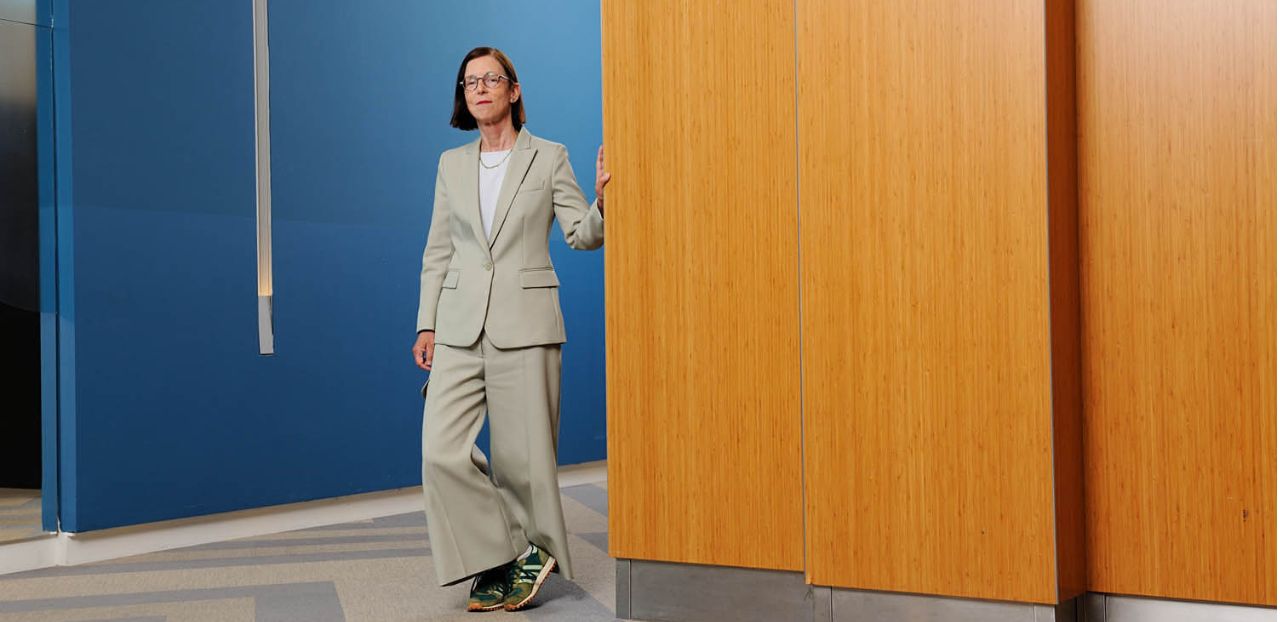
Good board members want to do the right thing. Yet there sometimes is a yawning gap between good intentions and good governance. In the boardroom, personal convictions clash with group dynamics, established routines, shareholder interests, and short-term pressures. So, how do you ensure that discomfort becomes the starting point of a better conversation? Patrick Nullens – Professor of Leadership Ethics at the University of Humanistic Studies in Utrecht, and, in that capacity, also involved with the Goldschmeding Foundation – discusses this topic, along with other principles of in-depth governance, with Laura van Geest, chair of the Netherlands Authority for the Financial Markets (AFM) since 2020. Van Geest is convinced that doing the right thing begins with three conditions: knowing, wanting, and being able. ‘It only really takes off once those three conditions are met,’ she tells Nullens during a conversation at the AFM headquarters in the heart of Amsterdam.
Earlier this year, during her keynote address at the symposium The Guardians of Reality (De bewakers van de werkelijkheid), Van Geest spoke about the phenomenon of ‘looking the other way’ in boardrooms.
According to her, looking the other way is a human and recognizable reflex, but it is never without consequences. She spent many years at the Ministry of Finance, then served as director of the CPB (Netherlands Bureau for Economic Policy Analysis), and for the past six years has been chair of the AFM. Each environment has a different culture. ‘The CPB, for example, was much more rooted in an academic tradition. It is very different at the AFM. As a board member, you adapt to that. Board members do not operate in a vacuum; they are not entirely detached from their environment. And in that environment, it is not always easy to swim against the current. If everyone says something is white, it is incredibly difficult to be the only one insisting it is black.’
Let us take a closer look at that boardroom. Over the past few decades, we have seen an increasing number of guidelines and codes. These provide directors with frameworks and external incentives. But what is needed for what I call an inside-out transition within the boardroom – the ability to adjust systems based on one’s own moral compass to facilitate a shift toward a more humane and sustainable economy? How can we take a deeper dive in the boardroom?
‘When it comes to transitions, I always talk about ‘knowing, wanting, and being able.’ You have to know what to do, you have to want to do it, but you also have to have the ability to do it – to be capable of it. All three of these conditions are equally important; one cannot exist without the others. Enthusiasm and commitment within an organization are important. The reverse is also true, ‘knowing’ and ‘wanting’ only leads to results if people actually ‘can’. That ability may stem from regulations, but also from other external factors. Companies have to deal with shareholders, financiers, and banks; they also need to survive financially. So, if quarterly figures suddenly become more important than long-term goals, then, no matter how much you ‘know’ and ‘want,’ it simply will not work. We saw this with the sustainability debate: it only really gained momentum once all the conditions of ‘knowing, wanting, and being able’ were met.’
In our In-Depth Governance project, we see that executives and non-executive directors feel a need for a safe space to collaborate across sectors on building a humane economy, share dilemmas, and exchange insights. Do you recognize this?
‘By discussing things together, you help each other move forward. That is certainly true. But I also see in the financial world in the Netherlands that there are quite a few platforms where we can talk to one another. In the Netherlands, we have all committed to climate goals, following extensive discussion. Key topics are explored and discussed together, and commitments are made regarding them. The same applies to issues such as sustainable financing or financial self-reliance. At the same time, I think there have been periods when the climate was more favorable than it is now. Particularly due to the influence of debates in the United States, certain issues are under pressure.’
And what does that mean?
‘Issues that companies used to state effortlessly are now approached in more guarded terms. Careful thought goes into the choice of words. I would venture to say that most Dutch companies genuinely support diversity, yet you now see multinationals, in particular, being more reserved about it or avoiding terms like ‘diversity,’ ‘inclusion,’ and ‘D&I’ as much as possible. Instead, they are more likely to speak of a ‘balanced candidate shortlist’ or something similar. New code words and buzzwords are emerging to keep stakeholders satisfied. On one hand, that is a pity, of course, but on the other, I also view it as enlightened self-interest. And I understand that, too.’
You have spoken before about the language used in the boardroom and linguistic blurring. You mentioned procrastination, evasion, sweeping things under the rug, and a failure to call things by their name... Is the use of clichés among board members not also a hindrance?
‘I do not entirely agree with you there. Some clichés are actually very apt and convey exactly what is meant. If I say, I am a ‘deal is a deal’ kind of person, that is a cliché, but people know right away what I mean. But language is certainly important. And in the boardroom, there is a tendency to speak in guarded terms. ‘Risks’ are quickly rebranded as ‘areas of concern,’ while structural signals indicating that something is not right are dismissed as ‘operational noise.’ I think that in the privacy of the boardroom, what matters most is whether you dare to call a spade a spade – to use yet another cliché. Look, people just do not like conflict, although you would sometimes suspect otherwise when watching the news. Up close and personal, we prefer to keep things harmonious. It is hard to be the first to raise a complex issue; looking the other way is often the first reflex.’
And how can you ensure that complex issues are actually discussed?
‘That is an important question. You cannot simply say ‘be critical,’ because that mostly encourages the people who were already critical. Research has shown that being the one who is always critical does not always benefit your social standing. I think that as the chair of an executive or supervisory board, you have an important role to play. For example, by agreeing on ground rules together, which makes the conversation easier. I always ensure every board member has time to speak. At the AFM, we have also built in various mechanisms for dissent, which gives everyone the maximum chance to flag risks and speak their mind. Of course, that does not mean everyone always experiences it that way or feels they have that space, but organizing it this way you at least increase the likelihood of an open dialogue. If you do that well, you also stand a better chance of being able to discuss any discomfort.’
What we are seeing in our research into deepened governance is that while board members are able to offer counterarguments using reports, figures, and rational arguments, it remains difficult to let your intuition or gut feeling speak in the boardroom. That feels much more vulnerable… Do you recognize that?
‘As a board member, you should not underestimate intuition. Intuition is distilled experience and certainly not synonymous with irrationality. It has more to do with pattern recognition. With extensive experience, you automatically learn to recognize patterns. And it is often based on pattern recognition that you ask for a time-out or for clarification. In the environments where I operate, it is not considered strange to speak from intuition. But that does require experience and a certain level of self-confidence. And an environment where it is okay to ask ‘stupid questions.’ My approach is: if I do not understand something, someone can surely explain it to me quickly. A single sentence can defuse an entire room: ‘I do not see it yet; who sees what I do not see?’ And if I still do not understand it after the explanation, there may be something else going on. If there is something I cannot quite figure out, it is a signal for me to hit the pause button. As a responsible board member, you have a kind of radar. And when that radar goes off, you have to raise your hand.’
Together with executives and supervisory board members, we have developed seven best practices (see the box ‘The seven best practices of In-Depth Governance down below). Of course, there is a whole world behind this. Which ones resonate with you particularly?
‘I actually recognize ourselves in all seven. ‘Know yourself and show yourself’ is a familiar motto for us. At the AFM, we are also strongly focused on ‘breaking through limiting routines.’ Clinging to the familiar is an almost inevitable human reflex. We recently launched the Supervision with a Future [Toezicht met Toekomst] program to break that pattern, to reflect on what truly matters to us. I believe a learning organization is important. I want us to learn from our mistakes – or from others’ mistakes, learning from ‘a fire at the neighbors.’ There are lessons to be drawn from what goes wrong at other supervisory bodies, whether domestic or international – take the Wirecard scandal, for example. Imagine if that had happened in the Netherlands, would we have seen it? I also believe in conducting pre-mortems: what will we do if this goes wrong? It is useful to reflect on that together. Besides, a pre-mortem is better than a post-mortem.’
The seven good practices of In-Depth Governance
Together with the University of Humanistic Studies in Utrecht and Nyenrode Business University, and in close consultation with 120 representatives from the business community, the Goldschmeding Foundation has formulated the seven golden rules for humane governance practice, in which executives and supervisory board members work towards a humane and sustainable economy, driven by a personal transformation.
- Seek out and explore discomfort
Make room for tension in the boardroom and view it as a starting point for change. - Listen and ask different questions
Facilitate conversations by listening attentively and asking hopeful, future-oriented questions. - Break free from limiting routines
Recognize which habits stand in the way of innovation and have the courage to change them. - Prevent moral complacency through ethical reflection
Systematically integrate ethical considerations into governance. - Know yourself and show who you are
Be mindful of your values, develop as an individual, and bring your authentic self to the table. - Dare to be moved
Remain open to connection, art, nature, and a sense of purpose; broaden your fundamental mindset. - Become a connector
Break through polarization and actively seek collaboration, including outside your own circle. Good leaders want to do the right thing. Yet, a gap sometimes exists between good intentions and good governance. In the boardroom, personal convictions clash with group dynamics, established routines, shareholder interests, and short-term pressures.
Do you think that, as an external supervisor, you should focus primarily on looking back, or focus on the challenges that lie ahead?
‘I believe you should look at the problems, at the challenges, and then determine the most effective way to achieve a result. As a supervisor, you can limit yourself to the rulebook or the big stick, but you could also say: this is the direction we want to take. A lot is changing in the financial world. Financial firms are increasingly becoming true tech companies. We, too, must adapt to that. We need each other to navigate this transition successfully. Supervision is, of course, a legal concept. Legislation naturally lags slightly behind developments, and supervision follows suit. Still, I believe that as a supervisor, we must play a proactive role.
We should not just look at what is illegal, but also at what is harmful. When we identify harmful practices, I believe we must take action. We did that with cryptocurrency, for instance. You could say that if you go to the Wild West, you run the risk of being shot. But if the Wild West comes here, we have a problem. That was the case with cryptocurrency. That is why we said at the time: it is here, it is problematic, it is harmful, we are concerned, and legislation is needed. And that legislation did follow.’
What should the AFM do better in the future?
‘I think that as a regulator, we also need to continue seeing the opportunities. We are by our nature serious people – the type who wear horn-rimmed glasses, and while we need not put on the proverbial rose-tinted glasses, we should not focus solely on identifying the risks. I think we need to hold ourselves more accountable for that. The same applies to setting open-ended versus closed standards. What should we as a regulator do? Should you prescribe rules? Or should you also give the market a chance to find its own way? The tricky part is that small service providers think about this very differently from large multinationals with full-fledged legal departments. The latter group says, ‘Let us figure it out ourselves,’ whereas the former primarily wants clarity. So that is something to consider. But, of course, you cannot compromise on your fundamental principles. We are mission-driven regulators.’
That goes without saying. But with deepened governance, we actually hope to go a step further – towards ‘doing good for society.’ The financial sector is a key pillar of our society. Should we not also be asking in the boardroom: what are we actually doing for society?
‘But our organization is thoroughly imbued with that mindset. Our mission states that we contribute to sustainable financial well-being in the Netherlands. We are committed to fair and resilient financial markets; that is the overarching goal. The Dutch financial sector is also active in this regard. There is the financial sector’s climate commitment, for instance. Furthermore, the sector is taking responsibility in the social sphere, for example through the Financially Healthy Netherlands Foundation (Stichting Financieel Gezond Nederland)) or the Wiser with Money (Wijzer in Geldzaken) initiative. You cannot simply dismiss this as enlightened self-interest. Insurers have established an ethical framework around data-driven applications within their umbrella association. However, we do see a trend in which foreign parties in particular, are engaging in data-driven price setting. And we should not be naive about that. Because if you are priced out of the market, that is the end of it, and fine words will not help you then.’
One of my favorite economists, Amartya Sen, says we must dare to call out injustice in the real world and then take action against it. It might be a bit of a big question, but where do you see that injustice?
‘My thoughts immediately turn to the public safety net we have created for people who are financially vulnerable. In the Netherlands, we always think that we have an egalitarian society and that we have everything organized. But in practice, the system has been made so complex that many people get lost in it or simply do not make use of it. To a certain extent, we have also made people wary of using it – think of the childcare benefits scandal.
You mention Amartya Sen; I, for one, am a fan of economist Esther Duflo, who wrote that economists should behave less like theoretical scientists and more like plumbers. How do you organize things in a way that reaches people? Surely, as a society, we ought to be capable of that.’
And what about you, as chair of the AFM Executive Board? How do you set a good example?
‘A chair is essentially a kind of director. Orchestrating the space, the pace, the language, and the sense of safety. I try to be open. I try to admit my mistakes. I think it helps when I say, ‘Yes, that was stupid of me; I handled that clumsily.’ When you do that, it also makes it easier for others to speak up. And I try to create an atmosphere where we are open, transparent, and solution-oriented. I believe that opens up many avenues. To my mind, these are fairly basic and simple principles.’
This interview was published in Management Scope 08 2026.
This article was last changed on 22-09-2026