
Mirjam van Thiel (Acomo): ‘A CFO is more than the financial conscience’
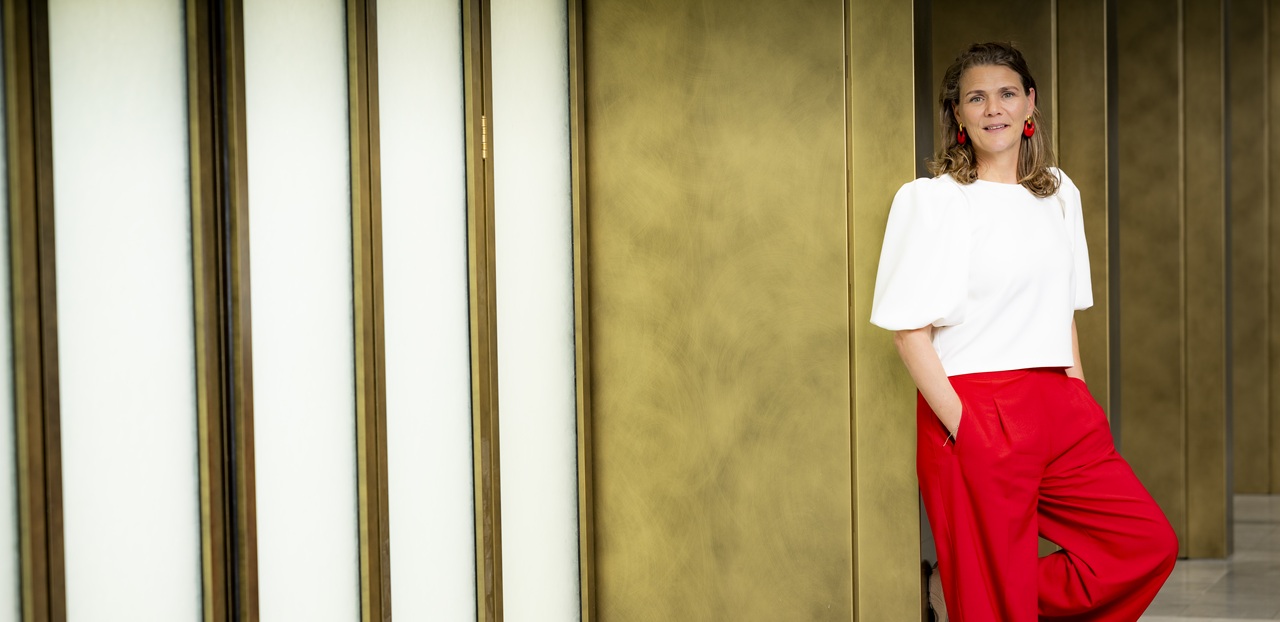
Mirjam van Thiel is back home. Not in Wijchen, ‘the place where I was born and raised and where my parents still live,’ but in Rotterdam. From the 21st floor of the World Trade Center in Rotterdam, Acomo's headquarters, the world is still at her feet. She has been living in this city since October 2024, within walking distance of her office. After a long stay abroad, she became group CFO of Acomo last year. Acomo is the holding company of ten companies in the world of plant-based food ingredients, including Catz International, Delinuts, Tovano, and Koninklijke Van Rees. The product range includes more than 700 products such as spices, nuts, edible seeds, tea, and similar. ‘During any day, there is a good chance you will eat or drink something that was imported by one of our companies,’ she tells Mohamed Bouker, partner at Deloitte, with whom she discusses financial stability, growth opportunities, soft skills, and career planning.
You spent years abroad. Was that a planned ambition?
‘No, not really. I never really planned my career. I never had an end goal or a big ambition in mind. It was always about going with the flow. That is just how I am. Seeing what comes my way. I have always been a bit of a late bloomer, too. I have always taken everything one step at a time. It started with my school career. I attended a secondary school, then went to a higher vocational school, and only then did I study business administration. That way of life has given me a lot. It has allowed us as a family to see a lot of the world. Australia, Indonesia, Malaysia, the Philippines, and the United States… We were constantly on the move. We were very good at that. As soon as our dining table and cupboard were in place and the painting of Utrecht – the city where I met my husband – was hanging on the wall, everything was fine. 'We are home again,' we would say to each other.’
What did you learn abroad? How did it shape you?
‘The most important thing is that our family has become closer. And I think I have become more resilient. When you constantly start over somewhere new, you really have to rely on each other. On your family, but also on your colleagues. You have to connect. And that comes relatively easily to me. I am someone who makes connections easily. I always invest in relationships. I want to understand people. I am also a people person. I often see the positive in people, have a positive outlook on the world, and usually see the glass as half full. I move on from bumps in the road quickly.’
Looking at your resume, it really says ‘food’...
‘Yes, I have always worked in food. First at Heinz, later at FrieslandCampina. And always in finance. That just suits me; I enjoy it. I first took on the role of CFO at Heinz in Australia. That was a really big step for me. I learned a lot from it, especially because I worked under a private equity-regime at the time. A very educational period. On the one hand, I saw how the investors managed to, in a very short time, create a culture. That was truly impressive.
On the other hand, I noticed that private equity was always overdemanding. For example, they knew full well that they could cut a maximum of 30 people when restructuring a particular department, but they insisted on cutting by 60. Then, shortly after, we could hire 30 new people. It was never enough. In the end that started to bother me. It conflicted too much with my personal beliefs. When I had the opportunity to join FrieslandCampina in Malaysia, I did not hesitate. That too was a wonderful time.’
A little less than a year ago, Acoma crossed your path. Were you familiar with the company?
‘To be honest, I had to figure out exactly what kind of company it was and what they stood for. I quickly became enthusiastic, especially after the first interviews. About the company and about the role I could play here. Everything fell into place for me here. It turned out I could put all my experience to good use here. And I could also develop further and discover new things, such as what it is like to work in a holding company with ten independent companies. That is a whole new dynamic. All the companies within the holding company have their own culture, their own systems, their own management teams, and their own CFOs. You have to have a feel for that. Not every CFO has that. You have to build a relationship with them; you cannot impose everything from above. It is really about working together based on relationships. Building together. That suits me well.
At a company like Acomo, soft skills are just as important as hard skills. What is more, Acomo is in an industry that appeals to me. We are in a market with a lot of potential. People want healthy and tasty food, food security, and they want sustainably produced food. We are working on all these themes. And we are confident that we can grow. Yes, when I got to know the company better, I really fell in love with it.’
After years abroad, it meant a return to the Netherlands for you. Was that a difficult decision?
‘No, on the contrary. The timing to return to the Netherlands also had to do with my personal circumstances. The oldest of my four children is in the second year of secondary school. At that age, it becomes increasingly difficult to move.
I also felt the need to ground myself more, to put down roots in the Netherlands, to give my children the foundation that I myself had. The experiences abroad were wonderful, I would not have missed them for the world, but at a certain point I was a bit tired of constantly saying goodbye and building something new.’
Has your experience abroad made you a somewhat un-Dutch CFO?
‘I do not know. I think I am in fact precisely a down-to-earth Dutch CFO. I have always retained something of the Dutch directness. I like the Dutch polder model. Discussing ideas and brainstorming together - I get energy from a group of people around a whiteboard. In Asia, they sometimes had difficulty with that. There, they expected a leader who sets the course in a room on his or her own. I did find a way to work around that. At one point, I found myself saying, ‘Guys, I'm just thinking out loud here. I am not giving instructions!’ But I am who I am. I am pretty straightforward, not very political, and I am not good at poker faces.’
The current CEO at Acomo, Allard Goldschmeding, was your predecessor as CFO here. Is that an advantage?
‘Definitely. I knew Allard from my time at Heinz. He was and is someone I trust 100 percent. Someone I can work with, someone I can learn from.’
You started in October 2024. That means you have been om the position for almost a year. How was that first year?
‘I look back on this first year very positively. I am happy with what I found. I work with great people and great companies. We have a robust business model sand are financially stable. Everything is very solid. And there are many opportunities for growth here. In short, it is a very good starting point for a new CFO.
In April, we announced our new ambitions to our investors at the Capital Markets Day. I was closely involved in the entire process from the start, which was very educational and enjoyable. It was a pleasant collaboration with my fellow CFOs, the management team, and especially with Allard. We truly did this together. As it should be. A CEO cannot do this alone. And neither can a CFO. You need each other. You need to work together on a coherent story.’
Do you see yourself as CFO as the financial conscience of the organization?
‘Yes, a CFO is at the least the financial conscience of an organization. And much more besides. My first and foremost priority is keeping the company financially stable. The foundation must be sound. Solid. The most important aspect of the holding company is financial stability. The working capital we can make available is one of the greatest added values for the companies. This umbrella allows these companies to grow much faster. Financial stability will always remain my top priority.’
What do you see as an important task for the holding company?
‘The holding company actually has four important tasks. One is governance & control, two is added value, three is strategic direction, and four is investor relations. As I mentioned, the parent company is primarily responsible for providing working capital financing, but it also takes the lead on issues such as sustainability, cybersecurity, and AI. My role is also to share knowledge with the various operating companies, and to explore how we, as a holding company, can improve certain activities and streamline them. Take the mandatory European sustainability reporting, we can learn a lot from each other there. Various initiatives are being taken within the group in this regard. We need to disseminate that knowledge throughout the company. I see that as one of my responsibilities.’
Some CFOs struggle with that role…
‘You can have all sorts of opinions about CSRD reporting, but my opinion is: stop whining and just do it. I definitely think finance has a role to play in this. Yes, it involves a huge amount of work, but in 2025, it simply is part of the job. It is not illogical that finance plays a role in this. No matter how you look at it, we have a magnitude of data at our disposal. Ultimately, of course, it is mainly about how to translate that data into action and work with companies on the right initiatives.’
I have noticed that CFOs often have to search for a purpose or the broader social good. Here it seems…
‘…close to heart. Absolutely. Issues such as food security and sustainability are fully incorporated into this organization. I also firmly believe that we have to do it for the greater good. We all have to take care of our planet. Acomo has a portfolio that can contribute to a better world. We can make an impact. I am very happy about that. Although there is still plenty of work to be done. We are doing well with our Scope 1 and 2 reductions, but we still have a lot of work to do with Scope 3. As CFO, I see it as part of my responsibility to challenge the company in the area of sustainability.’
And other priorities? You mentioned that the company wants to continue growing?
‘In addition to financial stability, we have two other important priorities: we want to tell our story, the story of Acomo, better. Tell people who we are, what we do, what we stand for. And yes, we also want to achieve growth. We see many opportunities for our companies to grow autonomously. We want to do this partly through our strong acquisition agenda. In the coming period, we want to acquire companies that play similar roles in the supply chain, just like us, in the specialty markets within the food sector. Our ten companies operate in five different markets: spices & nuts, edible seeds, tea, food solutions, and organics, or biological ingredients. We are particularly looking for partnerships and acquisitions in the areas of spices & nuts, organic ingredients, and food solutions. Financial stability is also very important to us in acquisitions. We will not do anything extreme when it comes to acquisitions. We do this is a responsible manner and will remain critical at all times.’
You operate worldwide. In times of geopolitical tension, which is undoubtedly a challenge?
‘Of course. But we are a company that thrives on dynamic market developments. Customers are looking for certainty, and we can offer that. We have a global network. If a product is unavailable somewhere, we will source it from somewhere else. When the Suez Canal was closed, we sourced our products not from Vietnam, but from Brazil. We can do that. Of course, it does require agility from the organization. So far, we have always found a way. After all, our tagline is ‘Building routes to healthier foods’ for a reason.’
This interview was published in Management Scope 07 2025.
This article was last changed on 26-08-2025