
Petri Hofsté: ‘They conceive, we approve – that separation is too rigid’
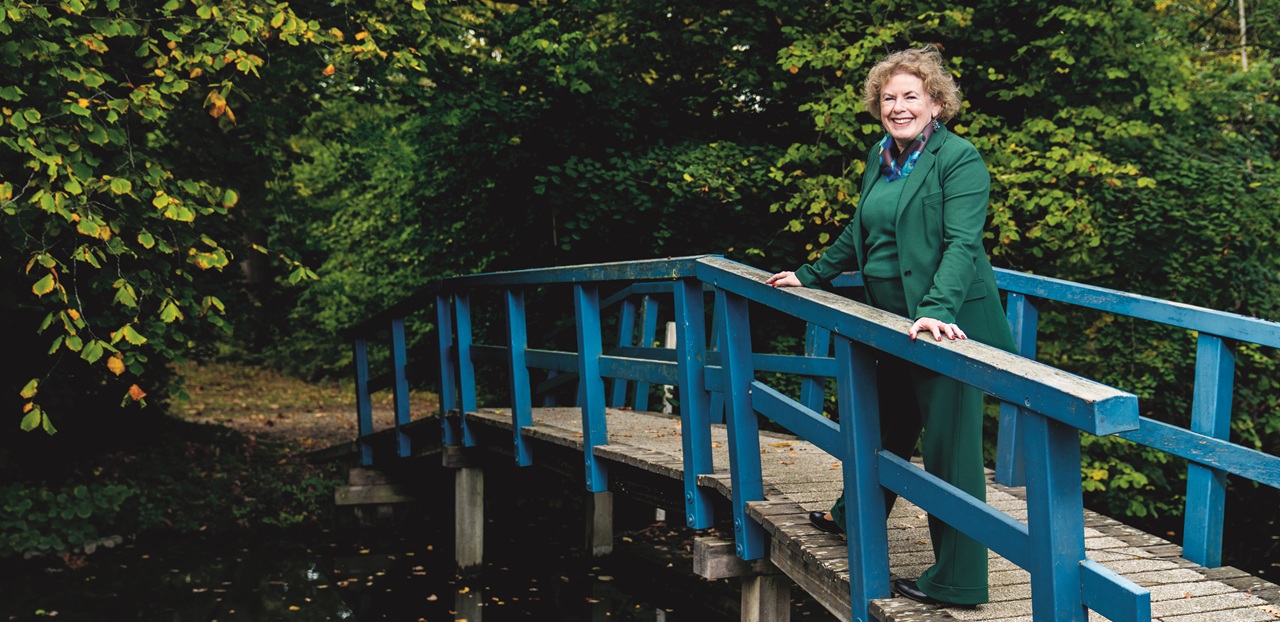
In her early years as supervisor, Petri Hofsté sometimes encountered directors who thought to overload the supervisory board with thick reports was a way to keep keep them happy and avoid too many difficult questions. ‘That bubble has been burst’, according to Hofsté. ‘Directors can no longer get away with that – and they no longer want to’. Over the last fifteen years, serving on several supervisory boards, she has seen the dynamics in the boardroom change significantly. ‘Directors and supervisory board members are increasingly becoming partners who work together to ensure continuity and create value.’
This has also changed the role of supervisory board member. The profession has become ‘enormously professionalized’, says Hofsté, who praises the pioneering work of Nyenrode Business University. ‘With training programs for supervisors and supervisory board members, the university was an early adopter of structurally embedding governance and professional supervision in education.’
Hofsté has been known as an influential supervisory board member for many years. Her current portfolio includes supervisory board positions at ING Bank, Pon Holdings, and FrieslandCampina. She previously held supervisory roles at Fugro, Rabobank, and Achmea, among others. Hofsté looks back on her evolving role as a supervisory board member. But she also looks ahead and reflects on what good governance should look like in the future. She does so during a conversation with Vincent Moolenaar, business director of Board & Governance Programs at Nyenrode. They know each other well: Hofsté has been a member of the board of the Nyenrode Foundation, which oversees the university, for over ten years and has been its chair since 2020.
That is why they do a brief evaluation of the symposium ‘Board Agenda 2035: Future of Supervision’, which took place a few days earlier at Nyenrode and attracted some 180 directors and supervisory board members. The symposium was organized on the occasion of the 75th edition of the Supervisory Board Cycle. For thirty years, this cycle has been a meeting place for supervisory board members and regulators who want to delve into current topics such as governance, integrity, strategy, risk management, and moral leadership.
How did you get into the supervisory board profession?
‘That happened early in my career as an accountant, around 1995. Back then, accountants had little to do with oversight – you were not automatically a guest on an audit committee, and as a public accountant, you were also limited in your supervisory roles. I chose a supervisory role on the board of Blijf van mijn Lijf Amsterdam, a foundation that provides shelter and support to women who are victims of domestic violence. Thanks to my financial background, I became treasurer and later chair. Here, like my colleagues, I learned the profession in practice.
We constantly asked ourselves what our responsibilities were as supervisors. How should we work together? We had little guidance – the articles of association said little about it, and beyond that, there was only the Civil Code. A stark contrast to the extensive regulations, information protocols, codes, and supervisory visions of today.’
When did you see the supervisory role change?
‘The turning point came around the turn of the millennium. After the major international accounting scandals at Enron, Worldcom, and Parmalat – and closer to home, at Ahold – the extent of what could go wrong in organizations if oversight and governance were not properly organized, became painfully clear. This highlighted the urgency of professional oversight. More attention was paid to training and to the role of behavior and culture. There was also a growing awareness that oversight is more than just retrospective control.
Shortly after the credit crisis, when I was responsible for banking supervision at De Nederlandsche Bank, the supervisory role was significantly strengthened. From then on, we had to look not only back, but above all look ahead. That perspective – understanding what happens ‘behind’ the figures and structures – fundamentally changed supervision. And it extended beyond the financial sector.’
How do you experience the public interest in the role of the supervisory board?
‘It has grown enormously. In the past, almost no one knew what a supervisory board did, but now people expect supervisory board members to be visible and take responsibility. That is a good thing: as a supervisory board, you serve a public interest. But it also makes the role more complex. In society, the responsibility of supervisory board members is sometimes confused with that of management board members. Society’s expectations of supervisory boards therefor do not always correspond with the tasks and responsibilities of this body. Liability is also part of the public debate, but that is not something I deal with on a daily basis. You have to think about that in ‘peacetime’, before something goes wrong. Those who fulfill their role well and exercise careful oversight protect themselves and the organization best.’
Do you think supervisory board members should be more visible?
‘The supervisory board must be accountable for its role, certainly to shareholders and other stakeholders. But public visibility has its limits. It is valuable to engage in dialogue with stakeholders. And we do that: we visit companies and hold discussions with clients, for example. But a supervisory board should not step into the shoes of the management board. You have to carefully guard the line between listening and managing in these dialogues.’
Should the dialogue with stakeholders be more explicitly included in supervisory board reports?
‘That would certainly help. Many supervisory board reports are rather procedural, as if they were checklists. I would like them to provide more insight into current issues and dilemmas and the considerations that have been made. This would allow supervisory board members to demonstrate that oversight goes hand in hand with reflection and professional judgment. But I also know how difficult it is to strike the right balance between transparency and supervisory confidentiality.’
In conversations with clients or NGOs, as a supervisory board member, you run the risk of them trying to use you for their own ends. How do you prevent that?
‘That risk certainly exists, which is why you have to be clear about expectations. A conversation with clients is meant to gain understanding of what is going on, not to influence decisions. With NGOs, things can sometimes be more sensitive. That is why I prefer to conduct such conversations in a broader context – it should not be about the role of a specific company, but about relevant social issues. This allows you to better understand the perspective of NGOs and avoids the tension of having to say no to questions about a specific case.’
Sometimes it is necessary to have a one-on-one conversation. Milieudefensie, for example, regularly knocks on doors to hold companies accountable for their climate policies. How can supervisory board members contribute to a constructive dialogue?
‘With complex issues like these, it is important to engage in dialogue and also maintain it. This is, of course, primarily the responsibility of the management board, but supervisory board members can also play a meaningful role. By listening and through interpersonal contact. That is crucial. In addition, companies and supervisory board members must understand where social movements come from. This is only possible by truly delving into the issues. As an organization, you could consider establishing a body in which various stakeholders – from shareholders, employees, customers, NGOs, to local communities, for example – participate for advice and discussion. In such a permanent or constantly changing body, organizations could identify social developments, concerns, or tensions at an early stage, discuss dilemmas and potentially address them more effectively. It could thus serve as a bridge between business and society: a tool for dialogue and, therefore, for preventing polarization.’
Which social issues should supervisory boards put on the agenda?
‘In addition to familiar themes such as climate and sustainability, digitization, AI, innovation, and geopolitics are important topics on the agenda. As a supervisory board member, I also frequently call for attention to be paid to social issues. Our society is facing increasing social uncertainty and polarization. This also affects organizations. Supervisory board members must understand how such forces influence behavior, culture, and decision-making within and about companies, for example through politics.’
As a supervisory board member, how do you stay informed about current developments?
‘I do this in many ways, for example, by attending educational sessions, lectures, and seminars at Nyenrode Business University and other institutions. But above all by talking to people from both inside and outside the organization. Continuing education is part of the job. I think it is important that, as a supervisory board member, you not only keep up to date with the content, but also continue to reflect on your own role.’
Boards of directors have become more diverse in recent years. Is that also true for supervisory boards?
‘Certainly, and that has contributed to the quality of supervisory boards, but we also need to be critical of the definition of diversity. When we, as a selection committee, were recently looking for a new supervisory board member, a colleague rightly asked: ‘Did we have a good interview with this candidate because of his suitability, or because he resembles us?’ That is a good question to ask yourself. Because, let us be honest: when we talk about diversity, it is often about visible characteristics – male, female, background, nationality. And of course, you hope that these differences also lead to different perspectives. Yet, there is always the risk that we will look for new supervisory board members who are like us – our mini-mes. Incidentally, my position is that there is a limit to diversity in a board or supervisory board. That is not always appreciated.’
And? Where do you think the limit of diversity lies?
‘Look, a supervisory board is not a parliament. It is not a group of people who have to reflect opinions of society, but a group of people with a common task: to oversee and contribute to the organization's mission and continuity. Diversity must be functional, serving the mission of the organization. Let me give you an example: if we are looking for a candidate for the supervisory board of Nyenrode, I do not want someone who does not believe in academic education and research and thinks business schools are snobbish and unnecessary. You may have a dissenting voice, but you cannot expect to arrive at a common vision and make decisions. Ultimately, you want people who share the purpose and contribute to it from different perspectives.’
How inspiring is the corporate governance code?
‘In my opinion, it is the discussions about the code that are particularly inspiring. The literal text as such is not what interest me, but what we mean by it and what we aim to achieve with it. These discussions advance the supervisory profession. The growing focus on risk management and long-term value creation has been valuable; these topics have led to improvements in practice.’
How has the collaboration between directors and supervisory board members changed in recent years?
‘The relationship is more balanced. The days when directors thought they could overwhelm board members with information are behind us. Directors realize that good oversight is also in their interest. They therefore want a supervisory board that thinks critically, that reflects, and adds value. There is still some grumbling about long meetings or the repetition of topics, but those are organizational issues. The intention is different: there is openness and a willingness to share responsibility from different roles and tasks. Directors and supervisory board members are increasingly partners in achieving continuity and value creation. This does not happen automatically, however. The rapprochement must come from both sides. If only the supervisory board takes steps, there is a growing risk of encroaching too much on the management board’s territory. The management board must also proactively seek dialogue and be transparent in the provision of information.’
There is sometimes criticism that supervisory boards are ‘too close to the management board’. What do you think about that?
‘The world is more complex, organizations are larger, and social expectations are higher. It is logical that this leads to more intensive oversight. Therefore, it is not a question of being too close to the management board, but rather that supervisory board members take their profession more seriously. Oversight is no longer a control function on the sidelines. It requires involvement and, at the same time, maintaining professional distance. Maintaining that balance is an art, and it also requires us keeping each other focused on it.’
What do you think about one-tier versus two-tier boards?
‘In the Netherlands, the two-tier model is firmly established, but due to internationalization, the number of companies with a one-tier board is growing, albeit to a limited extent. This sometimes fits better with their structure. Nevertheless, we have yet to develop many best practices for the one-tier model in the Netherlands. Regardless of which model a company has, it ultimately comes down to a good division of roles, cooperation, and responsibilities.’
Do you expect the number of organizations with a one-tier board to increase in the Netherlands?
‘Yes, I think so. I can imagine that organizations will opt for this if there is a need for a cultural change in the governance of the organization. A different governance model can help to initiate a different conversation about the dynamics between management and the supervisory board. One-tier structures are also emerging in the non-profit sector, with a distinction being made between executive and non-executive directors. This also clarifies the oversight role of non-executive directors, who are not involved in the organization on a daily basis.’
Will the two-tier model eventually disappear?
‘No, I do not think so. Both models have their value. The two-tier model has a long history and fits well into our European, Rhineland tradition, with its principle of broad stakeholder responsibility and not only a role for shareholders. That is a great asset. In that respect, I would like to see the Rhineland model adopted throughout Europe, because it is based on a balance between economic, social, and human interests. But again, the structure itself – one-tier or two-tier – is secondary. Ultimately, it is about people and their moral compass.’
Do you have any suggestions for the new corporate governance code?
‘The code could be more explicit about the division of roles between the board of directors and the supervisory board in relation to strategy. I believe that supervisory board members should also take responsibility for strategy – not for its implementation, but for the considerations and discussions surrounding it. The separation between ‘they conceive it’ and ‘we approve it’ is currently too rigid. In my view, strategy and the business model are more of a shared responsibility, partly because they also determine the administrative structure and implementation, in which the supervisory board plays a leading role as employer.
Incidentally, much has already been laid down in the governance code. In my opinion, having or developing a moral compass is ultimately essential for good governance. In complex, unpredictable situations, there are never only rational or optimal decisions. We then have to make judgments without knowing whether they will turn out well. That is why it is becoming increasingly important for supervisory board members to develop a view of humanity and the world, to understand their motivations, and to be risk-aware. Such a moral compass is not easy to lay down in a code, but it is important for the recruitment and selection of supervisory board members and directors: how someone thinks, what values they hold, and whether that person can make decisions together with others in an unpredictable world.’
This interview was published in Management Scope 10 2025.
This article was last changed on 18-11-2025