
Marike Bonhof (Ymere): ‘Small investment, huge impact’
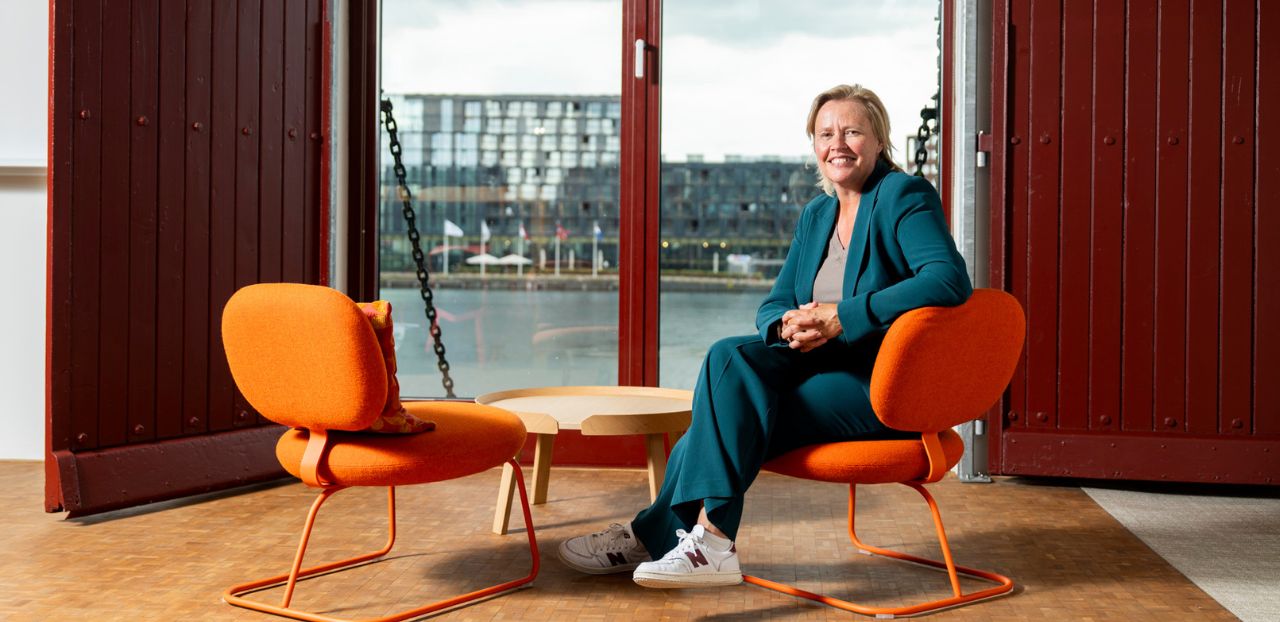
For the past three and a half years the first floor of a former warehouse, overlooking Amsterdam’s IJ River, has been the workplace of Marike Bonhof, CFO of housing association Ymere. This location suits her, as Bonhof, at her home in Almere, also lives by the water. In summer, she likes to go for a swim in the early morning. After a busy workday, she and her husband sometimes go sailing on their boat moored at a dock close by to get some fresh air.
Bonhof also has a professional connection to water. She previously served as CFO of the drinking water company Vitens for more than five years. In that role, she regularly warned of an impending water shortage. ‘Due to population growth, climate change, and soil contamination, the demand for drinking water will structurally exceed the available supply in the future.’ It turned out to be a difficult message to convey. ‘Drinking water is so taken for granted and is so cheap that no one feels the urgency.’ Yet Bonhof is certain that in a few years we will be facing water congestion. ‘Just as is happening now with grid congestion, new customers will soon be unable to connect to the water supply network.’
In her mission to prevent this from happening, she engaged in dialogue with housing associations. She believes that every new home should be built with water conservation in mind. ‘It is crazy that we use filtered water to flush the toilet. In Belgium, they stopped doing that years ago.’ She brought that experience with her to Ymere. She finds this a logical step, as housing and water are inextricably linked and are among people’s basic necessities.
At Ymere, the largest housing association in the Netherlands with over 72,000 homes, she faces additional social challenges. How do you make an aging housing stock resilient to heat waves and heavy rainfall? How do you keep neighborhoods livable as pressure on public space increases? And how do you ensure people can continue to live independently for as long as possible, now that the healthcare system is already barely able to cope? ‘As a housing association we build homes to last fifty to a hundred years and are in the position of landlord ourselves, therefor we have a long-term perspective and can really make a difference,’ she says to Lotte Hart, a partner at SeederDeBoer.
You started at the Ministry of Finance, worked for more than ten years at the City of Amsterdam, and are now at Ymere. Did you make conscious choices in your career?
‘Looking back, I see a common thread. I never chose for the money or the fame, but for roles where I could make a difference. In addition to my passion and dedication, I was fortunate that great opportunities kept presenting themselves. That started as early as during my public administration studies in Enschede. Thanks to a professor, I was able to do my thesis project at the Ministry of Finance. It involved a financial-technical issue but was actually an organizational one. I enjoyed it so much that I said ‘yes’ when the ministry offered me a job. To do that, I had to abandon my plan to pursue a Ph.D. and cut short a planned trip around the world. I became a financial advisor to the then Minister of Finance, Gerrit Zalm, and was able to provide advice on important strategic topics—first in education, and later in healthcare. Eventually, I also helped prepare the Spring Memoranda and was part of the budget negotiations.
At City of Amsterdam, my next employer, I took on my first managerial role in 2005. In 2015, after a stint with the City of Utrecht, I became financial director. What I learned during that period is that money is the key to making an impact. I wanted to use every euro wisely for the city and its residents. At the same time, I noticed that at the City of Amsterdam, I was very dependent on politics. After twenty years, I found that I wanted to have more control.’
How did you end up at Vitens?
‘That is thanks to the late Carien van der Laan. She ran a headhunting firm and was on a mission to bring more women to the top. She wanted to nominate me as a board member at Vitens. I was a wild card, because I did not fit the profile at all. They were looking for someone from the private sector with process engineering expertise. But Carien knew me as a person and believed in me because I am straightforward, curious, and open. She believed that I would fit well among the techies. And she was right about that.’
Did the world trip ever happen?
‘Yes, after five years, we finally went on a world trip. My husband quit his job, and I took unpaid leave.
We traveled through Africa and researched the marketing of solar panels in remote areas. I saw how important access to energy and basic services is. That is where the seed was planted for my later work: the realization of how fundamental issues like energy, water, and housing are to how societies function.’
As a housing authority, you face major social challenges. You have to respond to increasing climate risks, the energy transition, and the livability of neighborhoods. How do you manage all those urgent priorities?
‘You have to dare to make choices. You cannot do everything at once, even though that is what is needed. Everything we do as a housing authority is unprofitable. Our costs are higher than our revenues. We said, for example, that while we want to build new homes, we also have 75,000 homes with tenants living in them. If we have to choose, we are going to improve our existing homes first. That is not a popular choice, not even in politics. But in the past, we unjustifiably postponed maintenance. I feel a sense of responsibility toward our tenants. That is why we have to work tirelessly to use every euro we collect in rent effectively. We cannot be complacent and assume that The Hague will solve everything. It is up to us, too. This also applies, for example, to societal challenges surrounding the energy transition. Weaning homes off gas and making them more sustainable requires a huge amount of time and attention. We also need to respond to increasing climate risks such as extreme rainfall or heat.’
What role do you, as a housing association, play in this?
‘We, together with other parties such as the municipality, the province, the drinking water company, and the water board, are building a water-positive neighborhood in Haarlem. In these homes, toilets will soon be flushed with rainwater instead of drinking water, and heavy rainfall will be captured thanks to a green, water-rich environment. The great thing is that quality of life also improves. People are happier and healthier when there is more greenery. The challenge is that all parties involved have their own funding methods. Our saving on drinking water is money that a water utility does not have to invest—but that business model is complicated to get off the ground. And regulations, by definition, lag behind reality. A good example is how we only now try to use legislation to limit the consequences of grid congestion.’
How do you stay motivated when things get tough?
‘It can be very intense. Especially with cross-sector projects, you can run into many barriers because everyone looks at things from their own narrow perspective. I quickly pull myself together when I think about who I am doing this for. For our tenants, but also for my children who are struggling to find a home. I want to make a difference in society, but I can also deeply enjoy it when I have been able to make a difference for just one person.’
What are you most proud of when you look back?
‘There are two things that I would like to mention. When I started at Vitens, as an economist I saw that the scarcity of drinking water was becoming increasingly acute, demand was growing faster than supply, and this was exacerbated by climate change.
While Vitens had always extracted water from the ground, at some point I said we needed to look at other sources to spread our risks, including surface water. That was like blasphemy. Vitens is a company that takes pride in its groundwater, and rightly so: groundwater simply tastes better and has a more efficient purification process. There was tremendous resistance, yet we gave a small innovation team the space to further develop that concept. And it worked. Now everyone agrees that it is good for the company to be able to rely on different sources.
My second success story took place at Ymere. I wanted to put sustainability higher on the agenda, but this was met with skepticism. Sustainability was said to cost too much and, above all, disadvantage tenants. I demonstrated that this was not the case. That affordability, livability, and sustainability go hand in hand. More green spaces in neighborhoods reduce heat stress, lower aggression, and improve health. Those are demonstrable effects. That is the kind of synergy that is important to me.’
You are an executive and also serve on supervisory boards. How do you keep those roles separate?
‘As an executive, you often have to take decisive action. As a supervisor, you have to take a more contemplative approach. I do not propose solutions, but I ask good questions. Questions that executives have not thought of themselves, or that reveal a dilemma. Everyone has blind spots, no matter how good you are. I am very conscious of my roles. The most annoying supervisors are the ones who try to take the CEO’s seat. I know that from my own experience as a CEO, so I make sure not to do that myself.’
You and CEO Erik Gerritsen form a two-person board. How does that work in practice?
‘We have a management team within Ymere, of course, but the ultimate responsibility lies with the two of us. Our personalities are very different. That is valuable, but it also makes things complicated. It means you have to invest in a good collaboration: we do not only meet with each other; we also sometimes go out for something to eat to get closer to each other. Also, you have to be willing to sometimes compromise and advocate for something even if you personally think that you would have done it differently. As a board, you have to project unity.’
How do you, as a director and supervisor, deal with AI?
‘It is high on the agenda, both at Ymere and at the organizations where I serve as a supervisor. We focus on opportunities and risks. There is a frontrunner group. It consists of about 170 people who share what they can do with AI, naturally in a responsible way. For example, a tax specialist built his own AI agent, which allows him to quickly convert commercial financial statements into fiscal statements.
We have also used AI to analyze our repair maintenance. That amounts to 130,000 repairs per year. The insights were astonishing. It turned out, for example, that a certain type of door led to a disproportionately high number of repairs. No one knew that; we no longer purchase that particular door.
And, in our customer contact center, which receives about 1,000 calls a day, we now use an AI tool. It generates a summary immediately after every customer call so that everyone knows what was discussed and agreed upon. Previously, an employee had to do that manually. We invest the time we save in more human interaction. We are now able to, for example, better lend a listening ear to tenants who need it.’
Is digital sovereignty on the agenda at Ymere?
‘Absolutely. We work with Microsoft and ask ourselves what would happen if the United States were to stop providing services to Europe for geopolitical reasons. That is no longer an unthinkable scenario. As an organization, we are too small to solve this on our own, but within the industry association Aedes, we contribute ideas and closely follow developments. Our IT provider KPN, for example, is working on a sovereign network. Meanwhile, the supervisory board also keeps us on our toes: what is our Plan B if we lose access to the IT systems?’
So, is there a Plan B in place?
‘We are working on a step-by-step plan. Our organization will keep running. At most, rent payments might stop coming in for a while.’
You say that by investing wisely, and early on, in social issues, major problems can be prevented. Where else does that apply?
‘In social cohesion, for example. In the Schalkwijk neighborhood of Haarlem, we are working with the municipality, fellow housing associations, and project developers to set up a community center. Here, a social services organization runs a local program and various activities. If everyone chips in to pay for such a facility, the costs are manageable. For the neighborhood, it makes a huge difference. I can give another example of a neighborhood in Almere where many people with a history of mental health issues live. They benefit greatly from support and a place to meet. Through a rent discount, we managed to attract a social enterprise that can provide a safety net. This ensures that the new residents are better able to lead independent lives. In euros, it is a small investment. The social impact on quality of life, however, is enormous.’
This interview was published in Management Scope 06 2026.
This article was last changed on 23-06-2026