
Marcel Beukeboom (Naturalis): ‘Our natural environment is in crisis’
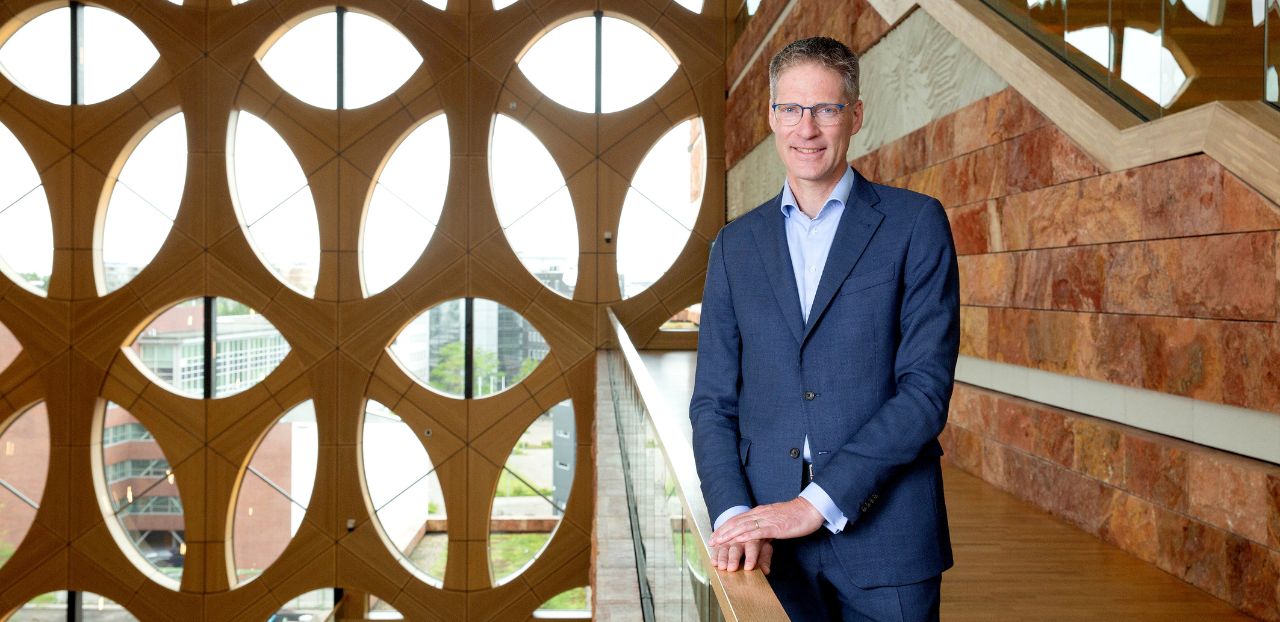
General director Marcel Beukeboom meets his visitor in the atrium of Naturalis Biodiversity Center. His towering figure rises above the groups of schoolchildren who are impatiently tapping their feet, eager to enter the museum. When he arrives, Pieter Hemels is fascinated by the wooden structure of the atrium, an architectural masterpiece resembling interlocking molecules. Beukeboom is visibly proud and tells his conversation partner from consultancy firm Ftrprf – which helps organizations change with futureproof strategies – about the Oertuin, a ‘living museum hall’ currently being constructed next to the center. It is clear that he feels himself at home at Naturalis. When he was appointed general director, he brought with him a wealth of societal and administrative experience, built up during his years as ambassador and climate envoy. That background resonates in his language and diplomatic phrasing. But behind that thoughtful style hides a passionate individual. ‘I said to the State Secretary for Defence: my definition of resilience is different from yours. We not only need tanks at the border, but also a robust ecosystem. Sea levels are rising, and biodiversity is declining. That has consequences for our food supply, coastal defense, and life expectancy.’
Is the conversation about biodiversity fundamentally different from the conversation about climate goals, which you focused on as climate envoy?
‘You cannot view these two themes in isolation. It has always been my goal to promote systems thinking by linking different dossiers and policy areas. Climate change and the loss of biodiversity are the result of our behavior and how we have structured society. It is therefore a shared problem that we must tackle together. I want to play a role in strengthening public-private partnerships. Through strategic partnerships with business, government, and civil society organizations, we generate greater impact and have greater leverage in protecting biodiversity.
Scale is important here: the larger the company, the greater the potential impact. You could even argue that to achieve the greatest impact, you should seek out the biggest polluters. For us, the deciding factor in these kinds of choices is whether we see a serious intention to change and a role for ourselves in helping to make that happen.’
What conditions do you set for a strategic partnership? Who should contact you?
‘My door is open to everyone. I do, however, expect companies to have the intrinsic motivation to adapt their business operations. You cannot get away with just a sponsorship. There are already enough companies engaging in greenwashing that, in reality, make no progress whatsoever. I am very pragmatic. Anyone can change, even if you do not have a spotless environmental record. As long as you are willing to take serious steps.’
The goal of the Paris Climate Agreement to keep global warming below 1.5 degrees Celsius will not be met. In a recent speech, you said that the Netherlands is the champion of biodiversity loss…
‘I do not want to sound alarmist, but it is safe to say that our natural environment is in crisis. No less than forty-five percent of Dutch flora and fauna is already threatened or has disappeared. Only fifteen percent of the original biodiversity remains. That is lower than the European average (forty percent) and has clear causes: intensive agriculture, urban and industrial expansion, habitat fragmentation, and high nitrogen emissions. More than a third of native plant and animal species are on the Red List and are threatened with extinction. I do not feel that we are adequately addressing this crisis.’
If nothing happens between now and ten years from now, what will Naturalis’s status report look like?
‘There will be nothing left to report on. We are losing species almost daily.’
The more the talk about urgency, the less it is heard?
‘That is true, and it is a dilemma. But it is not a matter of us versus them. Nature is all of us. It comes down to whether we dare to take responsibility. I hope that executives realize that true value always trumps shareholder value. What is your role when you go to work on Monday morning? Is it ‘after me, the world might as well end,’ or do you want to leave something good behind for future generations? It is up to the members of our boards, which is where the decisions are made. They can make a difference. And by that, I do not just mean a decision to switch to waterless urinals or vegetarian catering. The importance of biodiversity extends to the very core of your business, whether you are a consumer goods manufacturer dependent on raw materials, a farmer who grows crops and needs fertile soil and pollinators, or a financial institution with clients dependent on biodiversity. Incorporating these biodiversity issues into your decision-making makes your operations sustainable and future-proof.’
How do you view the role of the government?
‘As setting norms and frameworks, but also as setting the agenda. In recent years, not much has come of the latter. We hear everywhere around us that nature is considered important, but agreements are hardly ever followed through. As climate envoy, I have represented our country internationally for years. Since the Rio Conventions in 1992, we have been making international agreements with other countries on climate and nature protection, as well as the restoration and sustainable use of biodiversity. When I read our reports on the state of biodiversity in the Netherlands, I see a downward trend year after year. So, I do not necessarily expect new policies, but rather that we finally start adhering to the agreements we have made. This begins with the realization that nature and biodiversity are not nice-to-haves, but essential for our own resilience, safety, and health.’
What is your advice to the public sector?
‘I would seek to restore the balance between our economic activities and the nature that surrounds us. In recent years, we have repeatedly gone to Brussels to advocate for exceptions to existing rules, just to avoid having to comply with agreements. Even in education, nature is not mentioned as part of economic models – it is kept out of the picture, even though nature directly influences our economy and prosperity. Without nature, everything grinds to a halt. Meanwhile, the debate has become polarized, and we are forgetting that we can only find a solution by working together. Collaborating on recovery really does work. This is evident from the Global Biodiversity Framework, a framework of agreements that the Netherlands has drawn up together with other UN member states. One of the obligations under this framework is to provide transparency regarding the impact of public funding on biodiversity. The Minister of Agriculture, Fisheries, Food Security and Nature recently presented this study to the House of Representatives. What emerges is that government subsidies are often very detrimental to biodiversity, even if perhaps unintentionally. These economic incentives stimulate activities that place a heavy burden on ecosystems. For every two positive subsidies, there are thirty negative ones. If we can reallocate that money, we will already make a huge difference.’
Is it not true that measures and regulations aimed at restoring biodiversity still lead to enormous costs that undermine the economy?
‘This is an example of the ‘Doubt Brigade’. By sowing doubt, effective action is delayed, and the status quo is maintained. That is usually in the interest of those who profit from the current, polluting system. But it has to stop at some point; you cannot keep claiming that we cannot do without fossil fuels and that there is no other way to produce.
The government does, however, have the task of softening the transition for the traditional pillars of the old economy. And that is happening: many farmers have already switched to organic, regenerative, or nature-inclusive agriculture. Unfortunately, others are still trapped in a system of high intensity production, which leads to soil depletion, negative environmental impact, and a lack of animal welfare. The power lies with large, often invisible intermediaries who determine the global price. But supermarket chains also hold significant market power. This prevents farmers from making a sustainable transition. When an individual farmer decides to adopt a less environmentally harmful business model, he is not rewarded for this by the major players further down the chain, nor by the consumer.’
In this way, short-term thinking trumps any hopeful perspective. Apparently, a systemic change is needed. What can industry leaders do to contribute to such a shift?
‘Keep at it. Keep building connections. Things are definitely changing. There are already small supermarkets with an ideological mission that offer an ecological product range. Those are the innovators; we need to nurture them. Governments believe in the sector’s ability to self-regulate, but it is government who have every reason to ban factory farmed products from the shelves. I will keep pushing for that. When the new minister of agriculture took office, I sent him a letter outlining all the ongoing collaborations between Naturalis and his ministry. There are quite a few. As a scientific institute, we also see it as our task to mobilize people, to give them a nudge in the right direction. We try to understand nature so that, with that knowledge, we can empower others to protect it.’
What is Naturalis’ role in an international context?
‘Naturalis’ collection, with approximately forty-four million objects, is world-class. We make this collection, along with all the data and scientific knowledge, accessible to the scientific community worldwide. But more is needed. That is why we play a leading role in developing large-scale research infrastructures that rapidly and extensively map what lives where, using tools such as DNA analysis and AI technology. This allows us to monitor these changes over time. In this way, we can prevent species from going extinct, determine which policy measures are truly effective, and advise companies on how to transition to a world with more nature.
We are making enormous progress using these techniques. To help companies meet the CSRD’s reporting requirements, we have developed a toolset that allows them to determine their impact on nature. By modeling with geospecific data, you can measure the size of the footprint on the local environment. Companies hide behind perceived barriers of extra costs and loss of market share. But there are no formal obstacles. There are only perverse incentives that stand in the way of a healthy economic model.’
This interview was published in Management Scope 06 2026.
This article was last changed on 23-06-2026