
Nienke Meijer on leveraging collective wisdom
‘A sign of good governance’
Nienke Meijer in conversation with Victor Prozesky
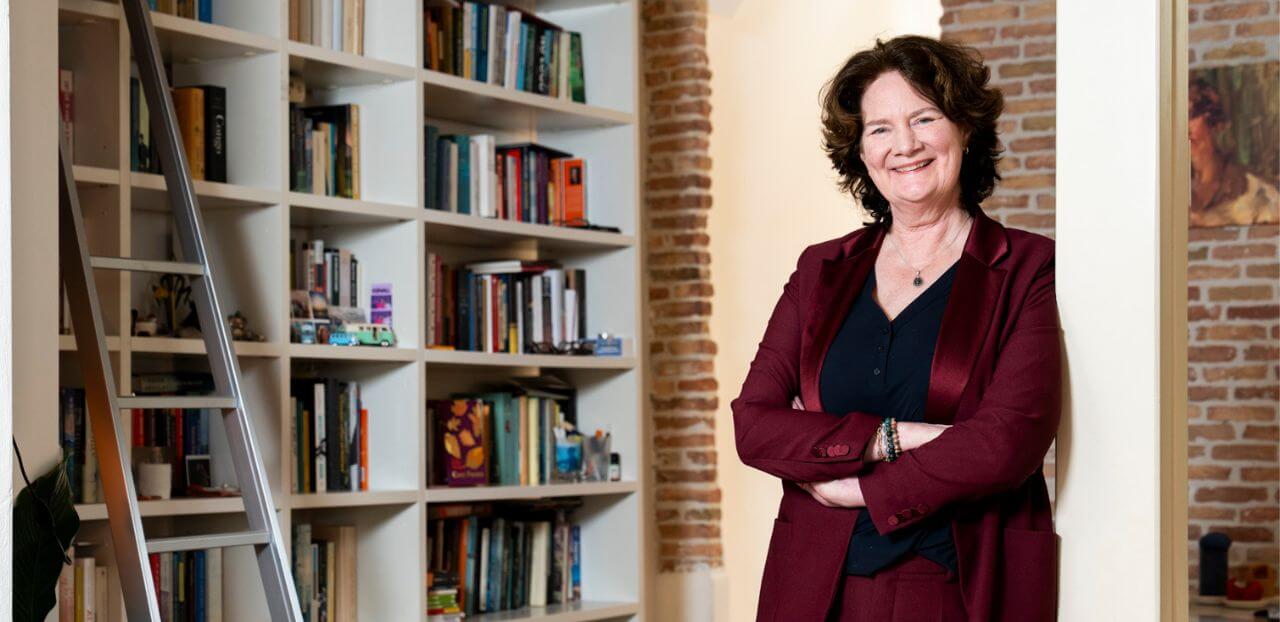
Nienke Meijer started in the media world as a publisher and CMO. She probably would have continued in that role if she had not tasted the satisfaction of serving on a board in 2002. ‘That was at Muziekgebouw Eindhoven. I was in my mid-thirties, still without any experience, but the seed had been planted,’ she tells Victor Prozesky, partner and founder of The Board Practice. A quarter of a century later, she oversees the boards of Achmea and PostNL. She is respected for her sharp understanding of the issues and her concrete, transparent approach. She herself is proud of her ability to remain curious, a product of her philosophy of life. Meijer always strives for connection - even outside the office. A symbol of this is the picnic table in front of her door. The table was her gift to the neighborhood when she moved to the city center of Haarlem. ‘I wanted to get to know my neighbors. It worked; everyone pulls up a chair when the sun is shining.’ But thanks to that table, the neighbors have also gotten to know each other better. I love that you can make a connection with such a small gesture.’
You studied psychology and marketing, giving you a specific perspective on the world of business and governance. In your opinion, what are the most important factors that distinguish good governance from bad?
‘There must be balance, in any case. Does everyone get a chance to speak? Do people listen to each other, or do they mainly try to convince others of their own point of view? I also always pay attention to how everyone sits at the table. Are they genuinely involved in the discussion, or are they just pretending? Good governance functions in a safe, open atmosphere. I can quickly tell if someone is putting on a charade. In your governance role, you must work hard to ensure healthy group dynamics.’
In this context, what is the strength of the supervisory board, based on your experience in healthcare?
‘Diversity in knowledge, background, and governance style. I think it is important to assemble a board made up of people from different backgrounds. They bring knowledge you did not know you could use. Diversity leads to creative solutions. Then, the chair in particular must ensure that a genuine discussion takes place.’
What do you think of the proposition that every board needs a contrarian, someone who plays devil's advocate?
‘Yes, there need to be critical voices, but not necessarily from the same person. Actually, everyone should feel free to ask difficult questions. In practice, I let the discussion continue until the minority’s’ voice has also been heard, or I actively go looking for it. In that regard, I would like to mention my chairmanship of the National Citizens’ Climate Council. That is a citizens' assembly that provides advice on the climate at the government’s request. As an independent chair, I served as the figurehead responsible for overseeing the process, safeguarding its independence, and ensuring that it truly reflected the Netherlands. A group of 175 people deliberated on the climate transition. Every participant had a different background; there were climate deniers and climate activists, and above all, also every opinion in between. Exactly what the Netherlands looks like right now.
What became clear is that all these people could really work together, despite their opposing views, partly because they had the time to learn from each other's differences and seek common ground. I found it life-changing. The supervisory board can learn from this by also focusing on collective wisdom. We are not used to tapping into the collective wisdom of the group in board meetings. It is of value to do so, otherwise we are missing opportunities.’
What is holding you back?
‘Time. In the National Citizens’ Assembly, we had seven weekends to work together on a relationship in which you truly get to know each other, in order to arrive at impactful recommendations. We do not always take that time in board meetings. Yet I believe we can take a cue from this. Every member of the supervisory board can learn to listen without trying to persuade. And every chairperson must dare to slow down. By slowing down the conversation, you hear voices that would otherwise remain unheard.’
How do you safeguard the power of collective wisdom when the world is changing so rapidly?
‘It is precisely in these times that it becomes clear that serving on a supervisory board is a profession. A profession that takes serious time and for which you must make time. Societal issues have become so much more complex: globalization, geopolitical developments, cybercrime, AI in new business models – the dilemmas for companies are significant.
Today’s issues are complex and systemic; they are all interconnected. That is precisely why we need all perspectives to find new solutions. That is collective wisdom. The essence is to navigate by our own compass and adjust our course when the situation demands it. I also believe we must constantly ask ourselves what humanness means.’
You emphasize the importance of humanness in the business world. Do you think executives’ pay enough attention to that?
‘Compliance is a key agenda item, especially at a financial organization like Achmea. Even in a crisis, we quickly revert to the numbers; they give us a foothold. That makes perfect sense, but it is also our task to help management recognize that people make the difference and that, through those people, they exert social, and thereby economic, influence.
I also believe that supervisory board members should regularly immerse themselves in the organization - talking to people, listening to different perspectives. After all, the ‘noise’ from the shop floor only reaches the supervisory board in small doses. Just be mindful that you are still an outsider. That means you can pick up on those voices, but you must realize that they might present a one-sided view.’
How do you view the rise of AI? Are we placing too much emphasis on technology at the expense of the human factor?
‘I am positive by nature. As long as we broadly understand what AI can do, AI can actually strengthen our humanity. If AI models free us from repetitive tasks, employees can tap into other, more in-depth skills. This requires supervisory board members to deepen their understanding of the subject matter, so that they also know which questions to ask to make AI work for us.’
Traditionally, the focus of the supervisory board has been the roles of supervisor and employer. It is precisely the third role, that of advisor, which has gained importance in recent years. Is it time to shift towards the role of trusted advisor, following the Anglo-Saxon model?
‘Yes, the advisory role is becoming more important. Directors also ask for advice. But I am in favor of the two-tier system. In my view, a strict separation of competencies yields a better result, whether you use a color matrix for that or not. I regard it as a dance between observing and keeping a distance. We monitor what is happening in operations and ask for a strategic overview, but we remain in the role of the questioner. I admit that this is becoming increasingly difficult. Current issues make you want to jump in. Yet you enable the executive board to function better if you keep your distance and ask the right questions.’
The geopolitical unrest in the world poses a threat that must be taken into account. To what extent is the supervisory board prepared for this?
‘The question is no longer whether a crisis will occur, but when. That is why it is very important to conduct crisis drills. During my time as a supervisor at the Leiden University Medical Center, the COVID-19 pandemic caught us off guard, just as it did everyone else. In the first few weeks, we fully assumed the role of the executive. That was not really helpful. After that, we asked the executive board what they needed to function effectively. Anyone who prepares well learns to distinguish between the natural way of reacting and the most desirable way of reacting, especially in crisis situations.’
The culture of an executive board and that of the supervisory board are influenced by a certain degree of power. We all know that too much power is unhealthy, but an overly democratic way of working is equally ineffective. What is the right balance?
‘I would not want to claim that power and democracy cannot coexist. The question is, rather, how do you ensure that you use your power in such a way that everyone gets a fair chance? Then, of course, you can go very far. You may be very critical, there are possibilities for intervention, and there may be a conflict regarding the substance. As soon as there are other motives, you are talking about power for power’s sake.’
You founded Stichting De Buitenboordmotor, a movement that aims to force breakthroughs in employment alongside companies, training providers, and the government, by identifying systemic barriers that hinder the transition to a new job. Have you succeeded in that?
‘Yes, I think so. Our motivation was to define where the systemic hurdles that keep our labor market locked down lie. We also wanted to rethink a new business model for employment, starting with the person, not human capital. What stands out is that we have built silos everywhere that prevent people from changing jobs across setors.
With De Buitenboordmotor, we show that you can break out of that mold if you focus less on ingrained procedures. A lot of value is placed on diplomas, but a diploma does not tell the whole story. Most people are capable of much more than what is written on a diploma. Regardless of their education. So, the question is: how can you ensure that companies hire people based on their skills and not just their diploma? That is how you create a labor market that works.’
One of the goals of De Buitenboordmotor is systemic change. Does that also apply to compensation policy?
‘People at the executive level’s perspective on salaries usually have more to do with emotion than with facts. This can be mitigated by normalizing the differences. That is why I am very much in favor of a transparent compensation policy, not only for CEOs, but for all positions in the organization. It is also essential to achieve equal pay for men and women doing the same work. In this regard, the discussion about remuneration must reflect your added value. This is just one aspect of being a good employer.’
As supervisory board member, you gained experience in various industries. How have you changed during this journey?
‘Being a supervisory board member is a matter of learning by doing. That means accepting that you will make mistakes too. I am still learning. You adjust your observations. I also think it is important for supervisory board members to be evaluated themselves. Feedback is a gift, even if it is not always pleasant to receive. Nevertheless, I have really learned to ask what I can do better. What helps is that I have remained curious. I always want to know what drives people, what is changing in the world, and what is possible in the realm of technology. That curiosity keeps me sharp.’
How do you stay true to your own values?
‘I am always skeptical of people who say they ‘want to give something back to society.’ That is not the most convincing reason to become a supervisory board member. Are you not also there to learn something yourself? That is why I enjoy teaching. The questions students ask me get me thinking again. You have to make sure that you stay fresh and keep an open mind about the world. That makes you reliable in conversations with stakeholders. Therefore, do not stay in your own bubble and do not shy away from difficult issues. You sometimes arrive at unexpected solutions if you listen carefully and ask follow-up questions.’
What do you do to stay qualified and up-to-date, besides studying?
‘I have been curious, my whole life long. Curiosity cannot be learned. Listen to your children, follow the news, do things outside your comfort zone. I myself learned much about the power of the collective at the National Citizens’ Climate Council. And with De Buitenboordmotor, I could really play a part in kickstarting a systemic change. Take the plunge as a volunteer, too. I volunteer at Theater De Liefde in my hometown of Haarlem. It gives me so much energy! The foundation of humanity is being curious, about yourself and others. The moment you as board member think you have seen it all, you need to stop immediately.’
This interview was published in Management Scope 04 2026.
This article was last changed on 07-04-2026