
Simone Huis in 't Veld on becoming a professional non-executive
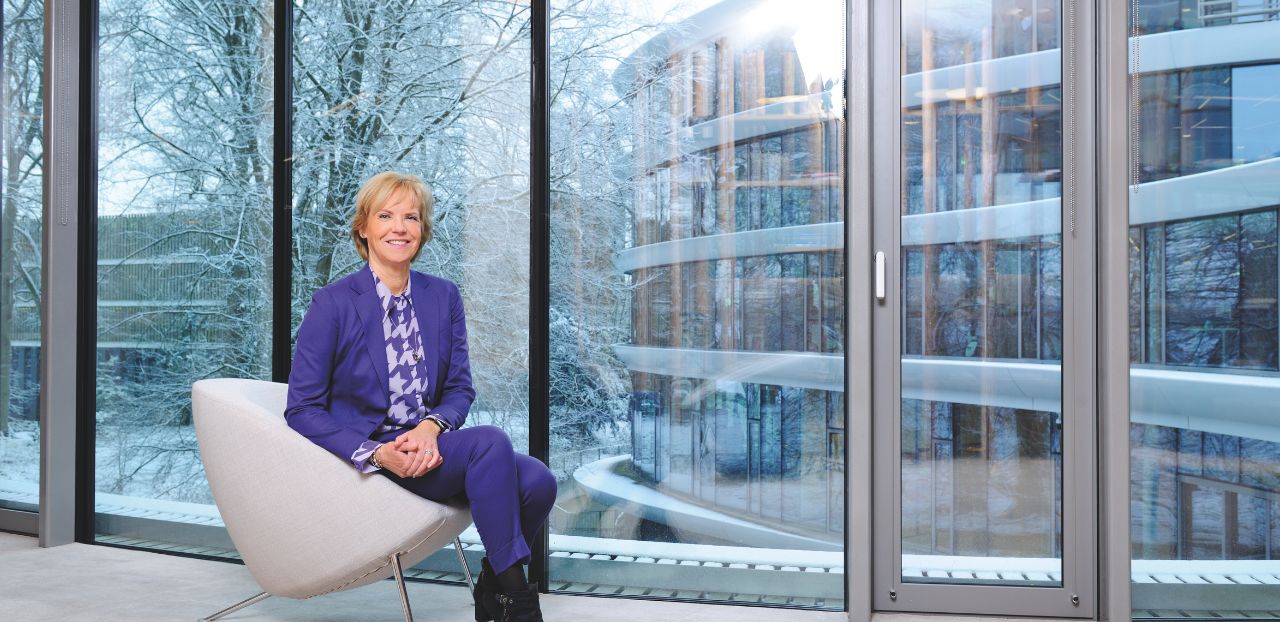
Actually, she was destined to work in her parents' furniture store. But she had other ambitions. Simone Huis in 't Veld became CEO of Euronext Amsterdam. Until a year and a half ago she decided it was time for something different. But what? A sabbatical brought her the to the realization that she wanted to become a professional supervisory board member. Now, more than a year later, she has put her words into action and sits on the supervisory board of Triodos Bank, has joined the supervisory board of directors of train operator Eurostar Group as a non-executive member, and is chair of the supervisory board of broadcaster NTR. This has earned her a spot in Management Scope's Next 50 Supervisory Board Members. ‘A ninth place ranking in the Next 50 is a great honor. I am incredibly happy about that,’ she tells Alexander Tamminga, partner at consulting firm Kearney. ‘But I will be honest with you: my ambition is to further expand my portfolio and earn a place in the Top 100 Supervisory Board Members.’
You were an executive for a long time and then, after a sabbatical, you decided to become a non-executive. Take us through that thought process…
‘When I started my sabbatical, I did not know what I wanted to do. I thought it would be good to take some time to reflect. Reset, reflect, restart – that was my mantra. Sometimes you need to pause for a moment before being able to look ahead again with wonder and a fresh perspective. I have always found it important to keep moving, to keep developing, to challenge myself. That moment of change came after five years at Euronext. After fifteen years in C-level positions, it was time for something different.
At the same time, I still had the ambition and energy to commit myself for at least another fifteen years. I consciously took a step back to consider what would suit me. I started learning to play golf, gardening, traveling, and I served soup to the children in the slums of Arusha, Tanzania. The latter was particularly cathartic. And during that sabbatical, I concluded that I did not want to take on another executive role. My conclusion was that I wanted to work for various organizations in non-executive positions as a professional supervisory board member.’
What did you do next?
‘I started talking to supervisory board members and headhunters. It actually went quite quickly, because within eight months I had three supervisory roles. A great portfolio. I did not rush into anything. I had already completed the supervisory board cycle at Nyenrode Business University beforehand. When it all became more concrete, I started to delve deeper into the organizations. I want to know in advance where I am going, what kind of organization it is, and who works there. I really want to understand what the company stands for. What is the culture, what is the history, who are the customers, what product-market combinations are there, what are the challenges? I wanted to have a good understanding of that.’
You said yes to Triodos, NTR, and Eurostar. Those are three completely different organizations. Or do you see similarities?
‘I certainly do. All three are organizations that fulfill an important social role, organizations that contribute to the transition we are all facing, and organizations that contribute to a better world based on a strong vision. Triodos is one of the most sustainable banks in the world. They are at the forefront of impact investing. NTR is committed to providing independent information in a media world increasingly that is dominated by tech giants. And Eurostar wants to offer a sustainable alternative to road and air travel with its high-speed rail service. That all resonates well with me.
What I also find interesting is that all three have different legal structures. Triodos is a listed public limited company (NV), the NTR is a foundation, and Eurostar is a public limited company with four major shareholders. At Triodos, I was appointed by the shareholders and assessed by the Dutch Central Bank (DNB). At Eurostar, I was appointed by the largest shareholder, on whose behalf I serve on the board as an independent member. And at NTR, I was appointed chair of the supervisory board by the Minister of Education, Culture and Science. All these different constellations appeal to me. They are also very instructive.’
Did you also say no to companies and organizations last year?
(Hesitates). ‘Yes.’
And to what kind of positions or organizations?
‘When you build up your portfolio, you have to be very conscious about when you say 'yes' and 'no.' Because full is full. When you build up a portfolio, you also commit yourself for a longer period of time, for four or eight years. Before you make that commitment, you have to think carefully. These are quite difficult considerations. I do not think it is appropriate to name companies I have said no to, but there are certain organizations that I simply could not or would not want to work for.
For me, it is important that companies or organizations contribute to society and to the transition we all need to make. They certainly should not harm the world. It has to align with my own worldview. Fortunately, through my positions at Deutsche Bank and Euronext, I have gotten to know many organizations from the inside.’
Before you joined, did you also talk to fellow supervisory board members?
‘Yes, of course. The NTR was a bit of an exception. The minister put together a completely new supervisory board. Which was quite a special starting point. That means we had to agree on a lot of things together – about roles and responsibilities. As chair, I felt extra responsible for that. It simply had to work. I immediately made it clear that resigning en masse was never an option (in 2024, the entire supervisory board of the NTR offered its resignation to the Ministry of Education, Culture and Science and immediately resigned, ed.). I said right away: we are not walking away from this, and certainly not all of us together. We will take on this responsibility together for the coming years.’
Were the onboarding processes similar?
‘No, not at all. With one, you have to take more control than with the other. But taking control suits me. At Eurostar, for example, I arranged to ride through the Channel Tunnel with a train driver. That was a first for them. I think it is essential to look around everywhere. At NTR, I went behind the scenes of the programs. At Triodos, I was in contact with many departments, such as risk management, because I wanted to understand the risk model. You cannot do that by just attending meetings.’
What kind of environment do you function best in?
‘I can hold my own in all complex dynamics. But I do need to understand them, though. And that certainly is a challenge when you start a new role. You really need to get to understand a company, its culture, and its structure. What is the communication culture? What are the consultation structures? That is where onboarding is crucial. Every company is different in that respect. And you have to find your way. In some organizations, the company secretary offers more support than in others. There is a difference between being a member and being the chair. As chair, you have much more contact with the director. The desired level of advice also varies from one organization to another.’
How do you see your role as a supervisory board member?
‘A good supervisory board member is involved and has a feel for the balance between control and trust. I try to maintain a balance between independent, critical oversight and good cooperation with the management. I also want to take on an advisory role – and I try to sense how far I should or can go in that regard. I see myself primarily as a connecting, accessible sparring partner. I think it is important to motivate individuals, teams, and organizations to grow and excel. But I am results-oriented, probably because of my executive background. I can think strategically. I can quickly get to the heart of the matter and, if necessary – even in a supervisory role – make quick decisions. And I am good at navigating highly complex fields. I also enjoy offering different perspectives, thinking outside the box.’
What were your own experiences on the other side of the table with supervisory boards?
(Laughs) ‘Yes, those experiences were very diverse. Generally speaking, in a supervisory board, you always have leaders and followers. The leaders are the people who actively read the documents, made inquiries into it, and are proactive. On the other hand, there are the sitters, people who show up at the meetings but do not play a very active role, let alone take initiative. I am exaggerating a bit, but that is how I experienced it in the past. I concluded that I did not want to belong to that last category. Fortunately, that category is also becoming somewhat extinct.’
Does it take some getting used to being on the other side of the table?
‘Supervisory work is very different from the day-to-day operations. Fortunately, during my time as an executive, I had already gained experience as a non-executive. I notice that in my first year as a supervisory director, I am also extra critical. Of myself. I want to maintain the dividing line. Of course, I occasionally catch myself wanting to intervene directively, but then I give myself a warning. I am very aware of that.’
How much time do all the supervisory board positions actually take up?
‘That is difficult to estimate. It fluctuates a bit, of course: some periods take up more time than others. You also need to maintain space so that you can scale up in times of crises, for example. In the beginning, it naturally takes a little longer to read all those documents and understand everything involved.’
Now, the world of supervisory board members is relatively small. Many, men and women, still come from the old boys' network and, so to speak, studied business economics together. Do you feel like the odd one out?
‘I do not have a typical background for a supervisory board member. For example, I do not have the ‘seven checkboxes.’ I am a self-starter. I ended up at university through higher professional education, where I studied sociology. A go-getter, yes. I come from a hardworking SME family. My parents had a furniture company in Westland. My sister and I always helped out. I was actually destined to take over the company, but I wanted to spread my wings. I told my parents that my ambitions lay elsewhere. They understood that. They always encouraged me to do what I want, but to do it with energy and passion. Go for it. That is what I did.
I have always been ambitious. And that might well be because of growing up in such an entrepreneurial family. I was given a lot of responsibility, and I took it. It made me independent and critical. That was also encouraged. My parents always encouraged me to express my opinion. They always challenged me. Why is that, they often asked. That has helped me tremendously. And it still does.’
You now have three supervisory roles, and you are listed in the Next 50. The question is, of course: what next?
‘A ninth place ranking in the Next 50 is a great honor. I am incredibly happy with that. But I will be honest with you: I want to be on that other list, the Top 100 Supervisory Board Members. I want to be an experienced, competent, and well-rounded professional supervisory board member at organizations that want to be at the forefront of their sector and face challenges in the areas of transition, growth, and innovation, and that fulfill a social role. So I am definitely open to more. That is to say, more supervisory roles. I do not want an executive role anymore. That time is behind me.’
What would you say to people who also want a place on the Next50?
‘Get started! Just start with your first role. And build on that. But the most important thing, of course, is that you do it in a well-considered way. You really have to aspire to a supervisory role. It has to be a good fit for you. But do not think it is something that can be done ‘on the side.’ These days, there is far more to it than attending a meeting.’
This interview was published in Management Scope 03 2026.
This article was last changed on 10-03-2026