
‘Pensions should not be a black box’
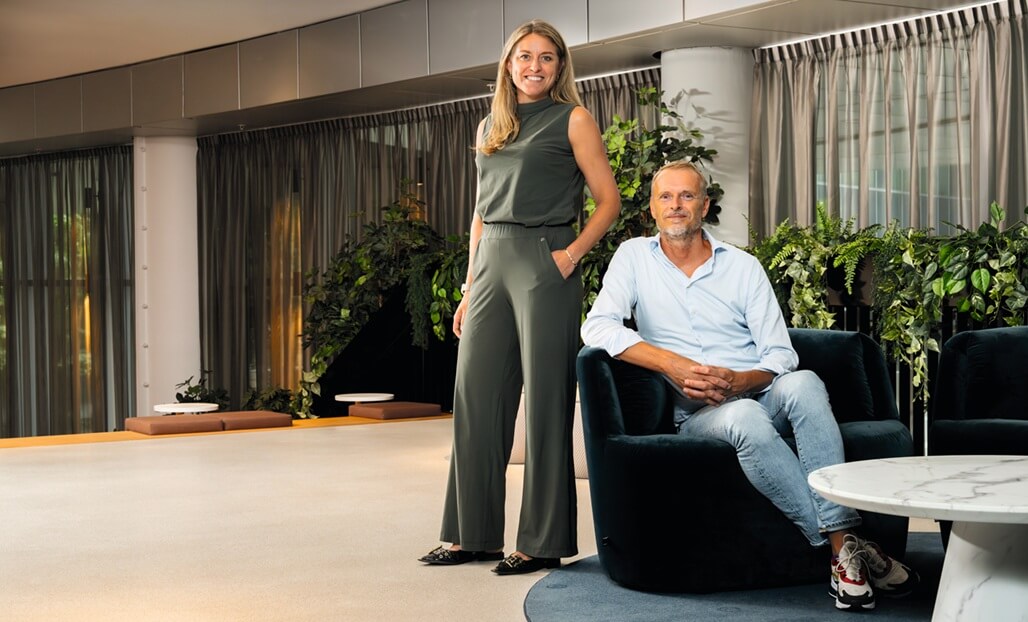
Pension administrator BeFrank is located on the eighth floor of the Oval Tower in Amsterdam-Zuidoost. Parent company Nationale-Nederlanden is housed on the three floors below, but: ‘BeFrank feels like BeFrank. I really see us as two separate companies,’ says CEO Kaya de Lange. ‘At the same time, with a parent company as large as Nationale-Nederlanden, we have tremendous strength behind us. We have the agility of a relatively small company, as well as access to the knowledge and expertise of a large corporate. I see that as the best of both worlds. For example, for the new pension law we regularly work together,’ adds Commercial Director Jan Hein Rhebergen. Moreover: ‘Pensions are products based on trust. Having a solid AEX-listed Dutch partner behind you provides greater peace of mind and confidence than partnering with a private equity firm. And we now manage fifteen billion in pension assets; so, we have long since ceased to be a startup.’
The rise of premium pension institutions (PPIs) as a new type of pension administrator alongside insurers and pension funds was driven, among other things, by public criticism regarding the lack of transparency and high costs of investment and pension products. Employees also demanded greater insight into the value of their pension savings. In 2011, BeFrank became the first PPI in the Netherlands to receive a license from De Nederlandsche Bank.
To mark the fifteenth anniversary, an event was held in the center of Almere this year, where visitors could visualize themselves as eighty-year-olds on a large LED screen using an age filter. This gave them a peek into the future. It was a playful way to literally bring the company’s mission – ‘making pensions more accessible’ – to life.
PPIs were established to shake up the conservative pension world. In your opinion, has that succeeded?
De Lange: ‘Very much so. The market was, and to some extent still is, strongly focused on the primary client: the employer with whom you sign the contract. BeFrank has shifted that focus to those for whom we are actually doing it: the participants. We are really trying to make things easier for them. The communication is truly different. Much simpler, shorter, with plenty of animations and videos, everything online, and real-time insight into what you have accumulated in your retirement account. Moreover, as a participant, you have the option to make your own choices regarding how you build up your pension. At the time, those were all innovative elements.’
Rhebergen: ‘Actually, it was quite illogical to launch a new brand for a product with such a long term. Few companies have dared to do so, but I think that is exactly why we succeeded. As an agile newcomer, we really brought a different, more modern perspective. After salary, pension is on average the second-largest employee benefit in terms of cost, and yet its appreciation as an employment benefit is often rated very low. That does not make sense. We want people to understand what has been arranged for them, to know how much money is going toward it, and be able to influence the outcome. I think new entrants like BeFrank have shown that people really appreciate having a say in their pension. And when employees are more involved in their pensions, appreciation for the investment employers make in this area also grows.’
The new pension law requires everyone in the Netherlands to switch to the system of individual, investment-based pension accounts (DC). BeFrank has been using that system from day one. What should a company be aware of?
Rhebergen: ‘To comply with the law, you essentially need to consider a few questions: are we moving to a new plan only for new employees, or is everyone making the transition? In the latter case, you need to consider compensation for accrued benefits. If you opt to include only new employees, this will create a situation where an employee who starts on December 1, 2027, will have a different contribution rate than someone who starts on January 1, 2028. That may be undesirable. The second question is: what will the flat contribution rate be? In other words, how much will you, as employer, contribute to the fund, and what contribution must the employee make? And finally, what will the insurance coverage look like for people who, for example, become unable to work or who pass away before their retirement date?’
Many employers are currently still struggling with the transition to the new system. Are your clients well on their way?
Rhebergen: ‘About a third have switched to the new system. The rest are currently going through the process and must be ready before the hard deadline of January 1, 2028.’
De Lange: ‘That short year and a half can feel like there is still plenty of time, but there is not. It takes time to get oriented, have the necessary discussions to reach a decision, involve the right stakeholders, and manage the consequences. It is therefore important for employers to start working on this in earnest right now. And, of course, we need to prepare ourselves thoroughly as well. We are doing everything we can by investing in automation, holding the right discussions with advisors and employers, and, for example, recruiting extra people to handle the peak workload, though finding the right people is not always easy because expertise in pensions is currently in high demand in many places. And this while failing to make the switch on time will have significant consequences. After January 1, 2028, the Tax Authorities will declare old pension plans ‘fiscally non-compliant.’ This could lead to far-reaching financial consequences for both employees and employers. Employers may also face fines.’
Rhebergen: ‘The choices an employer makes have an impact and require employee consent. After all, you are changing something you previously promised. Many stakeholders are involved in this process: the works council, sometimes the trade union, HR, pension advisors…
De Lange: ‘It also takes time to properly manage and communicate the consequences to your employees. We are talking about a major system change with sometimes significant consequences. For example, the impact for older people is different than for younger ones. We consider it important that employees fully understand this and grasp its impact. We are happy to help our clients with that.’
How can organizations help individual employees get a grip on the matter?
Rhebergen: ‘We ourselves hired a consulting firm to give everyone the opportunity to have a conversation about their individual situation. Your partner was also welcome to come along. That costs money, but compared to the total of your pension budget, it is a relatively small amount, while the effect is very significant. When people understand the consequences of the system change, it brings peace of mind on something that for many is still a black box. The importance of good communication on this subject is often underestimated, even though it can actually help ensure that people no longer find retirement daunting or mistakenly consider it too distant.’
De Lange: ‘We also organize many presentations at employers’ sites where participants can ask all their questions, and there we show how easy it is to find information about your pension accrual on your personal pension page or in the app. Or to make investment choices. For example, you can determine your investment profile in five steps. We are proud that eighty-five percent of our participants have logged in. By making it this easy to access, pensions becomes understandable and maybe even fun.’
Rhebergen: ‘In addition, we also organize activation actions with clients, webinars, and activation campaigns. By focusing on specific groups – for example, a few years away from retirement or, conversely, young people – you make it even more relevant and therefore more appealing.
And we make it personal, too. For instance, on the pension page, we do not refer to survivor's or orphan's pensions; instead, it shows exactly how much Lenneke – that is my wife's name – will receive if I pass away, and what Jop, Mies, and Loet – my children – will get.
BeFrank strongly emphasizes socially responsible investing and has been B Corp-certified for two years. What do employees and employers notice about this?
Rhebergen: ‘Pension means building a financial future. So, it really impacts what world you are building for yourself and your children. For us, ‘green’ is a standard part of the investment options, for both the employer and the employee, and our minimum standard is socially responsible and defensible, meaning, for example, no tobacco, cluster munitions, or child labor.’
De Lange: ‘With us, employers can choose from investment funds that correspond to a passive, an active, and a sustainable lifecycle. In the passive lifecycle, we follow the market as closely as possible and exclude only a number of companies that we truly do not support. In the active lifecycle, we take a more pro-active approach to identifying where we can generate returns, but there is also a significant green focus. In the sustainable and greenest lifecycle, managed by Triodos Investment Management, we invest entirely in funds that apply strict screening criteria based on people, the environment, and society. Within each lifecycle, participants can choose for themselves how aggressively or conservatively they want to invest. If they wish, they can also deviate from their employer's choice and, for example, opt for an even greener option. For us, it is really important that we are not prescriptive, but that employers and employees make that choice themselves.’
Rhebergen: ‘In addition, we believe that we, as an organization, can and must do our part. For example, much of our previous office has been reused in our new office, we do volunteer work together, we encourage sustainable transport, and we are very active in promoting diversity and inclusion.’
The transition to the Pensions Future Act (Wtp) is often seen as a ‘must.’ How can organizations use the transition to reassess their role as employers?
Rhebergen: ‘It is one of the tools in your entire HR policy. It really makes a difference how high the contribution rate will be, or whether or not you will be transitioning the entire workforce. You can use this opportunity to very specifically restructure and modernize your benefits package. For example, on the first page of our online portal, we show how much premium goes towards the pension per person per year. Then people suddenly understand that their employer is investing quite a lot of money in their future.’
De Lange: ‘Our position is that many people often start thinking about their pension too late. Many people tend to look first at the salary they are earning now, but pension is essentially the salary you will earn in future and is therefore, in my opinion, the most important employment benefit alongside salary. That is often underestimated. It can therefore truly be an asset if arranged well. One advantage of the new system is that pensions are becoming more transparent. We no longer use a graduated scale, but rather a so-called flat rate. The percentages are easy to compare, which also makes them easier to understand.’
What opportunities does the transition to the new pension system offer BeFrank itself?
De Lange: ‘The most important thing is that we continue to do what we were already doing well. From the start, we focused on larger employers, each with several hundred employees. We recently discussed broadening our target audience, but we decided against it. By continuing to focus on this target group, we can maintain our service at the level we consider important, especially given everything that is happening in the market now. We do see opportunities for further growth in potential new clients, such as corporate pension funds that decide to stop offering pensions themselves. We believe we can offer them good and somewhat more modern solutions.
In addition, we are working on new products and services. The employer is our primary client and will remain so, but the line is beginning to blur. In my ideal scenario, as an employee, you would have a good idea of what your pension will look like and whether it is sufficient. And if that is not enough, you can make use of the options we offer to bridge that gap, or consciously accept that there is a gap. What is most important is that people do not discover this only five years before their retirement. I expect that in the future, a new balance will emerge between what is arranged for your pension through an employer and what you have to arrange yourself. We do not yet know where that balance lies. But it is certain that this discussion will take place.’
BeFrank is no longer a fledgling organization. Can you tell us something about the current culture and your collaboration?
Rhebergen: ‘BeFrank brought a startup mentality to the somewhat conservative world of pensions. That appealed to me then – and still does.’
De Lange: ‘That startup mentality is still very characteristic of BeFrank. It is also reflected in the way we interact with each other. We have a clear division of roles. For instance, Jan Hein is often ‘out in the field’ and has a clear commercial focus. I focus more on the internal organization, all relevant stakeholders, and the further development of all strategic themes. We know how to find each other when necessary.’
Rhebergen: ‘We know what we to expect from each other. I approach the market with a great deal of confidence because I know things are going well internally. When both sides are doing well, we can thrive together.’
This interview was published in Management Scope 07 2026.
This article was last changed on 25-08-2026