
The Evolution of Boardroom Dynamics
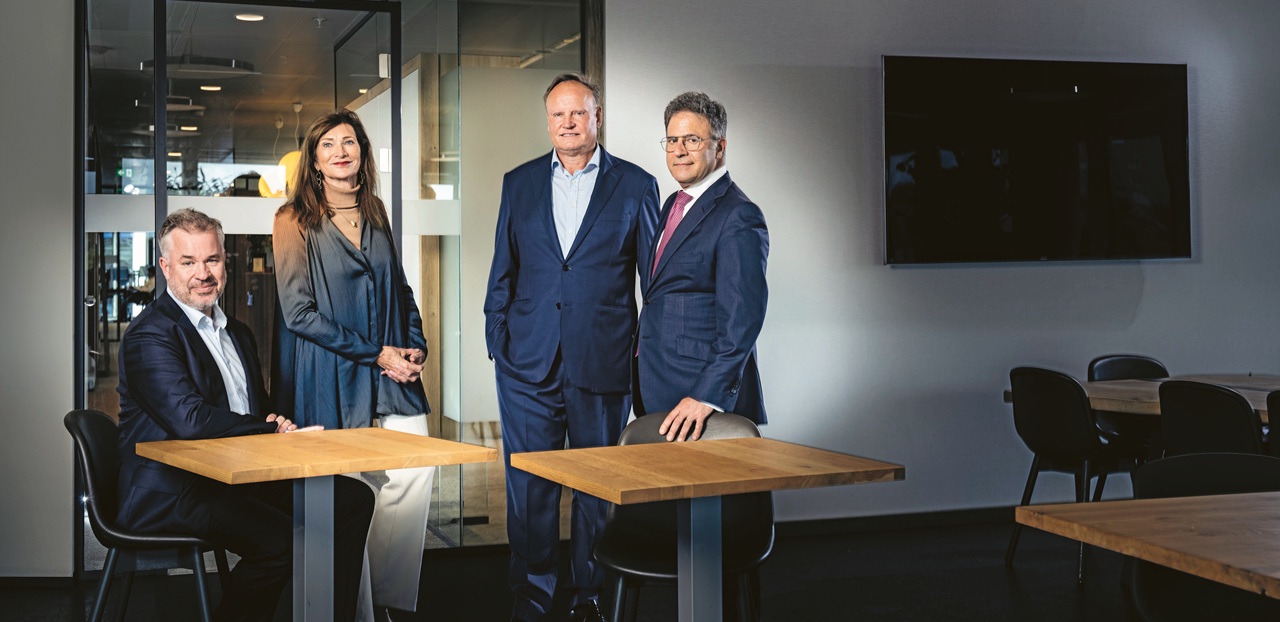
The roundtable at the ever-expanding Oaklins office in Amsterdam-Zuid begins like a refined school reunion. Two of the participants – Ruben Wegman and Mike Nawas – turn out to share a past at the renowned Canisius College in Nijmegen. Not in the same year, but still. They lost touch after high school, so there is a lot of catching up to do. Besides Nawas (chair of the supervisory board of Triodos Bank, among other things) and Wegman (CEO of technology company Nedap), Annemieke Roobeek (who attended the Fons Vitae Gymnasium in Amsterdam) has also joined the group. She is a member of the supervisory board of Randstad Holding, among other things. Led by Gerbrand ter Brugge, partner at international corporate finance house Oaklins Netherlands, they discuss the composition of the executive and supervisory boards, the dynamics between them, bypasses, and hands-on listening.
Ruben, as CEO of a company, I would think that you would want to have some say in the composition of the supervisory board?
Wegman: ‘It is quite difficult to put together a good supervisory board. It is easy enough to find a supervisory board member, but a good one is rare. Often, good supervisory board members have several positions to choose from. Nowadays, as a company, you really have to make sales pitches. When I started as CEO, I was told right away that you get the supervisory board you deserve. I want smart, committed people on both the supervisory board and the works council. If they then arrive at different insights based on the same principles, it might well be worth listening to.’
And does your supervisory board at Nedap have complete freedom
Wegman: ‘They can talk to anyone without me being present. Opinions on this vary among colleagues, but I believe in it. It ensures that supervisory board members are better informed about the substance of the issues.’
Can you talk to anyone you want at Triodos, Mike?
Nawas: ‘Yes, I can, and I think it is important. In those conversations, you get pure, unfiltered information that you can use in the dialogue with the board. But I have made clear agreements about this. You do not want to make the people you are talking to in the company uncomfortable, and it should not undermine the executive board. At Triodos, we often hold ‘lottery interviews,’ where we invite employees at random to talk to a member of the supervisory board. This prevents anyone from claiming they have an advantage because they happened to talk to the chair.’
How do you approach new appointments?
Roobeek: ‘With changes to the executive or supervisory board, a good profile is essential. That profile depends on the stage an organization is at. What does the organization need at that moment and in the coming period? Not only in terms of knowledge and competencies, but also in terms of character, personality, and dynamics. You need to take the time to think this through together and write it down in concrete terms. This also provides a good reflection on the composition and functioning of the executive board and supervisory board.’
Nawas: ‘It does indeed depend on the phase the company is in. Different situations require a different composition of the executive board. If it is a company with a major growth agenda, you often see that the CEO has ambitious plans. The other members of the board then have an enabling role. If the company is in crisis, you often have the opposite situation. Then the CEO is holding everything together, while the rest of the team sets the course.’
Wegman: ‘Supervisory board members all have a formal role, but they also all have an informal role in the dynamics of a supervisory board. That needs to be a good fit. If someone who has had a certain informal role leaves, you have to factor that into the succession process.’
Roobeek: ‘Yes, those are the real boardroom dynamics. A supervisory board needs to be alert to that and act accordingly. Do we also understand what phase the company is in? Do we know what kind of leadership is needed? I once worked at a company that was doing really well. Everyone was delighted: praise, crescendo! But such a CEO then needs to move on and cannot continue as a light version of themselves. As a supervisory board, you then also have to challenge them on that.
I am particularly vigilant when the CEO or supervisory board chair tries to bypass the appointment process by nominating their own candidate. I have more than once seen candidates put forward outside of the procedures, with the co-determination manipulated over a cup of coffee. The entire supervisory board needs to be wary of that. Incidentally, my experience from appointment committees is that appointments to the executive board are often still made in a straightforward manner based on the portfolios of existing divisions. Vertically. Appointments are actually an opportunity to redistribute the structure and portfolios to fit a future situation. In a supervisory board, appointments are already more interdisciplinary and less function-specific. Someone may have extensive knowledge of digital and organizational matters, or of operational matters and finance.’
You have just made some appointments at Triodos, Mike. Did you look at it differently than you would have done ten years ago?
Nawas: ‘Yes, definitely. Before we appointed the CEO, we carefully mapped out what functionality we needed in the executive board, what needed to be strengthened, and what portfolio that should fall under. With the appointment of a CEO, everything else shifts immediately. We paid a lot of attention to that. Much more than ten years ago. Back then, the assumption often was that it was patently obvious what a CEO, CFO, or CRO should do. Now, there is more focus on the dynamics.’
And if you have a very dominant CEO, who do you appoint next to them? Does that need to be a person with a very strong personality? Or specifically someone able to navigate without causing too many waves?
Roobeek: ‘We of course want to have countervailing power alongside the CEO. And then we look closely at: are you competent in terms of content, have you done this before, do you have a broader perspective, preferably also on strategic decision-making, what kind of network do you bring to the table? But also at character and personality: who are you and do you fit into the management team, will your arrival provide new impetus? We have seen the role of CFOs, in particular, change significantly in recent times. They were often incredibly boring people. And we have come to realize that it is not smart to hire people with such a boring profile. The CFO has truly become far more important, especially in terms of providing a reality check on strategy and its link with the business. We are now looking for a broader profile and personality.’
Looking back over the past few years, what stands out in terms of boardroom dynamics?
Wegman: ‘What strikes me is that the work of the supervisory board has become far more extensive. It does however seem that it is becoming less about the business and increasingly more about governance and the surrounding issues.’
Roobeek: ‘I disagree that it is less about the business. That is not the case in any of the companies I am involved with.’
Wegman: ‘But you will agree with me that a supervisory board position in 2025 will require much more time than it used to.’
Roobeek: ‘Yes, I agree with you. A supervisory board position takes significant time, more than it used to. You have to realize that in advance. You also have to approach a supervisory board position as if something could go wrong, and then you will have to be available. You have to schedule it that way. You cannot simply assume the sun will always shine and you only have to show your face a few times a year. I believe in an engaged supervisory board member who is visible, not just in the boardroom, but who also has contact with levels -1 and -2, and certainly with the employee participation body. That is how I interpret it, always in consultation with the CEO and the chair of the supervisory board. You as supervisory board member should also take the high road.’
Nawas: ‘A good supervisory board member is someone who takes the time, who talks to the organization, someone who can enthuse the works council and who brings outside knowledge to the dialogue with the executive board. For me, an engaged supervisory board member is the key to a good and successful supervisory board.’
Wegman: ‘Wait a minute. I am trying to imagine the opposite: a non-engaged supervisory board member? Does that happen?’
Ter Brugge: ‘Yes, I do encounter them. The supervisory board member who wants to be a supervisory board member because he enjoys mentioning it at the golf club. To create some interest. Although I think that used to be more common than it is now.’
This leads Ter Brugge to the following question: Did we perhaps have a bit more cronyism in the past? Are appointments more transparent these days?
Roobeek: ‘I think so. The appointment processes have certainly been professionalized by the committees we have in place and the profiles that are drawn up. I have had cases where an executive board chair wanted to push a candidate. And we in the supervisory board thought: ‘Oh, let him go through the process; he will drop out on his own.’ The professionalization of appointments ensures quality in the boardroom, and as a supervisory board member, you are largely responsible for that.’
Ter Brugge: 'I have seen supervisory board members resign when a company was in danger of going under. Because it was no fun anymore. As a supervisory board member, you are there for the good times and the bad.'
Wegman: 'I have come to the conclusion that I do not want supervisory board positions. I am unsuitable for it. I currently have a supervisory board position at a an excellent company, but I find it difficult not to be hands-on. I am used to going all in.'
Nawas: 'Yes, that is a process you as person have to work through. I actually find it enriching not to be hands-on for once.'
Roobeek: 'You have to be able to wear multiple hats and know what you do and do not do under each hat. I think it is fantastic because you can contribute so much from those different perspectives. A day without changing hats is a day not lived. But I believe there is a middle ground: a good supervisory board member can be a hands-on listener. If you listen carefully, if you have a broad background and a good feel for business and social issues, you can connect the dots: that is how we solved it back then, and in this situation, we can think of this and that.’
Wegman: ‘A trend I am noticing is that supervisory board members have become more risk-averse. Whatever happens: as a supervisory board member, you cannot afford to stumble. You cannot make mistakes. Avoiding risks is becoming increasingly important.’
Nawas: ‘So you think the intrinsic risk appetite of an executive is greater than that of a supervisory board member? I believe that as a supervisory board member, you should not focus solely on avoiding risk.’
Roobeek: ‘On the contrary. You should embrace the risks. I enjoy getting my teeth into complicated issues. At least then you are not there for no reason. You are there to put your shoulder to the wheel. A supervisory board member must be someone who is crisis-proof. In principle, things can go wrong at any moment.’
Not everyone has experienced a serious crisis in their career. There are enough people who have enjoyed 30 years of prosperity. If Microsoft is your background, you have seen growth and profits every year. And such a person then has to decide on 'the divestment of Germany' at an industrial company? A scar is an advantage, do you not think?
Roobeek: ‘Certainly. I once took a serious risk when I was first appointed as a supervisory board member at a large pharmaceutical company. Within six weeks, we were suddenly taken over by an American company. They immediately fired the management and only wanted American supervisors. I stood my ground on that. According to Dutch governance, it's a 'njet,' I said. I had to go through with it for a year. And I was terrified sometimes, but I did it. People realized that Dutch governance also has its advantages.'
Can we take it from the perspective of the executive board. Ruben, you implemented quite a significant change in strategy at Nedap, transforming it from a manufacturing company to a digital enterprise. How did you experience the supervisory board at the time? Did you work together? Did they help you? Did they oppose you?
Wegman: ‘We acted as a true team, with a clear long-term vision. Fortunately, we all agreed on that. Everyone realized that we had to transform. In that dynamic, you really need supervisory board members who understand what entrepreneurship is all about. And you all have to be open to change and feedback. I might be an atypical CEO who has worked for this company all my life. My starting point is that I want to leave Nedap better than what I found it. That might be a different starting point than that of a CEO who will be at the company for only a few years. In that case, as supervisory board, you might need to be sharper and more alert.’
Roobeek: ’In my experience, the CEO is often the one who has the most difficulty with feedback. I would assume that you are very good at this, Ruben. But as a supervisory board, you really need to incisively question a new CEO about it. How have you handled feedback in other situations, and what did you learn from it?’
Do you think there is an age limit or expiration date to be a supervisory board member?
Wegman: ‘I find that too generic. Some people are old when still young, and others know exactly what is going on at an advanced age. It is difficult to define that in rules. The most important thing is: do you have a winning team? Age is not that decisive.’
Roobeek: ‘I was 33 when I took on my first supervisory board position. I think broad experience and a diverse background are much more important. Geopolitical developments, for example, are increasingly coming into the boardroom, as is the impact of AI. That means you need people on the supervisory board with political, economic, and social antennae, people who know what is going on in the world and who can translate that into business.’
Executive as well as supervisory boards increasingly have to make quick judgment calls. Are we going to continue investing in America, or are we going to back off in the current situation? Are we going to bring production back from China? In the past, you could easily postpone such decisions for a year, but that is no longer possible. You have to make decisions more quickly, thereby running a higher risk of making the wrong decision. Would you agree?
Wegman: ‘Yes, and then it is nice if someone can still explain in five years down the line what the considerations were at the time.’
Roobeek: ‘It is very helpful to have a supervisory board member with an elephant’s memory. Someone who says: we took that decision in that context at the time. Someone who provides context and cover for the decision taken back then.’
Let us move on to a wish list for the coming years. If I may start: I would welcome a lower average age for supervisory board members. In the Netherlands, we still have relatively old supervisory board members. I think that people who are in the prime of their careers can also be very good supervisory board members and thus add value. What is at the top of your wish lists?
Roobeek: ‘I hope that interdisciplinarity in supervisory boards and executive boards will continue to improve. This is particularly important given the politically, technologically, and economically exciting times we live in. We need people with active antennae. I think this is also important in the war for talent. Broadening the roles within the board is becoming increasingly important for talent, rather than tasks within a division.’
Nawas: ‘In recent years, a great deal has been done to build governance and checks and balances. This has led to further legalization of the role of the supervisory board. It has weakened the debate. It should not be at the expense of its enabling role, the sparring role, or the informal role. I would like to see us dealing with this more easily in ten years’ time.’
Wegman: ‘My wish is for a supervisory board that is closely aligned with the company, that creates space. My wish is that we ensure that a supervisory board does not bring the outside world into the company unfiltered. We must ensure that there remains room for entrepreneurship, for making sensible decisions. This means taking a firm stand and not always covering your own back. I would prefer not to see any more ‘counter-reports for the sake of it’.’
This interview was published in Management Scope 07 2025.
This article was last changed on 27-08-2025