
Europe must chart its own course on China
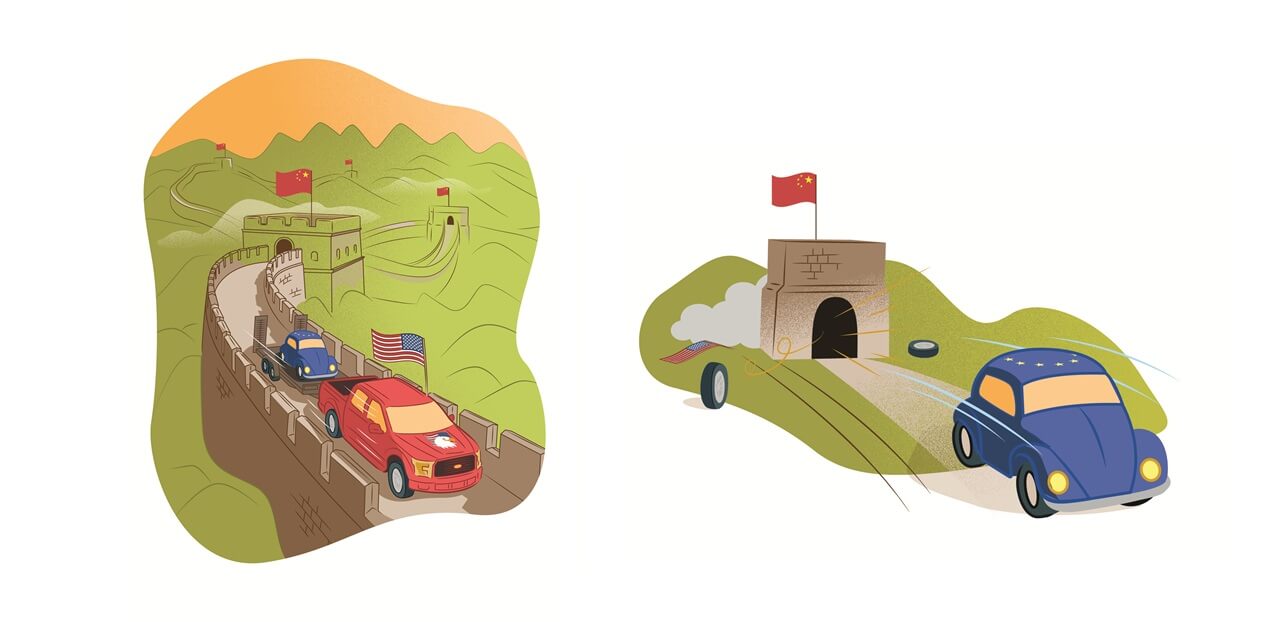
Europe is at a crossroads in its relationship with China. For too long, European leaders have allowed themselves to be guided by the American agenda. Europe blindly adopted the American narrative, with far-reaching consequences. The example of Dutch tech company ASML speaks volumes. The export restrictions imposed on the company were intended to slow China's technological progress. The result was exactly the opposite: China was given an extra incentive to develop its own alternatives and is now stronger than ever in the global chip industry. The machines that ASML sold in China were precisely the cash cows that financed its research and development. By cutting off this source of income, Europe not only weakened its own champion but also created a business case for Chinese companies. As long as ASML was supplying, for China to develop its own lithography technology required far too high an investment. But when it became clear that ASML would no longer be allowed to supply, that objection became irrelevant as China was forced to develop the technology itself.
Another example would be the Dutch frigate that sailed through Chinese-claimed territory in the South China Sea in 2021. By sailing through this Chinese-claimed territory, the US and its allies wanted to affirm the right of free passage in international waters. The importance of this route for international shipping was cited as argument for the action. However, what was not mentioned was that this was a primary Chinese trade route and that it was therefore not in China's interest to obstruct free passage of merchant ships. Armed with a rusted, outdated cannon - literally stuck in place - the Dutch frigate would in any case not have been able to defend itself in the event of an attack. The voyage was a provocation towards China, with a good relationship with the US outweighing the risk of an armed conflict with China.
A similar story unfolded with Huawei. When Google had to stop supplying its operating system, the Chinese rapidly developed their own alternative. A second version of this system was made compatible with IoT devices, including self-driving cars, and now forms the basis for advanced solutions in the field of autonomous driving. What was intended as a sanction became a catalyst for Chinese innovation.
American ‘spin’ made itself felt in other cases too. The Uyghur issue was used to justify restrictions on ASML, for example. The reasoning was that chips from ASML machines could end up in Chinese surveillance cameras. But if Europe had truly wanted to act on human rights grounds, other actions would have been more logical. China had, after all, been sitting at the table with European partners for years discussing its concerns about terrorism in Xinjiang. By adopting the American framing, Europe failed to choose its own, more effective path.
It is high time that Europe charted its own course. With its own strategy, one that does not blindly follow the American line but is based on a sober analysis of facts and interests. Now that the US under Donald Trump is increasingly tending toward isolationism, it is moreover an opportune moment for Europe to distance itself from the one-sided, negative American image of China.
A dangerous knowledge gap
An independent strategy starts with knowledge and that is precisely what is lacking. Europe suffers from a dangerous knowledge gap when it comes to China. The number of Dutch people with in-depth knowledge of Chinese language, culture, and economy is alarmingly small. University programs have been cut back, think tanks are financially dependent on government and therefore primarily follow the agenda set by The Hague. Companies that do have China expertise in-house sometimes see experts being excluded for fear of alleged ‘ties to China.’
This knowledge gap has concrete consequences. Those who master the Chinese language and understand the cultural context open doors that would otherwise remain closed. Communication becomes more fluid, negotiations become more effective, and business strategies can be implemented in a much more targeted manner. However, the number of people in the Netherlands with this level of knowledge about China is pitifully small.
On top of all this, the media also plays a role. Journalists often focus on negative stories because they ‘score’ better. A journalist writing about the earthquakes in Groningen is not likely to mention the houses still standing but will focus exclusively on the damaged buildings. The same holds here: the bad news about China overshadows the good news. This creates a simplistic image that feeds fear and obscures complexity. As a result, policymakers make decisions based on preconceptions rather than facts. In reality, our relationship with China is ambiguous: the country is both a partner and a rival, a market and a manufacturing country, a producer of cheap junk and advanced high-tech products. It is precisely this complexity that presents both opportunities and threats.
China as a market
For decades, European companies saw China primarily as an unlimited market for their products. But those days are over. Sectors considered strategic are strictly protected. A Dutch software company that tendered to equip ports with smart surveillance systems was simply barred: China no longer tolerates foreign interference in this sector.
In other sectors, such as offshore wind, opportunities were plentiful. Dutch companies that supplied coatings for underwater components enjoyed golden years. But here too, competition is now fierce, and those who do not innovate quickly and collaborate effectively locally will lose out. For example, Philips' position in MRI scanners is increasingly being swallowed up by Shanghai United Imaging. A Dutch SME in the agrifood sector experienced this firsthand. A large Chinese company was considering an order for 100 automated distribution systems, which would have resulted in enormous revenue. In the end, only seven were purchased. The Chinese company developed the rest internally. Opportunities remain. But it is true that once a Chinese player establishes a dominant position at home, it becomes a global challenger.
A driver of innovation
The misconception that China only copies and does not innovate still persists. This view is not only outdated but also dangerous, because it blinds European companies to the true strength of their competitor: China's incredible capacity for innovation. Chinese consumers are much more positive about new technologies than their European counterparts. While Europeans worry about privacy implications, the Chinese embrace new developments with enthusiasm. This enables Chinese companies to pile innovation upon innovation at an unprecedented speed.
While European companies are cautious, China simply releases half-finished products on the market. There is a convenient assumption that regulations will follow later. In this way Chinese companies are often leading the way in autonomous driving, biotechnology, and green industry. China can be seen as a giant ‘sandbox’ for technology development, not only for the domestic market but with the aim of serving global markets. This can be an opportunity for European companies: they can capitalize on the opportunities the Chinese market offers to bring new products to the market quickly, test them, and scale up production lines. But there are also risks. Innovations can be copied, improved, and offered worldwide at lower cost.
Agenda items
What does this require of European companies and politicians? A few agenda items: first, the realization that ignoring China is not an option. Anyone who thinks the Chinese market can be bypassed will stand disillusioned. Without China, it is virtually impossible to remain globally competitive.
At the same time, do not be naive. Europe must protect strategic sectors but must do so in a smart and proportionate manner. Introducing simple anti-dumping measures is like mopping the floor with the tap running. Chinese companies will develop, and there are advanced Chinese high-tech companies that have never received state aid and are now technologically equal to or better than their European counterparts. A more effective route is to set conditions that combine cooperation and protection. Consider making joint ventures mandatory for non-European investors, as China itself has been doing for years with its negative lists. In this way, Europe maintains control over strategic sectors and can still collaborate and innovate.
Furthermore, investing in knowledge is crucial. The Netherlands needs an independent think tank, funded by the business community, which conducts structural research on China and provides companies with useful insights and perspectives. In Germany such corporate-funded think tanks, such as the Bertelsmann Stiftung, Robert Bosch Stiftung and Stiftung Mercator, already exist. These are able to provide far more valuable long-term research than government-funded institutes. Only with a well-informed foundation can business leaders and politicians make decisions that extend beyond the whims of the day.
Finally, this requires a change of mindset in the boardroom. What makes this dynamic particularly challenging is the fundamental difference in time horizons. European companies are driven by quarterly figures and shareholder pressure. Chinese companies think differently. Loyalty to the collective and the long-term interest are deeply ingrained. Many employees accept low wages in the first years if this makes their company stronger for the future. This mindset gives Chinese companies a structural advantage in sectors where patience and perseverance are crucial. European companies can learn from this. Trading short-term thinking for strategic long-term thinking may sound like wishful thinking. But without this shift, Europe will continue to lag behind in a world that is increasingly shaped by China.
Essay by Sanne van der Lugt, strategic advisor and China expert, and Valérie Hoeks, sinologist and strategic advisor. Published in Management Scope 08 2025.