
Janine Vos (Rabobank): ‘We need to recalibrate work’
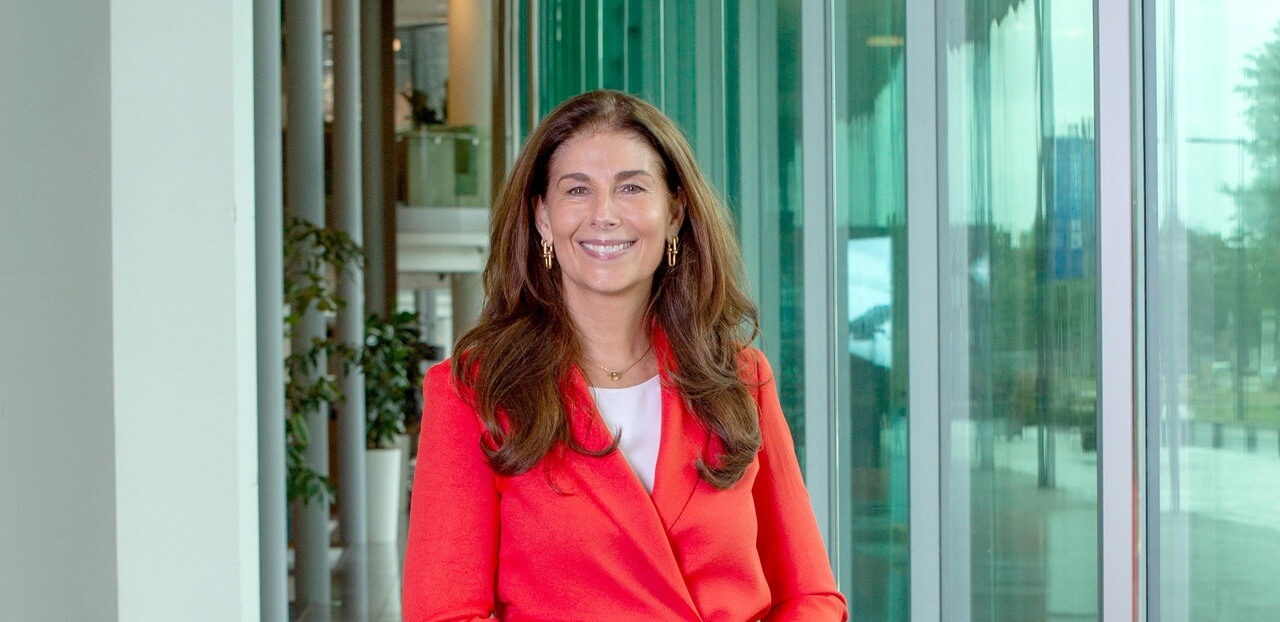
Janine Vos is one of the most influential executives in the Netherlands. In our Top 100 Corporate Women list, she ranks at no. 13 this year. As chief human resources officer and board member, she plays a key role in leadership development, organizational change, and diversity at Rabobank, a company that has transformed over the past decade from a somewhat cumbersome, old-fashioned bank into a leading tech enterprise. Vos feels right at home in that dynamic environment. ‘It is precisely that transition, the enormous change, that appeals to me so much. I really enjoy it.’
You worked at KPN for a long time. And now you have been with Rabobank for years. Both KPN and Rabobank have undergone major transitions. How did you experience that?
‘Especially at KPN, I saw the transition to a whole new world happen overnight. The arrival of WhatsApp, in particular, suddenly threw our entire business model into disarray. At KPN, it was always about ‘calling,’ but suddenly it was all about data. On top of that, we had to transform KPN from a sort of state-owned enterprise into a commercial company. Those were exciting times. It was the first disruption I experienced when I was starting out as a leader. I also saw the consequences for the people: within the changing organization, entirely new skills were suddenly required. That is where my interest and fascination with HR began.’
And at Rabo? Was the impact of the disruption just as significant there?
‘When I joined here, we were in the middle of a major efficiency drive. At the time, we had multiple banking licenses, and we had to consolidate to a single banking license. That was driven partly by regulations, but in the digital age, there was also no other way. You do not want to present your customers with sixty or seventy apps. Over the past ten years, we have transformed into a tech company. About twenty-five percent of our people work in IT. That is already a considerable percentage. But in the future, everyone will need to understand data and IT. Every role will soon have an IT or a data component.’
Were all the decisions made ten years ago well-considered, strategic decisions? Or were they efficiency-driven decisions, or perhaps even ad hoc decisions that happened to turn out well?
‘I think it was a combination of several factors. It was strategy, it was the regulator, it was efficiency, it was the competition, it was the labor market, and so on. From an HR perspective, for example, I saw a trend in the labor market where job profiles were gradually shifting toward data, engineering, and architecture. You could already see where things were headed to at the major American tech companies, The Magnificent Seven. Even ten years ago, the talk was already about AI. And it was certainly about data and digital. I think, in hindsight, we handled it well. We realized even back then that we had to think from the outside in.’
From the outside in?
‘Looking around you carefully. Viewing developments from multiple angles. We do many working visits. We recently visited a few major banks in the UK, but we also hear a lot through our members and clients. How are they implementing AI? How do they see their jobs changing? The practical side.
At the same time, we are delving into the scientific side and engaging in dialogue with scientists and professors both here and abroad. We are really focused on it. We have also done a few ‘system constellations’ (a method to uncover patterns and dynamics in organizations, ed.), for example in the area of sustainability. In one, I played the role of someone from Milieudefensie. And someone else was the minister or the regulator. Just to understand what others expect from Rabobank, how others view us. We did that with AI as well, everyone wearing a different hat. What if you look at the future of work from a regulator’s perspective? What if you look at it from the perspective of labor unions? And also that of The Magnificent Seven. It gives you new insights.’
We are now at a point again where many things are changing very quickly. Is it different now than it was ten years ago?
‘I think things are moving faster, and that we had more time back then. Moreover, the world is now more unstable in many ways. That means you have to make decisions faster. What I like about getting older and having experience is that I have learned to take a step back in moments like these. Take a moment of calm. Everyone is falling over each other; one wave of layoffs follows another because of AI. But I think you can also look for balance and ask yourself questions like: what could be a counter-reaction?’
What do you mean by that?
‘Instead of efficiency, could you also talk about value? What does AI add for us humans? What can it mean for the customer? How can we grow? As a board, we pause to consider those questions.’
Is the human aspect underestimated in digital transitions?
‘Yes, I do think so. You really have to get people on board, otherwise it will not work. The best example was during the COVID-19 pandemic. We had been trying to get people to use video conferencing for a long time before that, but it was only embraced when the benefits really became clear during the pandemic.
I think a lot of companies underestimate that human aspect. There is a clear distinction between AI readiness and human readiness. Look, AI readiness – that is there. The technology is not the problem. Tremendously much is possible, and even more will be possible in the near future. The question, however, is whether people are ready for it.
That is why my focus is primarily on human readiness, and we have been investing in it for years. The human readiness is crucial.’
And what skills are associated with human readiness?
‘Staying critical, meaning continuing to think for yourself and forming your own judgment. Only by understanding AI yourself can you make better decisions. But the key skill of the future is being flexible and able to adapt, to go with the flow. As a leader, thinking in terms of scenarios is important. You have to run through and feel out all possible scenarios. But even more so, you must be able to adapt along the way. Because one thing is almost certain: eventually, something will always happen that you had not anticipated. It is important to train yourself in this, to ensure that you remain flexible. Flexibility is actually a kind of muscle you train, a muscle that helps you adapt to change. I think a great many organizations underestimate this aspect.’
What does the digital revolution mean for you as a CHRO or for HR?
‘Concretely, it means, for example, that we need to take a close look at our entire job architecture—our job classification system with all its job profiles. No one was ever interested in that, but soon it will be of great strategic importance. Because you will need that job architecture to determine who has access to which data. Every role will soon have an impact on the entire chain. You really need to map that out very carefully.
In my field, we are re-evaluating all these themes. What is leadership when you will soon be managing agents or humanoids? What is culture in an organization where people and machines will be working together? How do you assess what constitutes good work? How do you compare a human to an AI tool that never needs a break? We are also re-examining job evaluation. I currently see in our contact center that people are doing some work at level six, but soon they might be doing machine project management at level eight. We have to reorganize everything. I am doing this together with our CITO, Alexander Zwart. We work together, give presentations together at our leadership events.
So, at Rabo, we no longer view HR in the traditional sense. No longer as a silo, but truly from a broad perspective.’
And how do get everyone on board? Your leadership team, for example?
‘We have been working on strategic workforce planning for years. A few times a year, we ask all leaders in our organization to reflect on what they see in their departments regarding changes in work. What skills do you need? What will you focus more on? What will you address in your conversations with your team? We look at capabilities, we look at costs, we look at team composition. Very broadly. That is not something you constantly have in your sights as a leader.’
And is it a reality?
‘I think people are engaged with technology. I think people are also concerned about their team. They ask themselves: will my team members’ job still exist in two years, and am I doing enough as a manager to ensure that everyone remains relevant? I find the balance between people and performance extremely important. Four years ago, we launched a program with Harvard and The School of Life, in which we train 3,800 leaders worldwide in dealing with paradoxes. Do you choose the short or the long term? Do you choose speed or control? That helps us enormously to view the situation from multiple angles.’
How AI-ready and human-ready are the supervisory board and executive board in reality?
‘We are also trying to go in-depth with our supervisory board and executive board. In special training sessions, we get to work and build practical tools. It is my conviction that, as an executive board or supervisory board, you really need to understand at least twenty percent of the content to be able to make the right strategic decision at all. Because even a supervisory board member or a board member can now throw everything into Copilot and ask what the strategic questions are that they need to ask. But the question is: do you really understand what you are asking? Do you understand the answer you get back? And do you understand what you are not asking?’
You are working hard on human readiness, disruption readiness, paradox training, and a focus on resilience. Is that all not a bit… soft?
‘Soft skills are hard profits. If people actually understand what they are doing, grasp the context, that is a profit. That will become even more important in the future. An interesting development is that, thanks to AI, we will soon have a profusion of intelligence. That is a new development in history. In the past, we have always paid a high price for knowledge and intelligence. And soon, we will have that in profusion. What are we strategically going to do with that profusion? Critical thinking is extremely important here. As are other so-called soft skills. The best thing about humans is that we are unpredictable. And that we make mistakes. Exactly this making mistakes will become an asset. What we have always tried to avoid will now become a skill. New ideas emerge from mistakes. We have always been focused on avoiding risks. But what will matter more in the future is how you move forward after a mistake. How quickly do you get back on your feet? That is a different mindset than avoiding mistakes.’
What will happen to the people who cannot or will not take that step?
‘That is something I am quite concerned about. I think we do not think about that enough in the Netherlands. People who keep learning and developing will be the winners of the future. But I do not know if everyone can keep up. We will have to reskill people. But there are limits to reskilling. We have a rule of thumb that we can reskill people to about two roles in addition to their current one. A product owner is not likely to become an AI scientist. But an engineer might be able to.’
Will people always be part of the process at Rabobank?
‘I think there will always be a considerable portion of work to be done by humans. People want to talk to other people. So, when you call customer service right now, you can still speak to a real person. Especially when people get angry or emotional. But developments are moving incredibly fast. AI is getting better and better, and it may soon be better at dealing with angry people than a flesh-and-blood employee.’
Until recently, topics such as diversity & inclusion and sustainability were important to the CHRO. Are those topics under pressure in the digital age?
‘It all requires extra attention. If we ask AI for a leader, there is a good chance it will present a white, somewhat older man. You have to be critical of that. At Rabobank, we have introduced the AI way of working. This requires you to take all these ethical aspects into account. Have you considered the consequences if this agent starts acting autonomously? Who are we excluding then? That is a question that really touches on diversity and inclusion. It is enormously convenient to use AI for resume screening, for example, but we, as humans, will always have to critically question the patterns. The same applies to sustainability. Some chatbots have a larger ecological footprint than humans. They consume more water, more energy. Is that what we want? These are all aspects that we really need to factor into the considerations. The question will soon also be how companies and organizations are going to pay for all the costs of the digital transition, because those who do not make those investments will become vulnerable. To answer that question, we will really have to work closely with the government. We will have to think together about the consequences and the future of work. That calls for a broad public debate.’
This interview was published in Management Scope 06 2026.
This article was last changed on 23-06-2026